
Before entering the Mexican market, medical devices need Registro Sanitario, or Sanitary Registration. Recently, regulatory simplification and a broader abbreviated reliance pathway have also come into play. COFEPRIS won’t repeat an already conducted assessment by a recognized authority. They’ll do a more focused review using that previous regulatory decision.
In June 2026, COFEPRIS published updated information and supporting guidance specifically covering medical-device registrations through equivalence agreements and the Vía Regulatoria Abreviada (Reliance). For international manufacturers, that makes choosing the correct registration pathway one of the most important decisions before preparing the Mexican dossier.
This guide explores the rules and guidelines governing medical devices in Mexico, along with classification rules, pathways, submissions, and more.
Medical Device Regulatory Authority In Mexico
The regulatory body overseeing medical devices is the Federal Commission for Protection against Sanitary Risks (Comisión Federal para la Protección contra Riesgos Sanitarios, COFEPRIS). Medical and IVD devices generally require its authorization before entering the Mexican market unless the product falls within an applicable exemption.
Its primary responsibilities include evaluating medical devices to ensure they meet the required standards, promoting public health, and assuring patient safety. For that, it conducts sanitary registration, manufacturing compliance, and post-marketing regulatory oversight.
The principal regulatory framework includes the following two laws, and the remaining are supplementary regulations:
- General Health Law (Ley General de Salud)
- Regulation of Health Supplies (Reglamento de Insumos para la Salud)
- Applicable Mexican Official Standards (NOMs)
- The Mexican Pharmacopoeia (FEUM)
- COFEPRIS guidance
Important Standards
The crucial COFEPRIS standards include the following:
- NOM-241-SSA1-2025 – Good Manufacturing Practices for Medical Devices
- NOM-137-SSA1-2008 – Medical Device Labelling, currently applicable during the transition discussed below
- NOM-240-SSA1-2012 – Installation and Operation of Technovigilance
Mexico has also been working on replacing NOM-240-SSA1-2012. However, the February 2026 National Standardization Program still listed PROY-NOM-240-SSA1-2024 as a project under development. Therefore, companies should not treat the proposed version like the final operative standard.
Mexico Medical Device Classification
Medical devices in the region are classified into four classes based on their associated potential risk. Let’s have a look below:
| Risk Classes | Description |
| Class I Devices |
|
| Class IIa Devices |
|
| Class IIb Devices |
|
| Class III Devices |
|
There are some low-risk exemptions for minimal-risk items. They don’t need a Sanitary Registration, only a simple operation notification.
Check Out: Medical Device Regulatory Services in Mexico
Medical Device Registration Pathways in Mexico
There are now different routes depending on the device and its previous regulatory history.
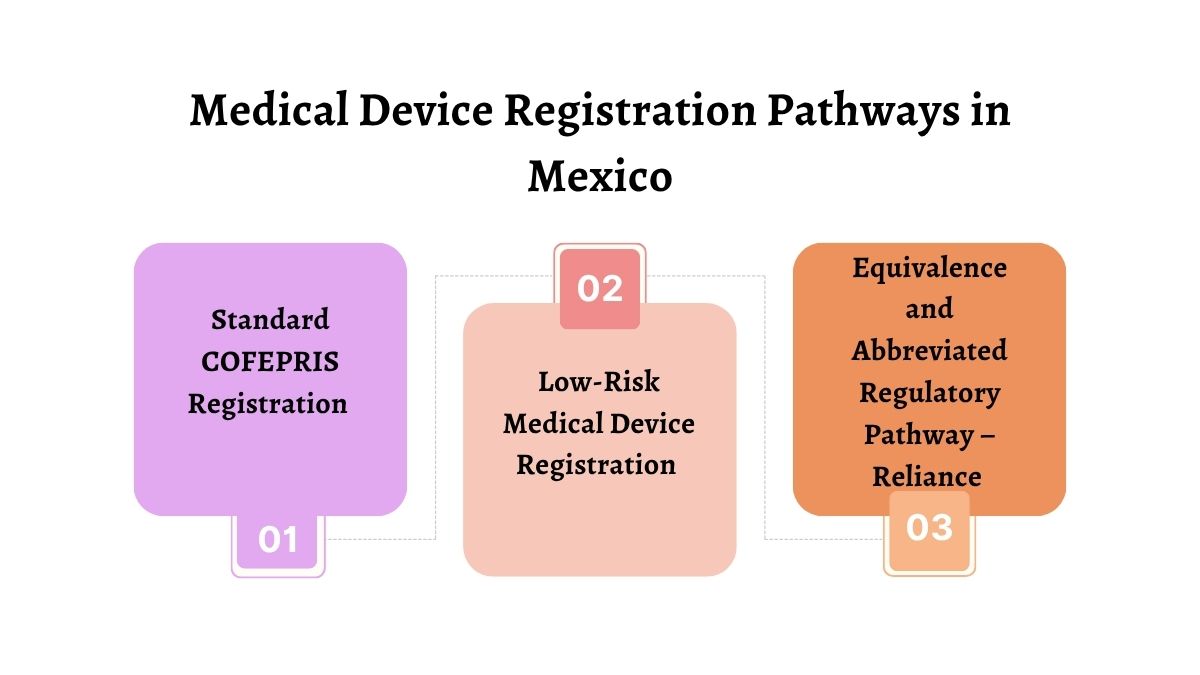
1. Standard COFEPRIS Registration
The standard pathway remains available for medical devices manufactured domestically or abroad. Under the current consolidated procedure COFEPRIS-04-060, the applicant submits the registration application together with the required technical and scientific evidence for the device’s safety, efficacy, and quality. This dossier is evaluated directly by COFEPRIS.
This route is particularly relevant where a product cannot satisfy the eligibility requirements for an abbreviated/reliance pathway.
2. Low-Risk Medical Device Registration
Certain devices identified as low risk use the dedicated COFEPRIS-04-070 procedure. As of 2026, the government portal lists:
- Government fee: MXN 16,499
- Published response time: 15 business days
- Registration validity: 5 years
But again, “low risk” does not automatically mean “registration exempt.” Companies need to establish which regulatory list their product actually falls under.
3. Equivalence and Abbreviated Regulatory Pathway – Reliance
COFEPRIS describes the Reliance pathway as an abbreviated evaluation procedure. Under this, it recognizes assessments performed by Reference Regulatory Authorities (Autoridades Regulatorias de Referencia—ARR, COFEPRIS-04-060). It then performs a focused review of key documentation before issuing the Mexican sanitary registration.
Reference Authority Evaluation → Focused COFEPRIS Review → Mexican Sanitary Registration
Industry analysis of the July 2025 framework identifies eligible regulatory jurisdictions. These are as follows:
- Australia
- Brazil
- Canada
- China
- European Union
- Japan
- Russia
- Singapore
- South Korea
- Switzerland
- United Kingdom
- United States
COFEPRIS’s June 2026 website now formally presents the Vía Regulatoria Abreviada (Reliance) and provides dedicated medical-device guidance. It’s a major opportunity for global manufacturers that already hold appropriate authorizations in recognized markets.
Important Note: COFEPRIS still issues the sanitary registration of medical devices in Mexico. Reliance changes how the evidence is evaluated; it does not eliminate Mexican regulatory jurisdiction.
Authorized Representative (AR) Requirements in Mexico
Foreign medical device manufacturers generally need a Mexican entity/person to act on their behalf for regulatory procedures. It’s especially important where the foreign manufacturer is not the applicant itself. COFEPRIS registration requirements include legal accreditation of the representative and a manufacturer representation letter for foreign-manufactured devices (in applicable cases).
The representative is crucial in coordinating regulatory submissions, maintaining communication with COFEPRIS, and supporting activities related to the product’s registration and compliance in the area.
Step-by-Step COFEPRIS Medical Device Registration
For most manufacturers, the practical process can be organized into the following sequence:
1 – Confirm Device Status
See whether the product is legally considered a medical device and if it requires sanitary registration or not.
2 – Determine Mexican Classification
Classify the device as Class I, II, or III under Mexico’s rules rather than simply importing its foreign classification.
3 – Check for Low-Risk/Exemption Status
Review whether the product falls under the low-risk registration procedure or an applicable no-registration list.
4 – Assess Reliance Eligibility
If the device already holds authorization from an eligible Reference Regulatory Authority, evaluate whether COFEPRIS-04-050 or the abbreviated pathway can be used.
5 – Establish Mexican Representation
Foreign manufacturers should have an appropriate arrangement as a Mexican registration holder or a local representation.
6 – Assess Gaps in Dossier
Compare existing FDA, EU, Canadian, or other documentation against current Mexican requirements.
7 – Prepare the Technical File
Compile administrative, technical, scientific, manufacturing, safety, performance, risk, and applicable clinical documentation.
8 – Prepare Spanish Documentation and Labeling
Meet the Mexican requirements of translations and local labeling.
9 – Pay the Applicable Government Fee and Submit
Use the appropriate current COFEPRIS procedure for the selected registration route.
10 – Address COFEPRIS Questions
Respond accurately and consistently to any administrative or technical deficiency requests.
11 – Receive the Sanitary Registration
Following a favorable assessment, COFEPRIS issues the Mexican registration.
12 – Maintain Compliance
Manage technovigilance, modifications, quality-system compliance, labeling changes, and renewals throughout the device lifecycle.
Documents Required for COFEPRIS Medical Device Registration
The product classification and chosen regulatory pathway lead to differences in documentation. Therefore, manufacturers should avoid building a generic “Mexico dossier” before they opt for the correct route.
The current COFEPRIS procedure for standard registration requires the following:
- FF-COFEPRIS-21 registration form
- Proof of payment
- Technical/scientific information showing the device’s reliability, efficacy, and quality according to the applicable COFEPRIS registration guide and FEUM requirements
A complete dossier can involve information covering:
1. Administrative Documentation
It establishes the applicant, manufacturer, and regulatory basis of the submission. It may include the application form, fee payment, legal/manufacturer information, and relevant representation documentation.
2. Device Description
The dossier should clearly tell about the product—what it is and what it’s for. It should mention the relevant models, variants, components, accessories, specifications, and intended use.
3. Technical and Scientific Evidence
The technical file must substantiate the device’s quality, safety, and performance. Depending on the device, it can involve performance testing, verification/validation information, and supporting scientific evidence.
4. Manufacturing and Quality Documentation
Manufacturers generally need evidence of an audited quality system, except where specific low-risk provisions apply. Those without acceptable certification may need to obtain GMP certification from COFEPRIS. Its own GMP certification program applies to medical-device manufacturing establishments and is intended to verify conformity with applicable manufacturing requirements.
5. Risk Management
Risk documentation should identify device hazards, evaluate relevant risks, and establish appropriate controls. Industry guidance commonly structures this evidence around ISO 14971 principles.
6. Clinical/Performance Evidence
The amount and type of evidence depends on device classification, novelty, intended use, and risk. Higher-risk or novel products generally require more substantial evidence than established lower-risk devices.
7. Labels and Instructions for Use
Mexican labeling requirements need to be incorporated into the registration strategy rather than treated as an afterthought.
QMS Requirements for Medical Devices in Mexico
Quality Management System (QMS) requirements for medical devices in Mexico focus on ensuring appropriate quality and manufacturing controls throughout the product lifecycle. Mexico’s framework includes NOM-241-SSA1-2021. It establishes Good Manufacturing Practices requirements for medical devices. COFEPRIS also requires applicable manufacturing sites to provide evidence of compliance, including a valid GMP certificate for Mexican manufacturers.
For foreign manufacturers, supporting evidence such as a certificate of good manufacturing practices issued by the relevant authority in the country of origin may be required. It depends on the application and device type.
Medical Device Labeling & IFU Requirements in Mexico
Medical device labels and instructions for use must provide the information necessary for safe use, identification, and traceability. Mexico’s current labeling framework includes NOM-137-SSA1-2025. It establishes sanitary labeling requirements for medical devices marketed or supplied in Mexico.
Depending on the device, labeling may include the generic and distinctive product name, manufacturer information, registration details, expiry information where applicable, warnings, precautions, and other required information. The label and Instructions For Use (IFU) should also remain consistent with the information authorized as part of the sanitary registration.
Registration Timeline for Medical Devices in Mexico
Medical devices in Mexico have varied registration times. These depend on the risk class of the device and review routes. The validity of the license remains for 5 years, and renewal must be submitted through the same registration route no later than 150 days before the expiration date.
Let’s look into the timeline below:
| Factors | Registration Timeline |
| Timeline by Device Class |
|
| Timeline by Registration Review Route |
|
COFEPRIS Medical Device Registration Cost
The current government registration portal lists the following fees for standard registration:
| Classification |
2026 Government Fee
|
| Class I | MXN 16,499 |
| Class II | MXN 24,198 |
| Class III | MXN 30,798 |
The registration is currently listed with a five-year validity. The equivalence procedure carries the corresponding class-based government fee range as well.
Import Requirements for Medical Devices in Mexico
Import requirements depend on factors such as whether the device already holds a Mexican sanitary registration and the purpose of importation. COFEPRIS provides specific sanitary import permits for medical devices with and without sanitary registration, with separate procedures for certain situations.
For registered devices, import documentation can include the applicable sanitary import permit, evidence of the sanitary registration, and relevant establishment documentation. COFEPRIS may request additional documentation such as a Certificate of Free Sale or evidence of Good Manufacturing Practices for any unregistered device and specific use case.
Important: Import requirements should be assessed according to the product, classification, where to use, and specific import scenario. There should be no assumption that every medical device follows the same route.
Post-Market Surveillance Requirements in Mexico
COFEPRIS approval gets the product onto the market. Technovigilance keeps it compliant once it is there.
Mexico’s post-market medical-device surveillance framework is currently based on NOM-240-SSA1-2012. It establishes requirements for the installation and operation of technovigilance. It aims to monitor the safety and functioning of devices used in the country and identify adverse incidents and emerging risks.
Thus, manufacturers and registration holders need an appropriate system wherever required, as follows:
Incident monitoring → Assessment → Reporting → Corrective action → Regulatory communication
Changes to the Device After Registration
Changes after registration involving technical information, labeling, instructions for use, manufacturing arrangements, or other registered conditions. They should be evaluated to see if regulatory action is required before implementation.
Mexico’s current procedure for technical modifications with assessment is COFEPRIS-2022-022-004-A, for which the government portal currently lists an 11-business-day response time. This makes change control particularly important for multinational manufacturers.
A change considered minor under an EU, US, or Canadian quality system should not automatically be assumed to be administratively insignificant in Mexico.
Conclusion
Mexico’s medical device registration process has updated a lot in recent years. COFEPRIS has consolidated registration procedures, shortened published response periods, expanded reliance on trusted international regulatory assessments, updated GMP requirements, and published a new medical-device labeling standard. This creates an opportunity, but not a shortcut around compliance.
Artixio understands the changes in this realm and offers comprehensive medical device regulatory services in Mexico. Connect with our experts at info@artixio.com and get thorough guidance in this matter.
FAQs
Can I sell an FDA-cleared medical device in Mexico without COFEPRIS registration?
Generally, no. FDA clearance or approval won’t authorize sale in Mexico itself. An eligible FDA authorization might allow a manufacturer to pursue Mexico’s equivalence/reliance pathway. COFEPRIS must still issue the Mexican sanitary registration.
Does a CE-marked medical device automatically qualify for Mexico’s abbreviated pathway?
Not simply because it carries a CE mark. The 2025 reliance framework broadened recognition considerably, including regulatory assessments associated with recognized jurisdictions, but manufacturers must satisfy the specific eligibility and documentary requirements of the applicable COFEPRIS pathway. Foreign authorization should therefore be assessed against the current Reliance guidance rather than treated as automatic Mexican recognition.
Are all Class I medical devices exempt from COFEPRIS registration?
No. Mexico has specific lists covering low-risk devices requiring registration and devices that do not require registration. COFEPRIS also maintains a dedicated low-risk registration procedure, COFEPRIS-04-070. Classification and exemption status therefore need to be assessed separately.
Does Mexico regulate medical software?
Yes. COFEPRIS’s medical-device registration guidance covers Software as a Medical Device (SaMD). It’s an addition to the Class I, II, and III medical devices.