
Put a tongue depressor next to a pacemaker and the gap is obvious. Both count as medical devices, yet they’re regulated very differently. Routine-care products sit at the low end of the risk scale. Implants, diagnostic systems and medical software can carry very different levels of risk, and the regulatory requirements change with that risk.
Before going further, it helps to keep two ideas apart: device type and regulatory classification. The type describes what a device is or how it’s used, such as an implantable device, an imaging device, an IVD or software as a medical device. Regulatory classification places the device in a risk-based class, and that class determines which controls and market requirements apply.
This article covers both. It starts with the common types of medical devices, then compares how classification works under six major frameworks: the US FDA, the EU MDR, India’s CDSCO, Japan, Australia and Canada.
Types of Medical Devices
A medical device can be described in several ways: by its purpose, by the setting it’s used in, or by the technology behind it. These descriptions are useful shorthand, but they aren’t regulatory classes. Those come later in the article.
Single-Use Devices
As the name suggests, these are made to be used once, or on one patient during a single procedure. Syringes and certain catheters are typical examples.
Implantable Medical Devices
An implantable device goes partly or fully inside the body and is meant to stay there once the procedure is over. Pacemakers and hip implants are two well-known examples.
Medical Imaging Devices
These let clinicians see what’s happening inside the body, whether that’s a structure or a process. X-ray equipment and MRI systems are the familiar examples.
Medical Equipment
This covers equipment that stays in regular use over long periods. Over that time, it may need servicing or calibration, and usually someone trained to run it. You’ll find patient monitors, anesthesia machines and hemodialysis systems in this group.
Software as a Medical Device (SaMD)
Here, the software is the device. It performs a medical function without being part of any hardware medical device. Certain diagnostic tools and image-analysis software fall into this group.
In Vitro Diagnostic Devices
IVDs test samples taken from the body, such as blood or tissue. The results give information about a disease, a condition or some other aspect of a person’s health. The range is wide, from blood glucose testing to certain tests for infectious diseases.
Personal Protective Equipment
PPE isn’t automatically a medical device. It can be regulated as one when it’s intended for a medical purpose, as with certain medical gloves, gowns and masks.
Surgical and Laboratory Devices
This group covers devices used during surgery, or in laboratory testing for a medical purpose. Forceps are one example, and certain diagnostic laboratory instruments are another.
What Is Medical Device Classification?
Classification is how a regulator decides which risk class a device belongs to, based on its intended use. The basic logic is simple: the higher the risk, the tighter the controls.
What changes from market to market is the class structure itself. The US FDA works with Class I, II and III, while other regulators use different names and a different number of classes. A device therefore has to be classified under the rules of the market it’s going to, rather than borrowing its class from somewhere else.
Several factors can feed into the decision: the device’s intended purpose, how it interacts with the body, how long it’s used, whether it’s invasive or implantable, and whether it’s an active device. Which of these apply, and how they’re weighed, depends on the framework.
Here’s how classification works in the US, the EU, India, Japan, Australia and Canada.
US FDA Medical Device Classification
In the US, there are three classes: Class I, Class II and Class III. The class tells you how much control the FDA considers necessary to be reasonably sure a device is safe and effective. Class I gets the least, and Class III gets the most.
| FDA Class | General risk level | Main regulatory controls | Examples |
| Class I | Lowest risk | General Controls |
Elastic bandages, enema kits
|
| Class II | Moderate risk | General Controls and Special Controls |
Powered wheelchairs, some pregnancy test kits
|
| Class III | Highest risk | General Controls and Premarket Approval (PMA) |
Implantable pacemakers, breast implants
|
Not every Class I or Class II device needs a premarket notification (510(k)), because some are exempt. Check the device’s classification regulation, though, since exemptions can come with limits.
To find a device’s FDA class, manufacturers usually start with the matching product code and regulation number. There are more than 1,700 generic device types, grouped by medical specialty panel in 21 CFR Parts 862–892.
For a quick answer, try the FDA’s Product Classification Database. You can search it by device name, product code or regulation number.
Still unclear? A manufacturer can send the FDA a 513(g) request for information on how the device is regulated. A user fee applies to this request.
EU Medical Device Classification Under the MDR
Europe splits devices into four classes under the Medical Device Regulation (MDR): Class I, IIa, IIb and III. Where a device lands depends on its intended purpose and inherent risks. Annex VIII of Regulation (EU) 2017/745 is where you’ll find the rules for working this out.
| EU Class | General risk level | Typical profile |
| Class I | Lowest risk |
Many non-invasive devices
|
| Class IIa | Low to medium risk |
Certain short-term invasive devices and some active devices
|
| Class IIb | Medium to high risk |
Certain long-term invasive devices and higher-risk active devices
|
| Class III | Highest risk |
Devices with the highest potential risk, including certain implants and devices involving the heart, central circulatory system or central nervous system
|
Class I has three subcategories worth knowing:
- Class Is covers devices supplied sterile.
- Class Im covers devices with a measuring function.
- Class Ir covers reusable surgical instruments.
All three remain Class I, but a notified body must be involved for the relevant aspects.
Risk level alone doesn’t settle the class. Annex VIII works through a series of questions:
- What is the device for?
- How long will it be used?
- Is it invasive or implantable?
- Is it active?
- Which part of the body is involved?
If more than one rule applies, the strictest result stands.
Need help applying the rules? MDCG 2021-24 Rev.1, the European Commission’s classification guidance, was updated in April 2026 and walks through them with worked examples.
India Medical Device Classification Under CDSCO
India’s Medical Devices Rules, 2017 set out four classes, from Class A to Class D, with risk rising at each step.
| India Class | General risk level |
| Class A | Low risk |
| Class B | Low-moderate risk |
| Class C | Moderate-high risk |
| Class D | High risk |
The rules themselves sit in the First Schedule of the Medical Devices Rules, 2017. A device’s class is arrived at by measuring its intended use and risk against them. On top of that, CDSCO puts out device-specific classification lists and updates them from time to time.
One exception is worth noting. Certain Class A devices are exempt from licensing. To qualify, a device has to be non-sterile and have no measuring function, and it must meet the conditions in the relevant amendment.
In practice, the safest move is to look up the exact device on CDSCO’s most recent classification list before you decide on a class.
Japan Medical Device Classification Under the PMD Act
Japan has four classes, from Class I to Class IV, with risk climbing from Class I to Class IV. Medical devices are regulated under the Pharmaceuticals and Medical Devices Act (PMD Act), with both MHLW and PMDA playing a part.
| Japan Class | General risk level | Regulatory category | Typical regulatory route | Examples |
| Class I | Extremely low risk | General Medical Devices | Notification to PMDA |
Scalpels, tweezers
|
| Class II | Low risk | Controlled Medical Devices | Certification by a registered certification body when certification standards exist; otherwise approval may be required |
MRI systems, electronic endoscopes
|
| Class III | Medium risk | Specially Controlled Medical Devices | Certification may be available for designated devices; otherwise ministerial approval based on PMDA review |
Ventilators, bone prostheses
|
| Class IV | High risk | Specially Controlled Medical Devices | Ministerial approval based on PMDA review |
Pacemakers, artificial heart valves
|
The class number doesn’t decide the route on its own, though. For some Class II and Class III devices, a registered certification body can certify the device, provided an applicable certification standard exists. Other devices need approval from MHLW after a PMDA review.
Australia Medical Device Classification Under the TGA
Australia also uses a risk-based model. For non-IVD devices, the main classes are Class I, Class Is, Class Im, Class IIa, Class IIb and Class III. The greater the potential for harm, the higher the class, and the more regulatory evidence is generally expected.
| Australia Class | General risk level | Examples |
| Class I | Lowest risk |
Surgical retractors, tongue depressors
|
| Class Is / Class Im | Low risk |
Sterile surgical gloves, measuring cups
|
| Class IIa | Low to moderate risk |
Dental drills, ultrasound machines, digital or infrared thermometers
|
| Class IIb | Moderate to high risk |
Lung ventilators, blood bags, condoms
|
| Class III | High risk |
Heart valves, major joint replacement implants
|
Intended purpose is at the centre of TGA classification. The TGA also considers how invasive the device is, where in the body it’s used, and for how long. If several rules could apply, the device takes the highest class among them.
It’s up to the manufacturer to get the class right. That step comes before any application for inclusion in the Australian Register of Therapeutic Goods (ARTG). The TGA’s official What classification is my medical device? tool can help you work through the rules.
IVDs are handled under a separate classification system in Australia, so they shouldn’t be placed in the structure above.
Canada Medical Device Classification Under Health Canada
Canada also has four classes. Class I carries the lowest risk and Class IV the highest.
| Canada Class | General risk level | Examples |
| Class I | Lowest risk | Bandages, manual wheelchairs |
| Class II | Low to moderate risk |
Powered toothbrushes, hearing aids
|
| Class III | Moderate to high risk |
Hip implants, shoulder prostheses
|
| Class IV | Highest risk | Pacemakers, artificial hearts |
The classification rules are set out in the Medical Devices Regulations. For non-IVD devices, Health Canada looks at how invasive the device is, whether it transmits energy, and what could happen if it failed. The answers shape the final class. IVDs have a classification system of their own.
Before a Class II, III or IV device can be sold or imported in Canada, a Medical Device Licence (MDL) is generally needed. Class I devices don’t need one, although establishment licensing may still apply depending on the activity.
Medical Device Classes Across Major Markets
Class names vary from one market to the next, and so does what they mean. A device that’s Class II in one country may land in a different class elsewhere. There isn’t even a fixed number of classes worldwide, because each regulator sets its own.
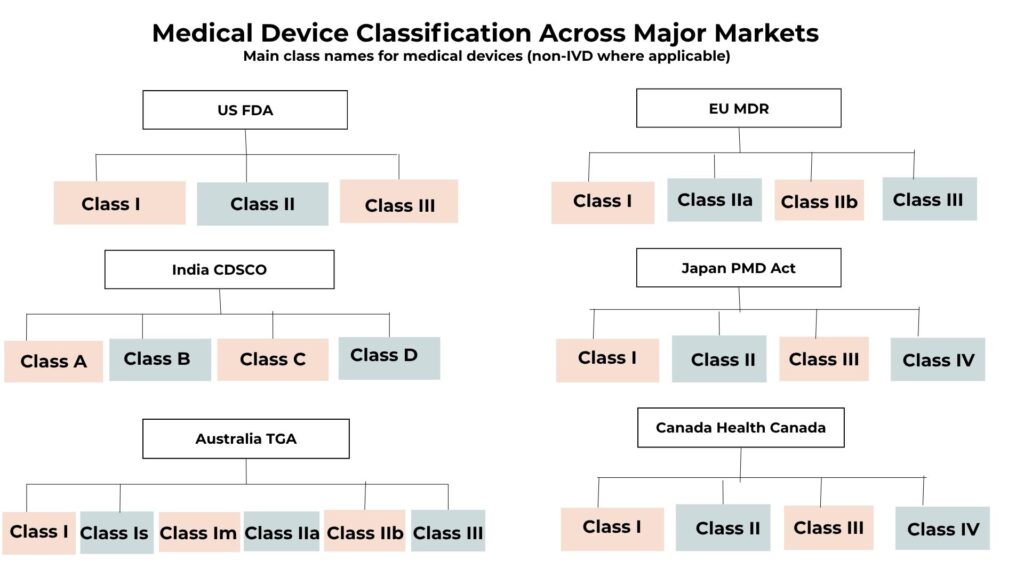
| Market |
Main medical device classes
|
| United States | Class I, Class II, Class III |
| European Union |
Class I, Class IIa, Class IIb, Class III
|
| India |
Class A, Class B, Class C, Class D
|
| Japan |
Class I, Class II, Class III, Class IV
|
| Australia |
Class I, Class Is, Class Im, Class IIa, Class IIb, Class III
|
| Canada |
Class I, Class II, Class III, Class IV
|
All six systems are built around risk, but each applies its own rules. Intended purpose, how the device is used, and whether it’s invasive or implantable can all shift the final class, along with factors specific to each market.
Planning to sell in more than one market? Check the class again with each regulator. Don’t assume it will carry over.
What Affects Medical Device Classification?
A device isn’t classified by its name. Regulators look at how it’s meant to be used and at what could happen if something goes wrong.
Typical questions include:
- What is the device intended to do?
- How long is it used?
- Does it enter the body?
- Does it stay inside the body?
- Does it depend on a source of energy?
- Where in the body is it used?
- Is software involved in its medical function?
The rules behind these questions differ by market. That’s why the same device has to be checked against each country’s classification rules before it’s supplied there.
Conclusion
There’s no universal class system for medical devices. Every regulator works with its own class names and its own rules.
So when a device is headed for a new market, its classification needs a fresh look under that country’s framework. The intended use, the design, how the device interacts with the body and the level of risk involved can all change the final class.
Artixio supports medical device companies with device classification and regulatory planning across global markets. Explore our medical device regulatory consulting services.
FAQs
1. Is there one global classification system for medical devices?
No. Each market has its own classification rules and class names, so a device may not hold the same class in the US, EU, India, Japan, Australia and Canada.
2. What decides the class of a medical device?
That depends on the market. Regulators may consider what the device is meant to do, how it’s used, whether it enters or stays in the body, and the risk tied to its use.
3. Does Class II mean the same thing in every country?
No. Two markets can both use “Class II” and still mean different things by it, with different requirements attached.
4. How is a device type different from a device class?
The type is about the product itself: is it an implant, an IVD, an imaging device or medical software? The class tells you how that device is treated under a specific regulatory system.
5. Do IVDs use the same classification rules as other devices?
Not in every market. Australia and Canada, for example, have separate rules for IVDs. Always check the framework that applies to the market you’re entering.