
Every piece of equipment used in pharma manufacturing has a direct impact on product quality. If a machine fails, the medicine that comes out of it could be ineffective—or even unsafe. To avoid that risk, companies use equipment qualification and process validation activities. It’s basically a way of proving that the machines can do what they’re supposed to, every single time. For regulators, this isn’t just paperwork—it’s proof that patients are being protected.
Read below to know more about the meaning and differences between IQ, OQ, and PQ.
IQ, OQ, And PQ Definition
Let us understand each of IQ, OQ, and PQ in detail below:
What Is Installation Qualification (IQ)?
Installation Qualification (IQ) is documented verification that equipment or systems, as installed or modified, comply with the approved design, the manufacturer’s recommendations, and/or user requirements.
What Is Operational Qualification (OQ)?
Operational Qualification (OQ) is documented verification that equipment or systems, as installed or modified, perform as intended throughout the anticipated operating ranges.
What Is Performance Qualification (PQ)?
Performance Qualification (PQ) is documented verification that equipment and ancillary systems, as connected together, can perform effectively and reproducibly based on the approved process method and specifications.
Also Read: Summary of Safety and Clinical Performance Services
Process Validation: IQ, OQ, and PQ
IQ, OQ, and PQ are qualification activities that support a state of control and, where applicable, the process validation lifecycle. They should not be treated as interchangeable with process validation itself.
Installation Qualification Validation
Installation Qualification verifies that equipment, systems, and associated components have been installed in accordance with approved specifications and are suitable for their intended use. The scope of IQ should be defined based on the equipment, system, and its intended use.
In addition, CGMP requirements relevant to the equipment and the methodology used for IQ should be documented thoroughly in the Validation Master Plan (VMP). Requalification should be considered after significant changes, maintenance, or modifications that could affect the qualified state of the equipment or system, based on a documented assessment. Periodic requalification may also be performed where justified by the qualification strategy, equipment, and applicable GMP requirements.
How well did the installation process follow the guidelines of the manufacturer and their requirements? This is how it is usually determined whether an IQ is successful or not.
Here are some areas it includes:
- Location of installation and appropriate floor space.
- Documentation of computer-controlled instrumentation, if any.
- Connection of the system to a proper power supply
- Cross-checking the instruments with a packing list after unpacking.
- Collection of manuals and certifications available.
- Examining the system for any damage
- Making sure of the environmental and other operating conditions.
- Installation of any ancillary instrument.
- Firmware version and serial number documentation
- Recording the last calibrated or validated date of the tools used in performing IQ.
Also Read: What Is Computer System Validation (CSV) In Pharma
Operational Qualification Validation
This is the next validation step after IQ. OQ is generally performed after the relevant IQ activities have been completed and the equipment or system has been shown to be appropriately installed. Operational qualification is conducted to confirm that the equipment is working as it is claimed to be by the manufacturer. To know whether it is consistent with the user requirements and manufacturer specifications. So, at the time of OQ, all the items as per the test plan will be tested. Performance is properly documented as well.
Areas in which OQ is involved, but not limited to, are:
- Temperature control, distribution, and protection system
- Displaying and signaling units
- Servo motor and air flaps
- Measuring humidity and its control system
- Card accessing and reading systems
- Carbon Dioxide control systems
- Fan/ fan speed controllers
After completion of the OQ, check if:
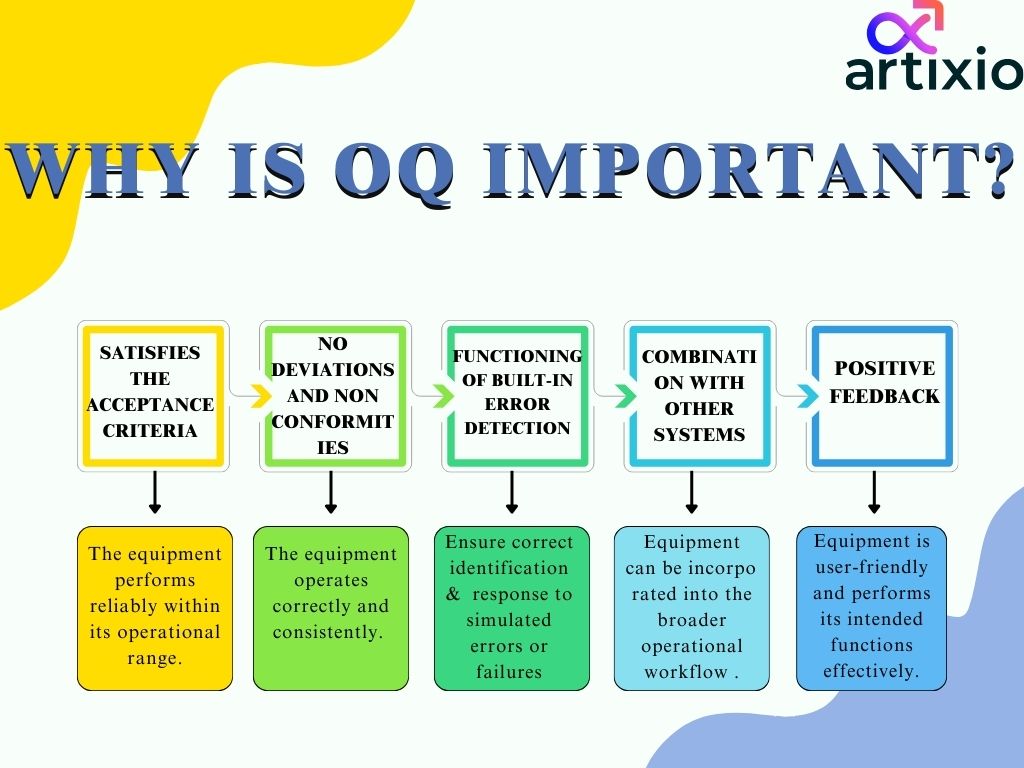
It satisfies all the acceptance criteria mentioned in the OQ protocol; significant deviations and non-conformities showing the proper functioning of equipment are not identified; the built-in error detection and handling mechanism works properly; it can combine with other systems or processes without any issues, if applicable; and there is positive feedback from operators and end users. The OQ can be considered acceptable when the predefined acceptance criteria have been met, and any deviations have been appropriately evaluated and resolved.
Performance Qualification Validation
Performance Qualification (PQ) verifies that equipment and ancillary systems can perform effectively and reproducibly under the intended operating conditions. Depending on the qualification strategy, PQ may use actual production materials, simulated materials or other justified approaches. Equipment qualification supports, but is distinct from, process performance qualification (PPQ).
Rather than individual testing of the instruments or components, it is tested as a partial or overall process. But before any tests can take place, a detailed test plan must be created based on the process description.
FDA’s process-validation guidance distinguishes process qualification from the broader equipment and facility qualification activities that support it. During process qualification, the qualified facility, equipment, utilities, trained personnel, materials, and commercial manufacturing process are evaluated together under defined conditions.
Design of the facility and qualification of the equipment and utilities
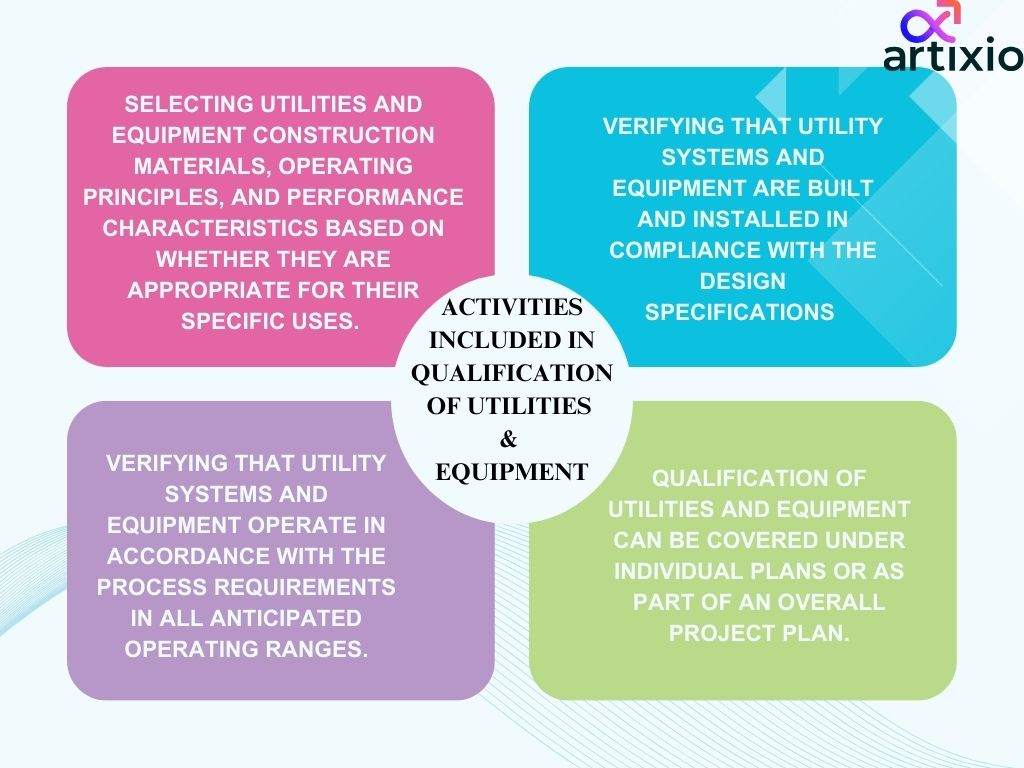
In part 211, subpart C of the CGMP regulations of buildings and facilities it is stated that proper designing of the manufacturing facility is required. FDA’s process-validation guidance identifies facility design and the qualification of equipment and utilities as activities that support process qualification. These activities should be appropriately established before process performance qualification is conducted.
Process Performance Qualification (PPQ)
In PPQ, the actual facility, equipment, utilities, trained person with the commercial manufacturing process, control procedures, and components to create commercial batches are combined together. To establish the manufacturing conditions in PPQ, cumulative data of all the relevant studies should be used.
Confirmation of the product design and performance of the commercial manufacturing process as expected is demonstrated when a PPQ is a success. Successful completion of PPQ provides documented evidence that the commercial manufacturing process can perform effectively and reproducibly under the defined conditions. Commercial distribution remains subject to applicable regulatory approval and release requirements.
Also Read: What Is Computer Software Assurance (CSA) In Pharma
Documentation & Protocols
Check all the documents and protocols to be followed here:
Installation Qualification (IQ) Documentation & Protocols
IQ Protocol: An Installation Qualification protocol is designed to outline the methodology, scope, and criteria for the conduct of an IQ. It includes the following:
- Identification details of the equipment, like the model, manufacturer, and serial number.
- A list of equipment as well as systems that are to be qualified.
- Installation requirements according to the manufacturer’s specifications.
- Environmental condition requirements like the temperature and humidity.
- An installation criteria checklist to be verified.
IQ Checklist: A detailed checklist drafted from the IQ protocol. It must cover all aspects, including physical/software installations, calibration, electrical connections, and environmental conditions, to be verified.
IQ Report: This report documents how the protocol was executed. A summary of the findings/observations and results is included. It should also state clearly whether the equipment installation satisfies the predefined criteria.
Operational Qualification Documentation & Protocols
OQ Protocol: An Operational Qualification protocol is designed to outline the methodology, scope, and criteria for the conduct of an OQ. It includes the following:
Objectives: State exactly what the aims are to achieve, together with specific operational parameters and functions to be tested, if any.
Scope: Explain the systems, equipment, and processes within the OQ.
Methodology: Step-by-step procedure to be described for conducting the operational tests. Any setups or conditions required are included.
Criteria for Acceptance: It must be based on the manufacturer’s specifications, user needs, and regulatory requirements.
OQ Test Scripts/Checklist: Detailed checklists used to conduct the tests specified in the protocol.
OQ Report: OQ testing execution and outcomes are documented here.
Standard Operating Procedure: This is important to ensure the correct and consistent operation of the equipment in the operational tests.
Calibration and maintenance record: Records must be kept as proof of the proper calibration and maintenance of the equipment before as well as during the OQ tests.
Traceability Matrix: It makes sure that all the appropriate operational parameters are tested and validated against the requirements.
Performance Qualification Documentation & Protocols
As we have already discussed, the PQ stage has 2 elements. Out of which the Process Performance Qualification elements describe the PPQ protocol. This has significant importance, as its purpose is to make sure the ongoing product quality by documenting it over a period of time.
PPQ Protocol: This protocol must include the following elements:
- Manufacturing conditions along with the processing limits, operating parameters, and component inputs.
- The data to be recorded. How and when it will be evaluated.
- Tests and acceptance criteria used to demonstrate consistent product quality across the PPQ batches or runs.
- Sampling plan describing the methods of sampling used during and between the production batches.
- Statistical and analytical approaches used to evaluate process performance and support science- and risk-based decisions.
- Description of the variability limits as well as the contingency plan for managing nonconformance.
- Approval of the protocol by the quality unit and all other relevant departments.
Also Read: What Is Corrective and Preventive Actions (CAPA) In Pharma
Regulatory Requirements For IQ, OQ & PQ
For pharmaceutical manufacturing in the United States, equipment and process qualification and validation are addressed through the drug CGMP framework in 21 CFR Part 211 and FDA’s process-validation guidance.
21 CFR 211.63 requires equipment used in drug manufacturing, processing, packing, or holding to be of appropriate design, adequate size, and suitably located to facilitate operations for its intended use and cleaning and maintenance. 21 CFR 211.100 requires written procedures for production and process control, while 21 CFR 211.110 addresses in-process controls and testing designed to assure batch uniformity and integrity.
FDA’s Process Validation: General Principles and Practices describes process validation as a lifecycle approach consisting of process design, process qualification, and continued process verification. Qualification of facilities, utilities, and equipment supports the process qualification stage.
In the EU, EudraLex Volume 4, Annex 15 provides GMP requirements for qualification and validation of facilities, equipment, utilities, and processes. It applies a lifecycle and risk-based approach to qualification and validation.
Common Challenges Faced In IQ, OQ, and PQ
One of the major challenges includes the combination of business goals, deadlines, and a lack of understanding of what must be included to put together a complete technical file. Common challenges include poorly defined user requirements, incomplete qualification protocols, inadequate acceptance criteria, insufficient documentation, inappropriate equipment selection, and failure to assess the impact of changes on the qualified or validated state.
Best Practices For Successful Qualification

Before each qualification process (IQ, OQ, and PQ) can take place, a protocol is designed, and, as per the protocol, the processes. So proper preparation of the protocol is a crucial step in successful qualification.
Recognize potential risks that are associated with the installation of the equipment and lead IQ activities based on the risks. Conducting these activities makes sure that the elements affecting the quality and safety are addressed. Reviewing previous IQ protocols for similar equipment, if possible, will help to understand the common failures and challenges. Prepare for the effect of environmental conditions on the installation process.
Test the equipment across its intended and justified operating ranges. This is done to confirm that the equipment is operating well in its operating range as it is claimed to be. Where appropriate, challenge relevant alarms, interlocks, failure modes, and error-handling functions defined in the approved test plan. This action shows us whether the equipment is reliable for its error management system. Use tools and technologies that would allow for real-time monitoring. This will help in gathering the data instantly at the time of PQ and PPQ.
IQ, OQ, And PQ Example In Pharmaceuticals
A common example is the autoclave machine.
IQ Examples: Checking if the autoclave is placed properly in the sterilization room. Checking for proper connections for electricity, water, and steam. Does it meet environmental requirements like ventilation and appropriate room temperature and humidity control? Verification of installation documents such as manuals and certificates, and that all components are installed properly.
OQ Examples: To confirm that the autoclave is operating as it is intended to be. Checks whether the autoclave can achieve and maintain the validated temperature, pressure, and exposure conditions specified for the intended sterilization cycle, including appropriate alarm and safety functions. Testing for the safety and emergency features.
PQ Examples: To demonstrate that it is performing as expected in real or actual conditions to produce sterilized products. Several cycles of sterilization are conducted with a real load. Verification that the sterilization process consistently achieves the predefined acceptance criteria for the intended load configuration.
Streamlining Pharmaceutical Equipment Validation With Customized Regulatory Support
Streamlining pharmaceutical equipment validation with regulatory compliance can be challenging. Customized regulatory support can help avoid failures of the qualification processes conducted. Moreover, it helps in developing more specific protocols rather than the standard ones, which might not be specific to product type and requirements.
In addition, the quality of the qualification process depends on the test plan drafted. Thoroughness and accuracy can be incorporated if an expert hand is included. At Artixio, we have a team of regulatory experts and experts in the field of medical devices. We can help you navigate smoothly through these processes. Contact us at info@artixio.com.
FAQs
Q. What is IQ, OQ, and PQ full form?
IQ stands for Installation Qualification. OQ stands for Operational Qualification, and PQ expands to Performance Qualification. They are commonly used qualification stages for equipment and systems.
Q. What is OQ vs PQ?
Operational qualification focuses on whether the system or equipment is operating properly. Is it doing all the functions as it is expected to perform? Is what is focused on OQ. PQ focuses on demonstrating that qualified equipment and ancillary systems can perform effectively and reproducibly under intended conditions, while PPQ evaluates whether the overall commercial manufacturing process can consistently produce product meeting predetermined requirements.
Q. Why is there a need to perform IQ, OQ, and PQ?
IQ, OQ, and PQ are qualification activities used to demonstrate that equipment and systems are appropriately installed, operate as intended, and perform effectively and reproducibly under specified conditions. They support the overall validation and control strategy but should not be treated as synonymous with pharmaceutical process validation.
Q. Can we do OQ before IQ?
OQ is generally performed after the relevant IQ activities have demonstrated that the equipment or system is appropriately installed. However, the exact qualification sequence should be defined in the approved qualification strategy and protocol.
It must be ensured that there are no errors in installation and all conditions, like the environmental as well as electrical and other conditions, are met. This is essential for the proper functioning of the equipment.