
What we casually call medicine may technically contain one or more drugs. A drug can be used in different ways, while medicine is generally associated with therapeutic use. This difference between drug and medicine becomes easier to understand through their uses and examples.
Drugs vs Medicines: Key Differences
What Are Drugs?
The term drug is wider in meaning than medicine. Some are used for treatment. Others are used in research or outside healthcare. The effect may be helpful or harmful. That is why very different substances, from painkillers to cocaine, can still come under the term drug.
What Are Medicines?
Medicine is mainly connected with healthcare use. It can contain one drug or several drugs along with other ingredients. The purpose may be to prevent illness, treat a condition, or help with its symptoms.
Are All Drugs Considered Medicines?
Some drugs are medicines, but not all of them. The difference depends mainly on how the substance is being used and whether the purpose is therapeutic.
Types of Drugs and Their Classification
Drug classification can be based on different things. Origin, purpose, regulation, and action in the body are some of the common bases.
- Origin-based: Depending upon the source of the drug origin, it may be classified as natural, semi-synthetic, or synthetic.
- Regulatory Drugs: The regulatory authorities classify the drugs as prescription drugs that are given only upon a doctor’s prescription, over-the-counter drugs that are sold without prescription, as they come under the safe drug category, and Controlled drugs are shown to affect the brain and its emotions leading to serious effects if used in excess. Examples of such drugs are opioids, sedatives, etc. The sale and distribution of these drugs are regulated by government authorities to prevent any misuse.
- Therapeutic Drugs: This category includes drugs according to their therapeutic effects, such as analgesics, antibiotics, antipyretics, antihypertensives, etc.
Examples: Paracetamol (analgesic), Acyclovir (anti-viral), Penicillin (antibiotics), etc. - Pharmacological Drugs: In this category, the drugs are classified according to their pharmacological action in the human body, such as cardiac drugs, CNS drugs, gastrointestinal drugs, etc.
Classification Of Medicines
Medicine classification includes different categories.
- Essential Medicines: This includes the medicines that are officially written in the WHO essential Medicines List.
- Generic Medicines: These are off-patent drugs, sold as generic medications.
- Branded Medicines: These are patented medicines, sold under the brand name.
- Biologics and Biosimilars: Biosimilars involve medicines comprising living organisms whereas biosimilars are highly similar versions of biologics.
Difference Between Drug and Medicine
The major key differentiating aspects between drugs and medicines are discussed below:
| Aspects | Drugs | Medicines |
| Definition | A substance that alters the body working either in a positive or negative way. | A substance that is used for the prevention or treatment of any disease. |
| Context | May be used in for medicinal or non- medicinal context. | It is used only in terms of medicinal context. |
| Purpose | Used for diagnostic, medicinal, research, legal, illegal purposes. | Used for prevention, treatment or ease of symptoms of any disease. |
| Prescription | Drugs are used upon prescriptions, over the counter also upon nonprescription illegally. | May be used upon prescription and also as over the counter medicines. |
| Dosage Form | Common dosage forms are pills, powders, injectables, etc. | Common dosage forms are tablets, capsules, syrups, etc. |
| Regulation | Use of drugs may be regulated such as alcohol and may also be non-regulated such as heroin. | The use of medicines is regulated by regulatory bodies such as FDA, CDSCO, EU, etc. |
| Approval Process | Usually, drugs are not used upon approval. | Medicines are used upon approval by FDA, CDSCO, EU, etc. |
| Usage | The use of drugs may be medicinal or non-medicinal. | The use of medicines is always for medicinal purposes. |
| Potential For Abuse | It has great potential for abuse. | It has mild potential for abuse. |
| Social Impact | Positive as well as negative social impact. | Positive social impact. |
| Overlap Use | Drug such as cannabis has dual effects such as it is curable as well as addition forming. | Medicine such as opioids may have positive as well as harmful effects. |
| Side Effects | Use of drugs is habit forming and show unexpected effects. | Medicines have minor and sometimes major side effects |
| Controls | Controls here can be achieved by use of drugs only upon prescription. | Controls here can be achieved by imposing certain rules and guidelines by the regulatory bodies. |
| Examples | Example of drugs are cocaine, heroin, cannabis, opium, etc. | Example of medicines are Paracetamol, analgesics, anti-inflammatory, etc. |
Medicine vs Medication What Is the Difference
Medicine and medication are sometimes used interchangeably. Medication usually comes into use when referring to a drug that a person is taking for a health condition.
Conclusion
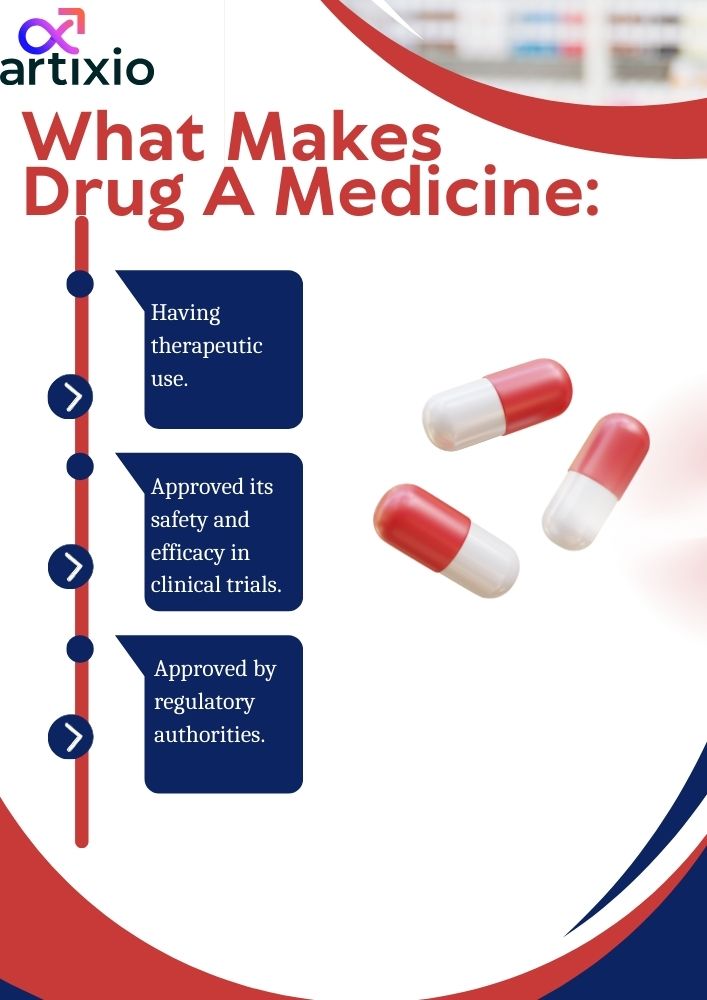
Not every drug is used as medicine. The difference between drugs and medicines is mainly seen in their purpose, with medicines being used for therapeutic needs.
At Artixio, we provide end-to-end pharmaceutical regulatory affairs services and registration support to help you navigate global approval pathways and accelerate market entry.
Artixio supports pharmaceutical companies with:
- Drug registration strategy
- Dossier preparation & submission
- Regulatory authority coordination
- Lifecycle management
- Market entry support across global regions
Reach out to us at info@artixio.com to discuss your product regulatory process and market entry.
FAQs
What is the difference between drug and medicine?
Drugs are medicinal or non-medicinal chemical substance with positive or negative effect on the body whereas medicines are intended for therapeutic use with positive effects on the body.
How do prescription medicines and drugs differ from each other?
Prescription medicines are approved and controlled for patient use, while “drugs” can refer to any chemical substance, whether it’s used in medicine or not.
What are the different types of drugs used in medicine?
Different types of drugs used in medicines are analgesics, anti-inflammatory, stimulant, inhalants, etc.
What are the natural substances that can be used as medicines as well as drugs?
Natural substances such as cannabis, opium, coca leaf, etc, can be used as medicines as well as drugs.
Is it possible for a drug to transition into a medicine?
Yes, it is possible for a drug to transition into medicine, but this process requires high clinical safety and efficacy testing.
What are herbal or natural products considered, drug or medicine?
If the herbal or natural product is used for therapeutic use, it is classified as medicine.
What Are Some Examples of Drugs and Medicines?
Examples of drugs are opium, cannabis, heroin, etc. whereas the examples of medicines are analgesic, painkillers, paracetamol, etc.
Is Aspirin a drug or medicine?
It’s both. Technically a drug, but in everyday use, it’s a medicine.