A CEP stands for Certification of Suitability to the monographs of the European Pharmacopoeia. It is used for substances covered by a Ph. Eur. monograph. The certificate shows that the monograph, along with any extra tests that may be needed, is suitable for controlling the quality of that substance. EDQM manages the CEP procedure.
A sister file can be used in certain cases when a company already has a CEP and needs another closely related CEP for the same substance. EDQM updated the sister-file guidance in 2026, and the revised guidance applies from 1 September 2026.
This article covers CEP meaning, the application process, submission requirements, and sister CEP submissions.
What Is Certification of Suitability (CEP)?
A Certificate of Suitability (CEP) is granted by EDQM. It shows that the relevant European Pharmacopoeia monograph can be used to control the quality of a substance, with extra tests added where needed.
The CEP procedure is based on a centralized assessment of information on the manufacture and quality control of the substance. A valid CEP can then be used in a marketing authorisation application, subject to the requirements of the relevant competent authority, instead of repeating the corresponding detailed quality information for that source.
Under CEP 2.0, newly granted CEPs are electronic documents with electronic signatures. CEPs issued in the old format before 1 September 2023 remain valid until they are revised. For existing CEPs, a hybrid CEP may be issued after certain revisions or notifications when the content of the CEP is affected.
The CEP procedure can apply to different pharmaceutical substances, including active pharmaceutical ingredients (APIs) and excipients, as long as they fall within the scope of the procedure.
Importance Of Certification Of Suitability
A CEP can simplify the quality assessment of a substance used in a medicinal product application. Once EDQM has assessed the substance and granted a CEP, the certificate can be used to support the quality part of a marketing authorisation application, subject to the requirements of the competent authority.
The procedure also avoids repeated assessment of the same substance data by different authorities. It provides a common reference to the relevant European Pharmacopoeia monograph and any additional controls specified in the CEP.
CEP holders must also keep the certificate up to date. Changes to the approved information may require a notification, revision, or renewal, depending on the nature of the change. A CEP must be renewed once, five years after the original issue date, to remain valid.
Types Of CEP
EDQM identifies three main types of CEPs:
1. Chemical CEP
A Chemical CEP covers the chemical purity and microbiological quality of a substance described in a European Pharmacopoeia monograph.
2. Herbal CEP
A Herbal CEP is issued for herbal drugs and herbal drug preparations that fall within the scope of the CEP procedure.
3. TSE CEP
A TSE CEP addresses the risk of transmitting agents of animal spongiform encephalopathies for materials covered by the relevant European Pharmacopoeia requirements.
Combined CEPs can also be granted in certain cases, including:
- Chemical CEP with sterility
- Chemical + TSE CEP
- Chemical + TSE CEP with sterility
New CEP applications are outside the scope of the procedure for biologicals, human tissue derivatives, blood derivatives, vaccines, medicinal products, and substances that do not meet the applicable Ph. Eur. monograph scope.
How To Apply For A CEP?
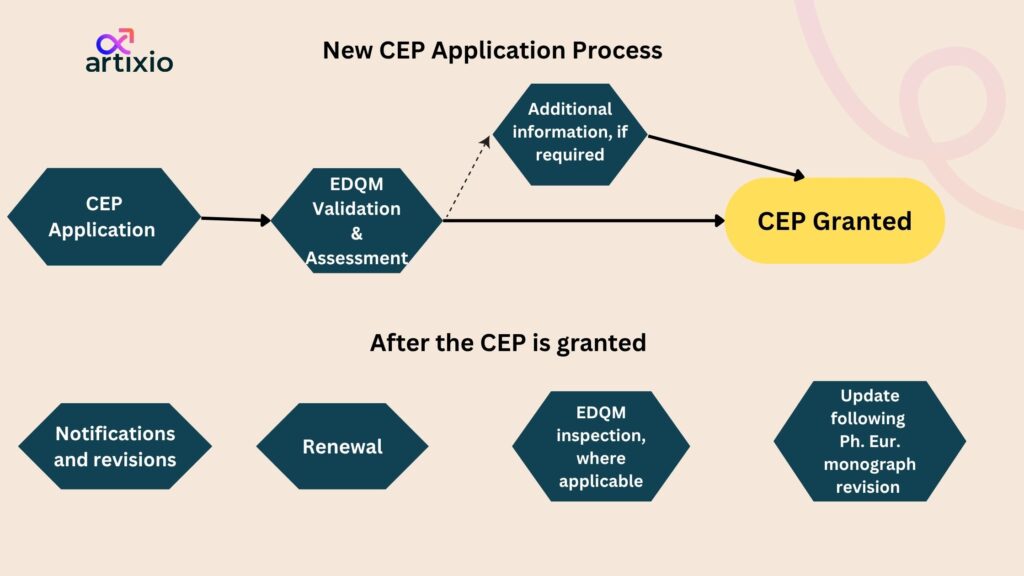
A new CEP application is submitted electronically to the Certification of Substances Department (DCEP) of the EDQM. Applicants first need to make sure that the substance falls within the scope of the CEP procedure.
For a new application, EDQM requires:
- a completed application form;
- a dossier in CTD format, covering Modules 1, 2 and 3;
- a Quality Overall Summary (QOS) in Module 2;
- the technical information required for the particular type of CEP application, such as chemical purity and microbiological quality, sterile substances, herbal substances, or TSE risk, as applicable.
Once EDQM receives the application, it is validated and then listed for assessment. New applications are evaluated through three assessment rounds. EDQM may send deficiency letters requesting additional information. If sufficient information is still not provided after the applicant has responded to a maximum of two EDQM deficiency letters, the application is closed. When the assessment is successfully completed and the issues raised have been resolved, EDQM grants the CEP.
Electronic CEP Submission Requirements
EDQM introduced automation for receiving CEP submissions on 1 November 2025. The aim is to make the receipt and routing of electronic applications more efficient, but applicants need to follow the required submission format for the automated process to work correctly.
CEP submissions are sent electronically through the Common European Submission Platform (CESP). Most submissions must be in eCTD format. Submissions for substances intended only for veterinary use may use vNeeS, while submissions dealing with TSE risk may be provided in PDF format.
For an eCTD submission, applicants must provide an eCTD validation report and validate the submission against the applicable EU regional validation criteria. Any validation fail errors should be corrected before the application is sent to EDQM. Since 1 April 2026, applications that do not meet the applicable electronic-submission requirements may be rejected on receipt.
EDQM updated its electronic-submission guidance again on 19 August 2026. The current guidance explains where the validation report should be placed, how it should be named, and which file formats are accepted. It also clarifies that changes made to Module 3 should be described in Module 1 rather than highlighted directly in Module 3.
Sister CEP Submissions
A company that already holds a CEP may sometimes need a separate CEP for the same substance. This may be necessary when the change cannot be handled through a revision of the existing CEP, or when separate CEPs are needed for different manufacturing conditions or qualities, such as an alternative manufacturing process, manufacturing site, or grade. In such cases, the new application may be submitted as a sister file, provided it meets the EDQM eligibility conditions.
The sister-file procedure is intended for similar dossiers and allows applicants to benefit from a fast-track procedure and harmonised assessment. EDQM focuses on the differences between the new application and the existing CEP dossier.
The revised EDQM guidance, effective 1 September 2026, clarifies the eligibility criteria for sister files. It also expands the procedure to include CEP applications for sterile substances, while TSE CEP applications remain outside the scope of the sister-file procedure.
Sister CEP Submission Requirements
A sister-file application must meet the EDQM eligibility criteria and include the documentation required for assessment.
The submission should include:
- a completed EDQM sister-file application form;
- a comparative table showing the differences between the existing CEP dossier and the proposed sister file;
- a complete dossier in eCTD format;
- a nitrosamine risk assessment, where applicable to the substance;
- the supporting information needed to explain and justify the differences from the existing CEP dossier.
The comparative table is particularly important because EDQM uses it to understand how the sister file differs from the existing CEP dossier. Current EDQM guidance also makes clear that a sister-file request must fit the intended scope of the procedure. If the proposed manufacturing process uses different starting materials, reagents, or intermediates, the application will normally not qualify unless the applicant can show that the underlying chemical principles and reaction mechanisms remain the same as those in the referenced CEP dossier.
What Does “CEP Grade” Mean?
The term “CEP grade” is commonly searched, but EDQM guidance deals with this as different grades of the same substance rather than as a separate type of CEP. A grade may relate to specific physical characteristics of the substance, such as a micronised or milled grade.
When a manufacturer produces more than one grade of the same substance, EDQM allows either a single CEP or separate CEPs, depending on the differences between the grades.
A single CEP may cover more than one grade when the specifications and impurity profile are the same for each grade. The dossier should describe how each grade is produced and include appropriate batch-analysis information.
Separate CEPs are required when the grades have different impurity profiles or require different tests or impurity limits.
When a specific grade is requested by the applicant and approved by EDQM, it is shown as a subtitle on the CEP, and the relevant quality information is included in the approved specification. Under current CEP 2.0 requirements, information relating to a specific grade should be included in the dossier only when that grade is actually being claimed.
Conclusion
A CEP can support the quality assessment of a substance by showing that the relevant European Pharmacopoeia monograph, together with any additional controls where needed, is suitable for controlling its quality. The CEP procedure is managed by EDQM and includes requirements for new applications, electronic submissions, assessment, revisions, renewals, and sister files.
The procedure has continued to evolve, with recent updates affecting electronic submissions, CEP lifecycle management, and sister-file eligibility. Applicants and CEP holders should therefore follow the latest EDQM requirements when preparing a new submission or managing an existing CEP.
For support with CEP applications, sister-file submissions, dossier preparation, regulatory submissions, and lifecycle requirements, explore Artixio’s Regulatory Affairs services.
FAQs
Q. How does a CEP simplify regulatory submissions?
A CEP can be used to support the quality part of a medicinal product application when the relevant competent authority accepts its use. It can reduce the need to reassess the same substance-quality information because EDQM has already evaluated the CEP dossier. However, the CEP does not replace all quality information or the requirements of the marketing authorisation application.
Q. What challenges are commonly faced during CEP applications?
Applications can be delayed when the dossier is incomplete, unclear, or inconsistent. EDQM may then ask for more information before the assessment can move forward. Following the current dossier guidance, QOS requirements, and submission instructions can help reduce these issues.
Q. How often must a CEP be renewed?
A CEP must be renewed once, five years after the issue date of the original CEP, for it to remain valid. CEP holders must also inform EDQM about changes to the information submitted in the original application and follow the applicable notification or revision procedure.
Q. What role does EDQM play in issuing CEPs?
The EDQM manages the CEP procedure through its Certification of Substances Department. It receives and validates applications, assesses the submitted dossier, may raise questions or request additional information, and grants the CEP when the assessment is completed successfully.
Q. Are CEPs accepted globally?
CEPs are used in several countries outside Europe, but each authority decides how they can be accepted or used. Applicants should check the rules of the target country before relying on a CEP for a submission.
Q. How long does it take to obtain a CEP?
There is no single fixed duration for every CEP application. The total time depends on the EDQM assessment period and the time taken by the applicant to respond to questions raised during the assessment.