India regulates alcoholic beverages under the Food Safety and Standards (Alcoholic Beverages) Regulations, 2018. The framework has been amended several times, including changes that took effect in 2026.
FSSAI treats a drink containing more than 0.5% ABV as an alcoholic beverage.
What follows covers the compliance areas that matter most for anyone manufacturing, importing or selling these products in India: how beverages get classified, the standards attached to each category, labelling and packaging obligations, licensing thresholds, and import-specific rules.
What Is an Alcoholic Beverage Under FSSAI?
FSSAI treats any beverage with more than 0.5% alcohol by volume (ABV) as an alcoholic beverage. The alcohol used must come from an agricultural source.
ABV shows the percentage of alcohol present in the drink. FSSAI then places alcoholic beverages into different categories based on the type of product and how it is made.
Classification of Alcoholic Beverages Under FSSAI
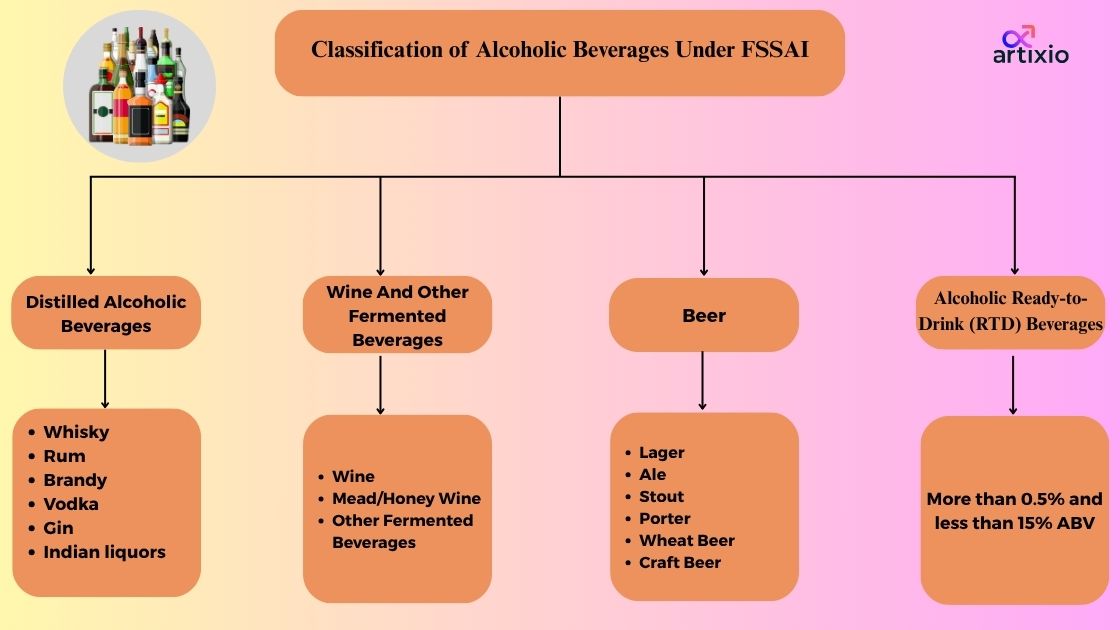
How a beverage is made — and what it’s made of — determines which category it falls into under FSSAI’s framework. Four broad groups cover the field: distilled alcoholic beverages, wine and other fermented drinks, beer, and alcoholic ready-to-drink beverages.
Distilled Alcoholic Beverages
These are beverages produced by distilling alcohol obtained from the fermentation of agricultural sources such as cereals, fruits, vegetables or molasses. This group includes products such as whisky, rum, brandy, gin, vodka and country or Indian liquor.
Wine and Other Fermented Beverages
This category covers beverages produced through fermentation, including wine and other fermented alcoholic drinks recognised under the regulations. Different types within this group have their own compositional and product standards.
Beer
Beer gets its own treatment under the FSSAI standards, with separate requirements depending on the type — lager, ale, stout and porter each carry distinct specifications rather than falling under one generic beer standard.
Alcoholic Ready-to-Drink (RTD) Beverages
RTD drinks are treated as a separate category under FSSAI. They are flavoured alcoholic beverages with more than 0.5% and up to 15% ABV and may use spirits or another alcoholic beverage as the base.
FSSAI Standards for Alcoholic Beverages
The requirements are not the same for every alcoholic drink. They vary by product and may include limits or conditions related to alcohol content, ingredients, additives, composition and safety.
Products such as brandy, whisky, rum, gin, vodka, wine and beer each have their own standards. The applicable requirements depend on the type of beverage being manufactured, imported or sold.
FSSAI also provides official testing methods for alcoholic beverages through its Manual of Methods of Analysis of Foods – Alcoholic Beverages.
FSSAI Labelling Requirements for Alcoholic Beverages
Alcohol labels in India have to follow the FSSAI rules for alcoholic beverages. The label should show the required product details and any declarations that apply to that drink.
The alcohol content must be declared on the label as a percentage of ABV or as proof.
A statutory warning is also required:
“CONSUMPTION OF ALCOHOL IS INJURIOUS TO HEALTH. BE SAFE-DONT DRINK AND DRIVE.”
The warning must be printed in English. States may also require it in a local or regional language. The minimum letter size is 1.5 mm for packs up to 200 ml and 3 mm for packs above 200 ml.
For alcoholic beverages other than wine with less than 10% alcohol, the label must also show the expiry date or use-by date. Wine has some additional declaration requirements, including allergen and origin-related information where applicable.
FSSAI Packaging Requirements for Alcoholic Beverages
Alcoholic beverages must be packed in suitable food-grade containers that meet the applicable FSSAI packaging requirements.
For alcoholic beverages supplied in bulk for further manufacturing, there is no upper limit on alcohol content under the alcoholic-beverage regulations. The bulk container must still meet the relevant safety parameters and carry the declaration:
“For Manufacturer of Alcoholic Beverages only.”
Packaging requirements should therefore be checked together with the current FSSAI Packaging Regulations and any product-specific provisions that apply to the beverage.
FSSAI Licensing Requirements for Alcoholic Beverage Businesses
Alcohol businesses need the FSSAI registration or licence that matches what they do and the size of the business. Applications go through the FoSCoS portal. From 1 April 2026, the turnover limits are:
- Registration: up to ₹1.5 crore
- State Licence: above ₹1.5 crore and up to ₹50 crore
- Central Licence: above ₹50 crore
These thresholds apply to food businesses generally, but some activities have their own eligibility criteria. Importers, for example, require a Central FSSAI Licence regardless of turnover.
Under the 2026 licensing reforms, FSSAI registrations and licences now have perpetual validity unless they are suspended, cancelled or surrendered, removing the earlier periodic renewal requirement.
Alcohol businesses may also need licences or permissions from the relevant state or Union Territory excise department. These are separate from the FSSAI licence, and the exact excise requirements differ by jurisdiction.
Documents Required for FSSAI Licensing
The documents needed for an FSSAI application depend on the type of business and the licence being applied for. FoSCoS uses activity-specific document requirements rather than one fixed checklist for every alcoholic beverage business.
The papers needed will depend on the business activity. These can include proof of identity and address, documents for the premises, an FSMS plan, water test reports and other records asked for in FoSCoS. It is best to check the latest document list for the selected Kind of Business (KoB) before submitting the application.
Import of Alcoholic Beverages into India
Alcohol entering India has to satisfy the import rules as well as the FSSAI requirements for that particular beverage. Before the consignment is released, it is checked at the notified port for compliance with food safety and labelling rules.
Importers must hold the appropriate FSSAI licence. Before a consignment is released, it may go through document checks, inspection, sampling and laboratory testing, depending on the case.
FSSAI has also issued specific directions for imported alcoholic beverages. For alcoholic beverages bottled at origin or imported in bulk with more than 10% alcohol and no expiry date, the FSSAI NOC is valid for 300 days. Consignments remaining at the port or Customs area beyond that period may require visual inspection for revalidation of the NOC.
State Excise Requirements for Alcoholic Beverages
FSSAI is only one part of alcohol regulation in India. State and Union Territory excise laws also apply and can cover areas such as manufacture, possession, transport, distribution and sale.
What is needed will vary from one state or Union Territory to another.
A business may also have to obtain excise licences, label approvals, transport permits or other local clearances. These requirements can change depending on where the product is made, brought into the state or sold.
Advertising and Claims for Alcoholic Beverages
Alcoholic beverage labels and promotional claims must not mislead consumers. FSSAI requires claims to be truthful, clear and consistent with the information given on the product label.
For alcoholic beverages specifically, health claims are not permitted. A beverage containing more than 0.5% ABV also cannot be described as “non-intoxicating” or with wording that suggests the same meaning.
Any claim used on the label or in promotion should be checked against the alcoholic beverage rules as well as FSSAI’s advertising and claims requirements.
Key FSSAI Alcoholic Beverage Amendments in 2026
Several changes to the alcoholic beverage rules started applying in 2026. These included updates for mead, craft beer, Indian liquors, wine-based beverages and RTD drinks.
For RTDs, the permitted alcohol range is now more than 0.5% and up to 15% ABV.
Some of the new labelling requirements were not enforced immediately. Their implementation date was pushed to 1 July 2026 because alcoholic beverage labels also go through state excise registration. The Second Amendment Regulations, 2025 also came into force on 1 June 2026. It made a specific technical change in Table 2 by revising the maximum limit for esters expressed as ethyl acetate in one product category from 0.2 to 3.0 g/l of absolute alcohol.
Conclusion
Alcoholic beverages in India are regulated through a combination of FSSAI requirements and state or Union Territory excise laws. FSSAI sets the product standards, classification, labelling, packaging and food-business compliance requirements, while excise permissions vary by jurisdiction.
Given how often these regulations get revised, it makes sense for businesses to double-check the current standard for whatever beverage they’re making, importing or selling — particularly in categories that have seen recent changes, like RTDs, craft beer, Indian liquors and wine-based beverages. The First Amendment Regulations, 2025 introduced several of these changes, while the Second Amendment Regulations, 2025 made a further technical revision that came into force on 1 June 2026.
Need support with FSSAI compliance in India? Explore Artixio’s food product regulatory services in India for assistance with product classification, labelling, licensing and other regulatory requirements.
FAQs
1. What are the FSSAI regulations for alcoholic beverages in India?
The Food Safety and Standards (Alcoholic Beverages) Regulations, 2018 are the main FSSAI regulations governing alcoholic beverages in India. It has been amended a few times since, most recently to update product standards, classification rules and labelling requirements.
2. How does FSSAI define an alcoholic beverage?
There’s a hard cutoff at 0.5% ABV. Below it, a drink isn’t classified as alcoholic; above it, the ethanol also needs to trace back to an agricultural source, not a synthetic one.
3. What are the main classifications under FSSAI?
Distilled beverages, wine and other fermented drinks, beer, and RTD beverages — each with its own product-specific standards on top of the broader category rules.
4. What is an alcoholic RTD beverage under FSSAI?
It is a flavoured drink containing more than 0.5% and up to 15% ABV, made using a spirit or another alcoholic beverage as the base. This category was formally added through the 2025 amendment.
5. Do alcoholic beverage businesses need an FSSAI licence?
In most cases, yes — though whether that means registration, a state licence or a central licence comes down to the business’s scale. Importers are the exception; they need a central licence no matter their turnover.
6. Is FSSAI compliance the same as state excise compliance?
No. The two run on separate tracks — FSSAI handles food safety and labelling, while excise departments deal with manufacture, sale and transport permissions.
7. Does FSSAI regulate imported alcoholic beverages?
It does. Imports have to clear both the Import Regulations, 2017 and whatever alcohol-specific standards apply.
8. What changed for alcoholic beverages in 2026?
Two amendments came into force this year. The First Amendment Regulations, 2025 took effect on 1 January 2026, though some of its labelling requirements weren’t enforced until 1 July 2026. Then the Second Amendment Regulations, 2025 followed on 1 June 2026, making a narrow technical change to permitted ester limits.