
If you’re planning to bring a health functional food into South Korea, you must check its regulatory route. The requirements differ depending on whether the product uses functional ingredients notified by the Ministry of Food and Drug Safety (MFDS) or individually recognized functional ingredients.
In this article, we’ll walk through how the MFDS works for these products, what the registration process looks like, and a few areas where companies usually get stuck.
South Korea Health Functional Foods Regulatory Authority
In South Korea, Health Functional Foods are regulated by the Ministry of Food and Drug Safety (MFDS) under the Health Functional Foods Act and related regulations. MFDS sets and administers standards and requirements for these products. These include functional ingredients, standards and specifications, labeling, and safety controls.
MFDS evaluates applications for individually recognized functional ingredients. It covers their safety and functionality. The National Institute of Food and Drug Safety Evaluation (NIFDS) supports MFDS in scientific and technical evaluation.
Some of the key regulations of MFDS that are applicable to Health Functional Food are given below:
- Health Functional Foods Act
- Enforcement Rule of the Health Functional Foods Act
- Enforcement Decree of the Health Functional Foods Act
- Regulation about Recognition of Functional Ingredient and of Standard and Specification for Health Functional Foods
- Labelling Standard for Health Functional Food
- Health Functional Food Code
- Act on Labeling and Advertising of Foods, Etc.
Contact us For
What Are Health Functional Foods As Per MFDS?
Health functional foods are foods manufactured or processed using raw materials or ingredients that have functional properties beneficial to the human body. Functionality here means achieving useful effects for health purposes, like regulating nutrients or providing physiological benefits to the structure and function of the human body.
Classification of Health Functional Foods in South Korea
Since Health Functional Foods are derived from functional ingredients, the two important regulatory categories are given below:
Notified Functional Ingredients
Those that are registered in the Health Functional Food Code. They can be used by anyone if they satisfy the manufacturing, functionality, and other related requirements.
Individually Recognized Functional Ingredients
Ingredients that are not registered within the Health Functional Food Code and not publicly notified come under this category. The applicant must submit the data required for the recognition assessment, including information concerning the ingredient’s origin, manufacturing process, characteristics, specifications, safety, functionality, intake amount, intake method, and precautions, as required by the applicable recognition rules.
Once individually recognized, the use of the recognized ingredient is subject to the conditions of the recognition.
Requirements For An Ingredient To Be A Functional Ingredient
Under the MFDS Health Functional Food Code, a functional ingredient is a substance that provides health benefits and falls within one of the following categories:
i) Processed raw material where the origin is from a microorganism, plant, animal, or water.
ii) Extract or purified substance of any of the ingredients mentioned above (i)
iii) Synthetic duplicate of the purified substance of any of the above-mentioned ingredients (ii)
iv) Combination of any ingredients mentioned in the above points.
Additionally, functional ingredients must either:
v) Be specified under the standards and specifications of functional ingredients of the Health Functional Food Code
vi) Be individually recognized under the Health Functional Food Act and the Regulation on Recognition of Functional Ingredient and of Standard·Specification for Health Functional Foods.
The use of an individually recognized functional ingredient is restricted to the business operator that has obtained the relevant recognition. MFDS states that individual recognition involves the submission and review of data concerning the ingredient’s safety and functionality, followed by recognition by MFDS.
The Dietary reference intake for Koreans can be found in the Annex, Table 3 of Health Functional Food Code.
Safety and Functionality Evidence for Individually Recognized Functional Ingredients
MFDS conducts an individual recognition assessment based on submitted data concerning safety and functionality. The recognition dossier can include information on the following:
- Origin and development history
- Manufacturing process
- Characteristics of the ingredient
- Functional or marker component specifications and analytical methods
- Specifications for harmful substances
- Safety data
- Functionality data
- Proposed daily intake and intake method
- Warnings and precautions
- Evidence that the ingredient is not identical or similar to a medicinal product
The exact evidence requirements depend on the recognition pathway and the nature of the ingredient.
Market Entry and Item Manufacturing Reporting for Health Functional Foods in South Korea
Domestically manufactured health functional foods can have the following regulatory process:
- Obtaining the required health functional food manufacturing business permission.
- Establishing compliance with the applicable standards and specifications.
- Completing item manufacturing reporting for the product.
- Ensuring the product’s labeling and functional information comply with the relevant standards.
- Conducting required quality-control and self-quality-inspection activities.
- Meeting post-market obligations after distribution.
For imported products, the importer must comply with the Special Act on Imported Food Safety Control and the Health Functional Foods Act. It includes the requirements that apply to the import declaration.
Documents Required for Health Functional Food Item Manufacturing Report
For a domestic manufacturer filing an item manufacturing report, the current Enforcement Rule requires documentation including the following:
- Manufacturing method description, including the basis for establishing the product’s use-by period;
- Names and amounts of raw materials or ingredients;
- Test/inspection results for compliance with applicable standards and specifications; and
- Where relevant, documentation demonstrating that the health functional food standards and specifications or the functional raw material/ingredient have been recognized under the Health Functional Foods Act.
Manufacture of Health Functional Foods in South Korea
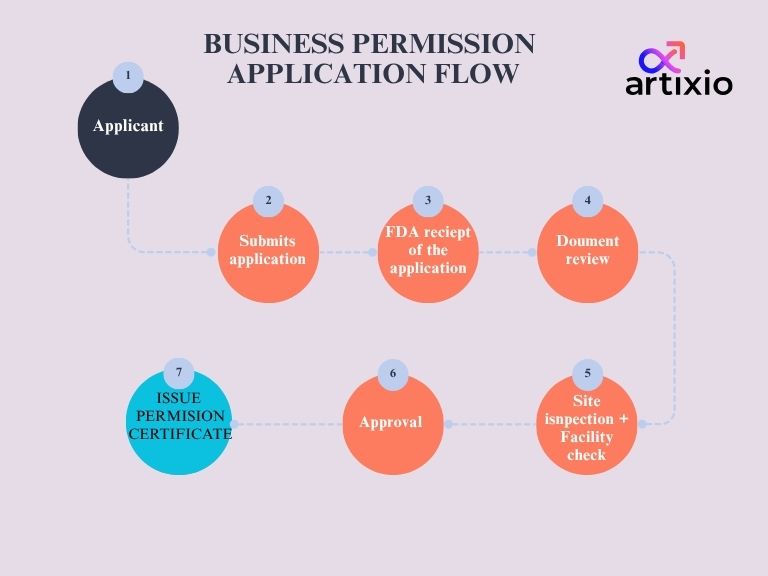
A person intending to operate a health functional food manufacturing business must obtain permission from MFDS for each business place and meet the prescribed facility and quality-management requirements. To obtain permission, the business person must submit a business permission application (Form 1).
After review of the documents, MFDS will issue a business permission certificate in Form 2. In case the business permission certificate is worn out or is lost, then the business person must submit a business permission certificate reissue application in Form 4. The flow of the business permission application is shown in the image below.
Documents for Manufacturing Business Permission
The following are the documents to be submitted for Health Functional Food manufacturing specialized businesses.
- The product type and the manufacturing method document
- List of main apparatus & Machinery along with the arrangement plan of the manufacturing facilities
- Land use plan confirmation and business administrative register certified copy
- Quality management appointment report as per Article 16 of the Enforcement Rule of the Health Functional Food Act.
- A certificate of education completion as per Article 13 (2) of the Act, when applicable
- Water analysis written result
Documents for Health Functional Food Manufacture Venture Business
The following are the documents to be submitted:
- Copy of the venture business confirmation under Article 25 of the Act on Special Measures for the Promotion of Venture Businesses.
- Technical data on the functional ingredients and components of the health functional food.
- Document describing the type of product to be manufactured and the manufacturing method.
- Quality manager appointment report under Article 16 of the Enforcement Rule of the Health Functional Food Act.
- Document evidencing the manufacturing entrustment contract with a Health Functional Food manufacturing-specializing business.
- Education completion certificate under Article 13(2) of the Health Functional Food Act, where the education has been completed in advance.
Import of Health Functional Foods into South Korea
Health functional foods imported into South Korea for commercial purposes are subject to the Health Functional Food Act and the Special Act on Imported Food Safety Control, administered by the Ministry of Food and Drug Safety (MFDS). Health functional foods are specifically included among the products subject to import declaration and safety control under the Special Act.
1. Import and Manufacturing Overseas Facility Registration Before Import
Businesses importing and selling health functional foods in Korea must complete the required imported-food business registration before conducting the relevant import activities. In addition, the overseas manufacturing facility producing the health functional food must be registered with MFDS before the import declaration is filed. MFDS states that failure to complete the required overseas-facility registration can result in rejection of the import declaration.
The overseas facility registration includes information mentioned below:
- Name and address of the manufacturing facility
- Name/contact details of the representative
- Type of business
- Whether a food-safety management system is applied
- Type of food manufactured, including health functional foods
- Consent to an MFDS on-site inspection where MFDS considers one necessary
MFDS states that registration is submitted through the Imported Food Information Maru system. Changes to registered information, such as the facility’s name, address, or relevant business type, must also be registered before the next import declaration.
2. Import Declaration and Inspection
An importer must file an import declaration with MFDS when importing health functional foods for sale or business use. Imported products are then subject to the applicable MFDS import-safety controls. These controls can include document review, field inspection, laboratory testing, and random sampling, depending on the product and inspection circumstances.
Products imported for the first time can be subject to laboratory testing, while products with a history of non-compliance or identified safety concerns may receive enhanced inspection. MFDS also operates risk-based systems that use information such as the country of origin, product, ingredients, manufacturer, importer, previous inspection results, and history of hazardous-substance detection to determine inspection priorities.
Where an import inspection confirms compliance, MFDS issues the relevant certificate of completion of import declaration, after which the product can proceed through customs clearance and into domestic distribution. Non-compliant products may be subject to notification of non-compliance and measures such as return or disposal.
3. Documents and Records to Be Maintained by Importers
The Enforcement Rule of the Health Functional Food Act requires a health functional food import business to maintain certain records. These include the business report certificate, standards and specifications recognition certificate, and functionality labeling and advertising pre-deliberation certificate.
Importers must also retain the import report certificate, shipping document, invoice/content list, and sales records for two years from the date of import. Where the product’s sell-by date is two years or longer, the records must be retained until the sell-by date. Transaction details and return records must also be maintained for two years.
Import businesses are additionally required to regularly inspect and hygienically manage storage facilities to prevent hazards during the import, storage, and distribution of health functional foods.
4. Post-Import Control
MFDS does not end its oversight at customs clearance. Imported health functional foods can be subject to collection and inspection after distribution. Products associated with safety concerns, non-compliance histories, or overseas hazard information may be collected and tested, and non-compliant products can be recalled, seized, or disposed of.
MFDS Labelling Requirements For Health Functional Foods
Health functional food labeling must include the information required under the Labeling Standards for Health Functional Foods.
MFDS identifies the following principal labeling elements:
- Health Functional Food emblem/mark
- Product name
- Identity and principal place of business
- Expiration date and storage method
- Contents
- Nutrition information
- Functional information
- Intake instructions, including intake amount and method
- Raw material contents
- Statement that the product is not a pharmaceutical product used for disease prevention or treatment
- Safety precautions and other information required by the detailed labeling standards
Additional requirements can apply to ingredients such as animal-derived ingredients, allergens, and high-caffeine ingredients.
Important 2026 Update
MFDS issued Notification No. 2026-66 on September 15, 2026, amending the Health Functional Food Labeling Standard. The amendment specifically changes the Health Functional Food and Excellent Health Functional Food Manufacturing Practice (GMP) marks so consumers can distinguish them more clearly from the HACCP mark used for general foods.
Health Functional Food Claims and Advertising
Only functions recognized under the Health Functional Food standards and specifications or functions individually recognized by MFDS may be expressed as functional information on the product. MFDS also states that health functional food labeling and advertising is subject to the applicable review system for functional claims. Claims must not falsely or exaggeratedly represent a product as having medicinal effects or imply that the product can prevent or treat disease.
Current Fees for Key Health Functional Food Procedures
The fee schedule under the Enforcement Rule was amended on June 2, 2026. Current fees include the following:
| Procedure | Electronic application | Visit/mail |
| New manufacturing-business permission | KRW 45,000 | KRW 50,000 |
| New business report | KRW 25,000 | KRW 28,000 |
| Item manufacturing report | KRW 18,000 | KRW 20,000 |
| Recognition of standards/specifications under Article 14(2) | KRW 1,000,000 | KRW 1,100,000 |
| New recognition of functional raw material/ingredient | KRW 4,500,000 | KRW 5,000,000 |
| Modification of recognized functional raw material/ingredient | KRW 1,800,000 | KRW 2,000,000 |
** Kindly note that the fee is subject to change. It is advised to confirm the current fee by visiting the MFDS official website. **
Post-Market Requirements for Health Functional Foods in South Korea
Health functional food businesses remain subject to quality control, inspections, labeling and advertising controls, traceability requirements where applicable, and adverse-event reporting obligations after products enter the market.
MFDS operates a Health Functional Food Side Effect Reporting System. Under the Enforcement Rule, serious adverse events involving death or a serious impact on a person’s life or health must be reported within 7 days of becoming aware of the event. Other adverse events must be reported within 15 days.
MFDS also operates food traceability controls, with traceability becoming mandatory in phases for specified businesses, including certain health functional food manufacturers and importers based on the applicable criteria.
Conclusion
Health functional foods in South Korea are regulated through a framework administered by the Ministry of Food and Drug Safety (MFDS). Companies should also ensure compliance with current standards for functional ingredients, product specifications, manufacturing, labeling, functional claims, advertising, quality control, and post-market management.
The regulatory framework is updated periodically. In 2026 alone, MFDS amended the Health Functional Food Code, labeling standards, and Enforcement Rule, so companies should verify the current Korean requirements before placing a product on the Korean market.
Artixio is here to help you with health functional food compliance in South Korea. Our regional experts and professional network always take you a step ahead with the MFDS regulations. We provide assistance right from development to market entry and maintenance. Connect with us through info@artixio.com for an expedited registration process.
FAQs
Q. Are health functional foods in South Korea subject to a general product-registration procedure?
Not in the same way as pharmaceutical products. The regulatory route can involve manufacturing-business permission, item manufacturing reporting, individual recognition of functional ingredients where applicable, and import declaration requirements for imported products.
Q. Does every health functional food require an individually recognized functional ingredient?
No. MFDS distinguishes between functional ingredients notified in the Health Functional Food Code and functional ingredients individually recognized by MFDS. A product using a notified ingredient can follow the standards and specifications specified in the Code, whereas an ingredient not publicly notified may require individual recognition.
Q. What is the current fee for recognition of a new functional ingredient?
Under the fee schedule amended on June 2, 2026, the fee is KRW 4.5 million for an electronic application and KRW 5 million for a visit/mail application.