
Japan is one of the most regulated healthcare markets globally, and medical device regulations in Japan reflect that. No medical device can enter the Japanese market without meeting the requirements formed under the PMD Act. It influences classification decisions and review expectations. Even post-market compliance requirements trace back to it.
From an agency perspective, an unclear classification can trigger additional questions and an extended timeline for reviews. So, before exploring the registration pathways, a clear understanding of how Japan classified medical devices and which authorities are involved is essential.
In this article, we explain the Japan Medical Device Classification system, Japan Medical Device Registration Process, PMDA regulatory requirements, approval pathways, and key compliance requirements for market entry.
Regulatory Authority for Medical Devices in Japan
Medical devices in Japan are regulated by two key authorities.
- Ministry of Health, Labour and Welfare (MHLW)
- Pharmaceuticals and Medical Devices Agency (PMDA)
Regulatory policies for medical devices in Japan are established by MHLW. The ministry also makes the final approval decision for Class III and Class IV devices requiring ministerial authorization, as well as Class II devices that lack an applicable certification standard.
PMDA is responsible for the technical review of medical device applications. It is also a primary contact point for higher risk device submissions, non-standard Class II applications, foreign site registration and regulatory consultations.
RCBs are private certification bodies authorized by the MHLW to certify Class II medical devices that fall within the defined certification standard.
Japan Medical Device Classification
Medical device classification in Japan uses four classes divided under a risk based system established under the PMD Act. The system is aligned with the GHTF principles. Each device is assigned a Japan Medical Device Nomenclature (JMDN) code. Together with the device’s intended use and applicable classification rules, the code helps determine the class.
This classification helps determine the applicable regulatory requirements and the Japan Medical Device Registration Process that manufacturers must follow.
| Class | Risk | Devices | Pathway |
| Class I | Low | Stethoscopes, Surgical Gloves, X ray films | Notification |
| Class II | Low to Moderate | Infusion pump |
Certification or Approval
|
| Class III | Moderate to High | Dialysis equipment, Orthopedic implants | PMDA Approval (some Class III devices with certification standards also go through RCB certification) |
| Class IV | High | Pacemakers, Heart valves | PMDA Approval |
Class II is where things get more tricky for many manufacturers. Standard Class II devices with established certification standards go through third party certification. Non-standard Class II devices without applicable certification standards may require full PMDA Medical Device Registration review and approval.
Among the most common causes of registration delays in Japan are classification disputes. Based on our experience, they regularly rank in the top three.
MAH Requirements for Medical Devices
A Marketing Authorization Holder (MAH) is a licensed entity based in Japan that assumes legal responsibility for a medical device placed in the Japanese market. Since foreign manufacturers cannot directly register medical devices in Japan, appointing an MHA is a mandatory regulatory requirement.
Acting as the primary regulatory contact, the MAH manages submissions to PMDA and MHLW. Responsibilities also extend to quality oversight, post-market surveillance, adverse event reporting and product recall management when required.
Medical Device Regulatory Guidelines in Japan
Core guidelines for medical devices are:
- PMD Act (Act no. 145,1960; revised 2014)
- QMS Ordinance (Ministerial Ordinance No. 169 of 2004; updated 2021)
- GVP Ordinance (Ministerial Ordinance No. 135)
- PMDA Guidance Documents (Tsuchi)
- MHLW Certification Standards
- IMDRF/GHTF Guidelines (adopted)
Reading only the PMD Act is a mistake manufacturers make more often.
Each layer has a different specificity. The PMD Act sets a legal foundation. Ministerial ordinances define operational requirements. PMDA guidance documents provide practical direction on technical matters that are not always covered in detail by legislation. Japan has adopted certain concepts from IMDRF and GHTF over time, while keeping a number of regulatory requirements unique to its own market.
Medical Device Registration Process in Japan
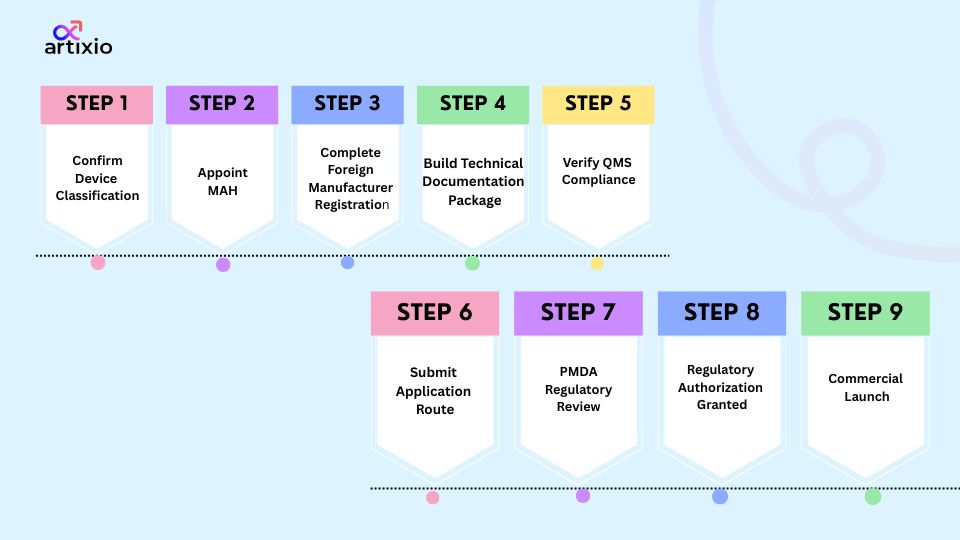
The medical device approval process in Japan follows a structured sequence. Here is the step by step approval process.
- Step 1: Confirm device Classification. Under Japanese medical device regulations, classification determines everything including the pathway.
- Step 2: Appoint a licensed Marketing Authorization Holder (MAH) in Japan. This is not a parallel task. It is a prerequisite.
- Step 3: Complete Foreign Manufacturer registration. Every overseas manufacturing site involved in production must be registered before certification or approval can move forward.
- Step 4: Build the technical documentation package. Device description, intended use, risk analysis, performance testing reports, and clinical data where required
- Step 5: Verify compliance with Japan’s Quality Management System (QMS). Run this in parallel. Compliance with Ministerial Ordinance No. 169 needs to be demonstrated before submission.
- Step 6: Submit the appropriate application route (notification, certification or approval)
- Step 7: PMDA regulatory review. Depending on the device classification and pathway, the PMDA may conduct a thorough assessment.
- Step 8: Regulatory authorization granted. It is issued following a successful assessment by PMDA and final approval from MHLW.
- Step 9: Commercial launch. Importation, distribution and market entry can begin once authorization is in hand and all labeling and import requirements are confirmed.
Among all stages, the preparation of technical documentation often has the greatest impact on review timelines. In complete or inconsistent technical files, gaps between the risk analysis and the clinical evidence. These are the most common reasons for delays during PMDA evaluation.
Required Documents for Medical Device Registration in Japan
Typical documentation includes:
Administrative Documents
- Application forms (including MAH details)
- Foreign Manufacturer Registration certificates
Technical Documentation
- Device description
- Intended use statement
- Product specifications
- Design documentation
- Risk management file
- Verification and validation reports (including software validation, where applicable)
- Sterilization validation (if applicable)
- Biocompatibility studies
Clinical Documentation
Where required:
- Clinical evaluation reports
- Clinical investigation data
- Literature reviews
Quality Documentation
- ISO 13485 certificates
- QMS documentation
- Manufacturing process information
While Japan’s QMS Ordinance (No. 169) is aligned with ISO 13485 principles, PMDA or the RCB typically conducts its own conformity inspection rather than accepting a third-party ISO 13485 certificate alone as sufficient proof.
Japan QMS Requirements for Medical Devices
Japan’s Quality Management System (QMS) requirements are based on ISO 13485 but are governed by Ministerial Ordinance No. 169, which introduces country-specific requirements for medical device manufacturers. As a result, ISO 13485 certification alone does not ensure compliance with Japanese regulations.
What needs to be documented:
| Japan QMS Requirement |
ISO 13485 Reference
|
| Design and Development Controls | Clause 7.3 |
| Supplier and Component Control | Clause 7.4 |
| Sterilization and Process Validation |
Clause 7.5.6 and 7.5.7
|
| Complaint Handling and Post- Market Feedback |
Clause 8.2.1, 8.2.2, 8.2.3
|
| Document and Record Control | Clause 4.2 |
| Risk Management | Clause 7.1
and ISO 14971 |
Before approval or certification is granted, PMDA or Registered Certification Bodies (RCBs) review the manufacturer’s QMS through inspections and document assessments as part of the Medical Device Approval Process in Japan. This is not a formality. Any gaps identified can significantly delay the registration process.
What Artixio has seen repeatedly is that companies that align their QMS documentation with Japanese requirements early in the project typically experience a smoother review process. Manufacturers trying to bridge compliance gaps at the final stage always regret.
Medical Device Labeling & IFU Requirements in Japan
Every medical device marketed domestically in Japan must carry labeling and Instruction for Use in Japanese. This applies broadly across device categories and there is no exemption for imported products or devices originally developed for other markets. Translating existing labeling is not enough either. The content itself must meet Japan’s specific requirements, not just the language.
Since August 2021, paper package inserts are no longer physically included with most devices. This information is now provided electronically, typically accessed via a code or barcode on the packaging, following an amendment to the PMD Act. Class IV devices still require the package insert content to be formally submitted to PMDA; for Class I–III, the content must still be published and accessible, just not physically enclosed
Product labels in Japan typically include the following elements, based on requirements under PMD Act Article 52:
- Product name
- Device classification
- Approval and Certification number
- Marketing Authorization Holder (MAH) information
- lot or serial number
- Storage conditions
- Expiry date (when applicable)
The IFU serves a broader purpose. It needs to clearly cover intended use, contradictions, warnings, precaution, operating instructions, maintenance requirements and disposal guidance.
Depending on the nature and risk profile of the device, additional safety-related information may also be required to support proper use by healthcare professionals or patients.
What Artixio consistently sees in practice is labeling deficiencies remain one of the most common reasons regulators request clarifications or corrections. Addressing labeling requirements early in the Japan Medical Device Registration Process can help reduce review delays and support a smoother submission pathway.
Registration Timelines for Medical Devices in Japan
Japan’s medical device review timelines vary significantly by pathway and risk classification. Rather than a single fixed schedule, PMDA publishes official target review times for four device review categories, and reports its actual performance against those targets annually.
PMDA Official Target Review Times
| Review Category | PMDA Target | FY2022 | FY2023 | FY2024 |
| New devices, priority review (80th percentile) | 10 months | – | – | – |
| New devices, standard review (80th percentile) | 14 months | 12.0 months | 11.4 months | 11.7 months |
| Improved devices, with clinical data (60th percentile) | 10 months | 8.9 months | 9.0 months | 8.9 months |
| Improved devices, without clinical data (60th percentile) | 6 months | – | – | – |
These figures reflect PMDA’s own review time only, the period from application submission to PMDA’s recommendation. They do not include MHLW’s final approval step, pre-submission preparation, documentation and translation work.
How pathway affects the process
Class I devices require notification (todokede) only. There is no PMDA product review, so this pathway is the fastest by design.
Class II devices with an existing certification standard go through certification (ninsho) by a Registered Certification Body (RCB), a separate process from PMDA’s own review track and not covered by the target-time figures above.
Class II or III devices without an applicable certification standard, and all Class IV devices, go through PMDA’s approval (shonin) review, falling into one of the four categories shown in the table above, depending on whether the device is new or improved, and whether it qualifies for priority designation, for example by addressing an unmet medical need, or via the SAKIGAKE program.
SAKIGAKE Designation remains a separate, distinct fast-track. PMDA’s official SAKIGAKE program, launched in June 2014, offers priority consultations and prior assessments for innovative medical products, including select medical devices, pharmaceuticals and regenerative medicine products. Timelines under SAKIGAKE are case dependent rather than fixed.
Medical Device Registration Costs in Japan
Registration costs vary based on device classification, review pathway, and documentation and inspection requirements. Class III and Class IV devices cost significantly more. Official PMDA figures show approval review fees of ¥2,334,300 for Class IV versus ¥1,879,900 for Class II/III (non-SME rate), reflecting the deeper review and heavier documentation involvement these classes require.
Regulatory fees vs. commercial costs
Not every cost driver is government-published. Regulatory fees, which include PMDA’s review fees (above), certification body (RCB) fees and QMS inspection costs, are set by PMDA or the relevant certifying body. Commercial costs, such as translation and MAH service fees, vary by provider and aren’t part of any official fee schedule, but are often substantial and worth budgeting for early.
PMDA notes that its own fees may change without notice, so figures should be reconfirmed close to submission.
Medical Device Import Requirements in Japan
Foreign manufacturers do not import directly. That is not how Japan works. All importation runs through the MAH. They bear full responsibility, hold the product approval or classification, act as the importer of record, and carry full responsibility for customs and regulatory import compliance.
A few things must be in order before any commercial shipment enters Japan:
- PMDA registration of the foreign manufacturing site
- Valid approval or certification number referenced in customs documentation
- Japanese-language labeling on all devices before market placement
- Lot and volume tracking maintained by the MAH for distribution traceability
Japan Customs enforces import controls in coordination with MHLW. devices arriving without proper documentation get detained. Sometimes returned. Neither outcome is quick to resolve.
Post-Market Surveillance Requirements in Japan
Japan’s post market surveillance framework is governed by the GVP Ordinance (Good Vigilance Practice, MHLW Ministerial Ordinance No. 135 of 2004). The MAH carries primary responsibility for everything that follows commercialization. All of it.
Core obligations:
- Adverse event reporting to PMDA follows a matrix based on both severity and whether the event was previously known. Deaths must be reported within 15 days regardless of anticipation status. Other serious events are reported within 15 days if unanticipated (not already described in the IFU or package insert), or within 30 days if anticipated. Non-serious, unanticipated events are compiled into annual reports rather than reported individually. (PMD Act Article 68-10)
- Field Safety Corrective Actions and recalls managed and reported by the MAH.
- For new medical devices, PMDA requires a post-marketing use-result survey during the re-examination period, governed by the GPSP Ordinance under PMD Act.
- Complaints must be documented and investigated.
- QMS periodic review incorporating post-market data.
- Labeling updates when safety information changes, with PMDA notification required under PMD Act Article 52 and Article 68-2-3.
PMDA publishes detailed guidance on reporting timelines and event categorization. The MAH must have operational systems ready to receive safety signals from the foreign manufacturer, assess them under Japanese requirements, and report within the mandated timeframes.
Conclusion
Japan is worth it. But only if approached correctly. The PMD Act framework is rigorous. PMDA’s review process is science based and thorough, and it does not move faster because a manufacturer’s internal deadline demands it. What makes Japan work for foreign manufacturers is preparation. Accurate classification, a capable MAH, clean technical documentation, a QMS that actually meets Ministerial Ordinance NO. 169, and a post market surveillance plan ready from day one of commercialization.
The outcome is achievable. It just requires the right groundwork. Our Japan regulatory affairs services team supports manufacturers across classification strategy, MAH selection, PMDA submission preparation and QMS compliance. Start the conversation early. Reach out to us at info@artixio.com It makes everything that follows easier.
FAQs
Q1. How long does medical device registration take in Japan?
PMDA sets target review times by category, measured at the 80th or 60th percentile, not a strict deadline. Standard-review new devices (target: 14 months) took 11.7 months in FY2024; improved devices with clinical data (target: 10 months) took 8.9 months. Both are running ahead of target.
Class I needs notification only, no PMDA review, the fastest route. Class II with a certification standard goes through RCB review instead of PMDA.
These figures cover PMDA’s review time only, not MHLW’s final approval, and don’t include preparation, documentation, translation, or QMS work beforehand.
Q2. What is the difference between an MAH and a D-MAH?
Same legal responsibility. Different setup. An MAH is a Japanese entity, typically a subsidiary or local company, that holds the product license directly under its own name and infrastructure.
A D-MAH is a third party Japanese entity appointed by a foreign manufacturer to hold the license on their behalf. Same obligations, same accountability. Just not owned by the foreign manufacturer. Note that a D-MAH cannot be appointed for Class I devices.
The risk with a D-MAH is capability. They are not all equal. Post market surveillance, adverse event reporting, recall management. If the D-MAH is not operationally strong in these areas, the foreign manufacturer carries the consequences.
Q3. Are clinical studies always required?
Not always. Depends on device class and available evidence. For many class II devices, published literature is sufficient. For Class III and IV, PMDA may require Japanese clinical data or strong justification for using foreign data.
Q4. What is the SAKIGAKE designation?
Japan’s expedited review pathway for genuinely innovative devices. Qualifying products receive priority PMDA consultation and accelerated timelines. Most manufacturers do not explore eligibility early enough to benefit from it.
Q5 What is the difference between certification and approval in Japan?
Certification applies to eligible Class II devices, and to some Class III devices where a certification standard exists, and is issued by Registered Certification Bodies. Approval applies to all Class IV devices, and to any Class II or III device without an applicable certification standard. It requires full PMDA technical review and takes significantly longer.