Nutraceutical products are seeing steady demand, and many food manufacturers are now looking to enter this segment. At the same time, FSSAI’s regulatory framework for nutraceuticals in India needs to be understood before moving ahead. That’s because these products are not treated the same as regular food.
In the following sections, we’ll look at how nutraceuticals are regulated in India and what the FSSAI registration process involves.
Nutraceutical Regulatory Authority In India
In India, nutraceuticals fall under the Food Safety and Standards Authority of India (FSSAI). The same authority that handles food safety also covers these products. FSSAI specifies standards and regulatory requirements for these products under its food regulations and administers food business licensing through the FoSCoS system.
If this is something you’re working on, we also take up nutraceutical product regulatory services in India.
Regulatory Framework of Nutraceuticals
It includes the Food Safety and Standards (Health Supplements, Nutraceuticals, Food for Special Dietary Use, Food for Special Medical Purpose, Functional Food, and Novel Food (FSS)) Regulations, 2016, plus subsequent FSSAI directions. FSSAI also published the draft FSS Regulations, 2022. FSSAI has subsequently re-operationalised specified provisions of the 2022 draft framework while its finalisation remains pending.
Definition, Scope & Delivery Format of Nutraceuticals (Nutra)
It’s a category of foods containing extracts, isolates, and purified chemical compounds. It provides physiological benefits, allowing consumers to maintain their health. Nutra doesn’tintend to treat or cure any medical condition, disease, or disorder. The formats in which they can be delivered are powders, tablets, granules, capsules, semi-solids, liquids, drops, gummies, pills, jelly, bars, biscuits, candies, chewable and mouth-dissolving strips. They are taken orally in specific quantities and at particular times.
FSSAI Licensing Process for Nutraceuticals in India
For the Kind of Business covering Food or Health Supplements and Nutraceuticals, FoSCoS currently lists a central licence, with no restriction on turnover threshold and a listed fee of ₹7,500 for that Kind of Business.
Application through FoSCoSApplication through FoSCoS
Submit an online application through the FSSAI portal – FoSCoS, i.e., Food Safety Compliance System – by following the steps given below:
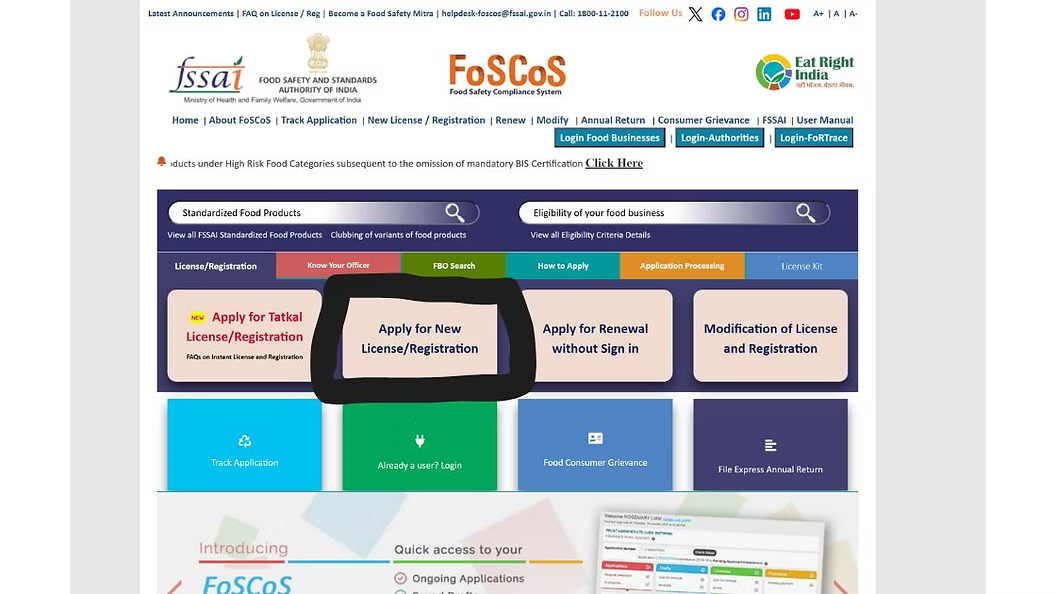
1. The applicant should visit the official FoSCoS website and then click on ‘Apply for new licence/registration’ as shown in the screenshot below:
2. The applicant should select the premise of operation, such as general, railway station, airport/seaport, or Tatkal registrations, as shown below in the screenshot.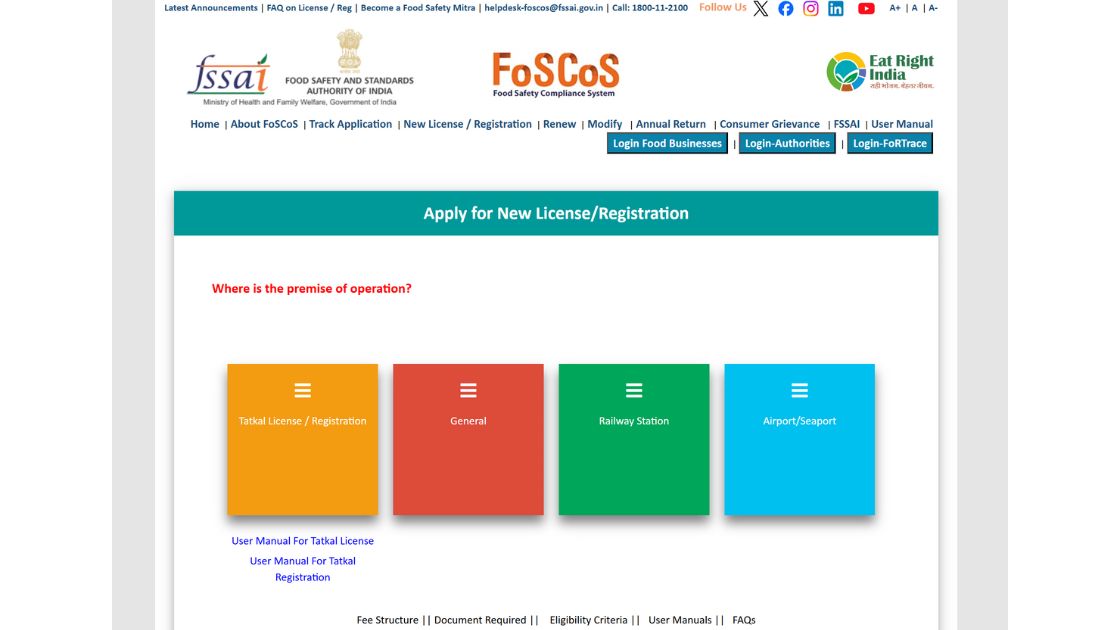
3. Then the applicant is asked to select the name of the state where the premises are located. You should select the appropriate state of the premises. 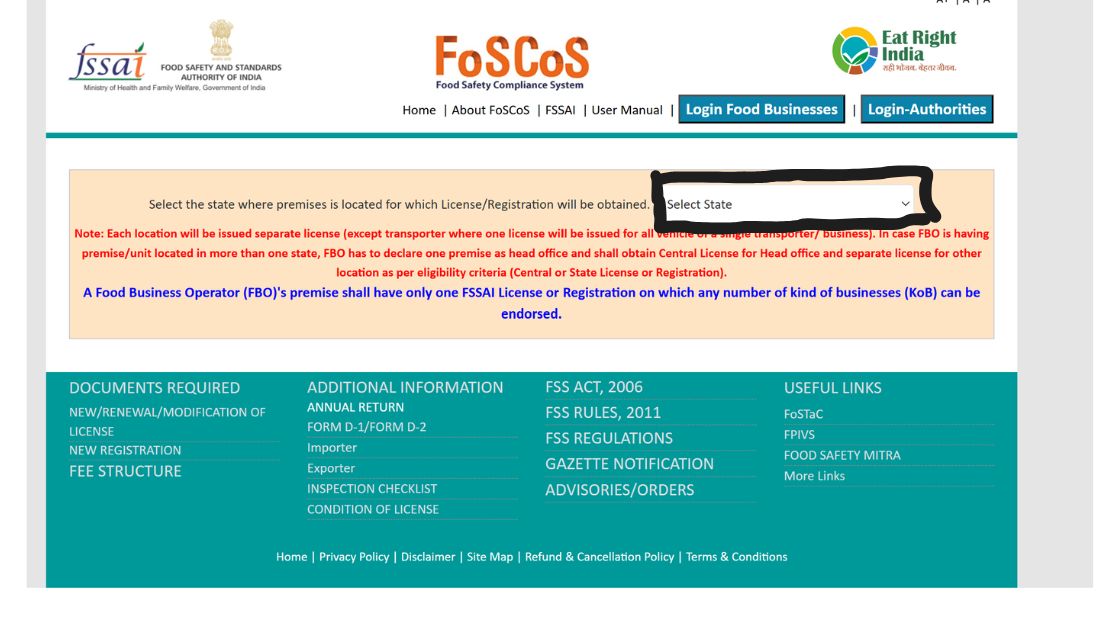 4. After selecting the state, as shown in the screenshot below, select the kind of business.

5. Select the manufacturer option, then select Food or Health Supplements, and select the type of licence, such as central, as shown in the screenshot below.
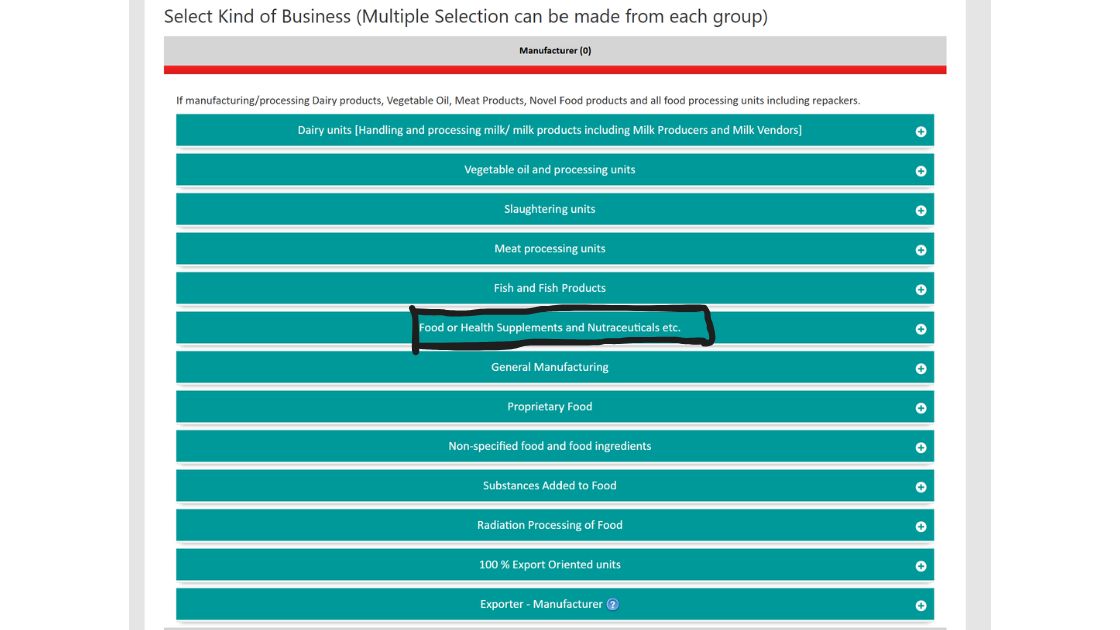
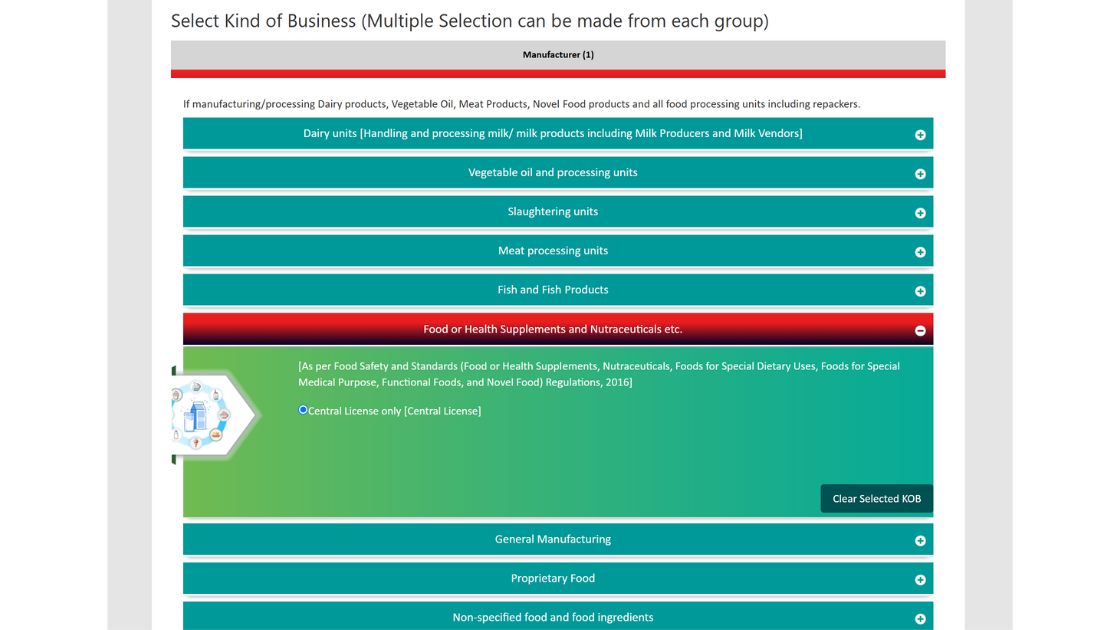
6. After proceeding, the next page will show your eligibility for a licence. Check it and click on the proceed button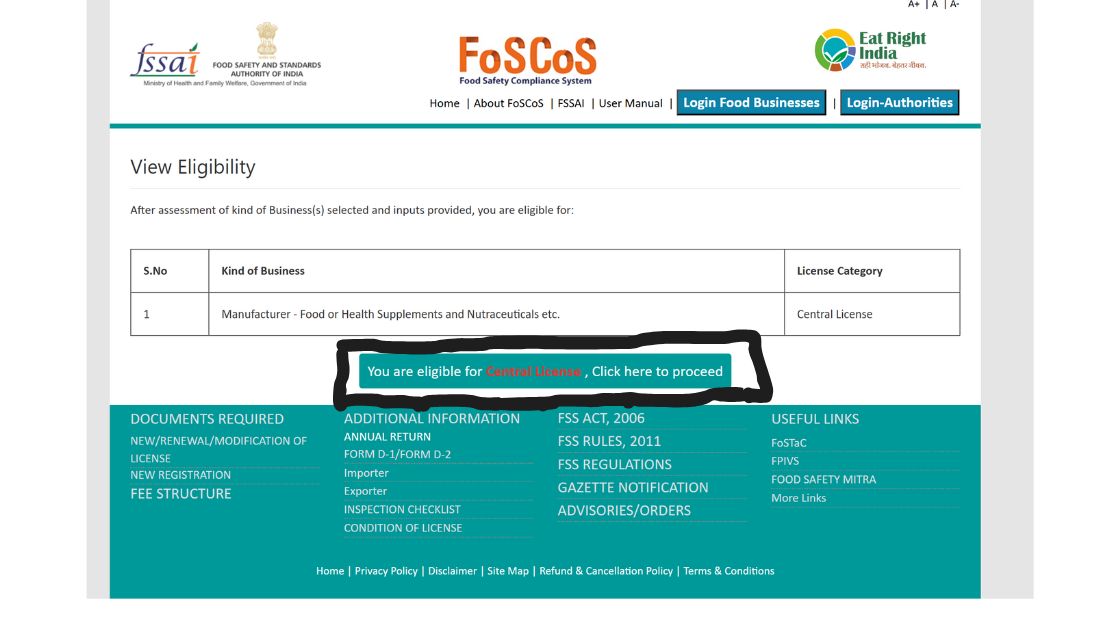
7. Then fill in all of Form B as per the details required in the parts of the form, such as premises, product selection, communication details, required documents, and payment. Then, finally, after saving all the information, submit your application.

- Product Details: Provide comprehensive details about the nutraceutical product. It covers its ingredients, formulation, intended use, and safety data.
- Label Approval: Ensure that the product label adheres to FSSAI’s Nutraceutical labelling regulations. It includes accurate nutritional information and claims.
- Manufacturing Facility Details: Provide information about the manufacturing facility, equipment, and quality control measures.
- Ingredients Source: Document the source and quality of ingredients used in the product.
- Packaging Information: Submit packaging details that live up to the FSSAI standards.
- Review and Approval: FSSAI reviews the application, assesses the product’s safety and efficacy, and grants registration if requirements are met.
- Compliance and Surveillance: After approval, maintain compliance with ongoing surveillance and audits by FSSAI to ensure product quality and safety.
Non-Specified Ingredients and Foods
Ingredients or foods that are not covered by the applicable standards may require approval under the Food Safety and Standards (Approval for Non-Specified Food and Food Ingredients) Regulations, 2017, before they can be used/marketed through the relevant food business route. The 2022 draft Nutra framework also expressly addresses non-specified foods and ingredients through this approval mechanism.
Licensing Review
The application is examined by the relevant FSSAI licensing authority against the applicable licensing and food-safety requirements. It’s not just a general “efficacy approval” of every nutraceutical product.
Documents Required for FSSAI Licensing of Nutraceuticals
For a nutraceutical/health supplement manufacturing application, FSSAI’s official guidance and document list include items mentioned below:
Application Form B
The applicant must submit the duly completed and signed Form B for the food business licence. FoSCoS identifies Form B as a document required for a new Central Licence application.
Blueprint or Layout Plan of the Manufacturing Unit
For manufacturing and processing units, the application must include a blueprint/layout plan of the processing unit, showing the dimensions in metres/square metres and the allocation of area according to operations.
List of Equipment and Machinery
Manufacturers must provide the name and list of equipment and machinery, together with the number of units, installed capacity, and horsepower used, where applicable to the manufacturing/processing unit.
Product Category and Ingredient List
The nutraceutical-specific FoSCoS guidance requires the applicant to:
- identify the relevant product category;
- provide the common/generic name for a health supplement or nutraceutical;
- provide the list of ingredients; and
- identify the requirements under the relevant Food Safety and Standards Regulations for the selected product category.
FoSCoS also directs applicants to the Food Product Identity Verification System (FPIVS) to help determine whether the ingredients and product fall within the relevant regulatory categories.
Water Analysis Report
For manufacturing and processing units, FoSCoS requires a chemical and bacteriological analysis report for water used as an ingredient in food, issued by a recognised/public-health laboratory to confirm its potability.
Details of the Food Business Operator and Constitution of the Business
Depending on the business structure, the application may require:
- list of directors/partners/proprietors or executive members, with their addresses and contact details;
- partnership deed or proprietorship declaration;
- Memorandum and Articles of Association; and
- other constitution-related documents specified by FoSCoS.
Authority Letter for the Responsible Person
For manufacturers/processors, FoSCoS requires an authority letter identifying the responsible person nominated by the manufacturer, including an alternative responsible person and the powers assigned to them for activities such as assisting during inspections, collection of samples, and packing and dispatch.
Premises and Identity Documents
The Central Licence document list includes proof relating to the premises and identity/constitution of the applicant. FoSCoS lists proof of possession of premises, such as a sale deed, rent agreement or electricity bill, and government-issued photo ID/address proof for the proprietor/partner/director/authorised signatory. FoSCoS marks some of these as optional in its current general Central Licence list.
Food Safety Management System Documents
FoSCoS lists a Food Safety Management System (FSMS) plan or certificate, if any, among the Central Licence documents.
Documents for Relabellers or Repackers, Where Applicable
If the business is operating as a relabeller, FoSCoS requires a No Objection Certificate and copy of the manufacturer’s licence. The nutraceutical-specific guidance additionally states that relabellers must ensure that their third-party manufacturers hold a valid FSSAI licence for manufacturing the same product.
Recall Plan, Where Applicable
FoSCoS lists a recall plan, including details of where the product is distributed, among the Central Licence documents where applicable.
Additional Documents Based on the Business and Application
Other documents can apply depending on the nature of the food business. For example, FoSCoS separately identifies documents relating to importers, exporters, 100% EOUs, specific food businesses and other specialised activities.
Nutraceutical Labelling Requirements in India
The label of a nutraceutical product must adhere to the Food Safety and Standards (Labelling and Display) Regulations, 2020. Plus, additional labelling provisions that apply to health supplements and nutraceuticals. The 2022 draft Nutra framework specifies additional declarations for these categories.
- The applicable category name, such as “HEALTH SUPPLEMENT” or “NUTRACEUTICAL”, in capital and bold letters in close proximity to the product name or brand name.
- Target consumer group and/or age group where the product is formulated for a specific group.
- “NOT FOR MEDICINAL USE”, unless an exemption applies to the relevant category.
- Recommended usage level.
- Duration of usage, where applicable.
- “Not to exceed the recommended daily usage.”
- Appropriate warnings concerning excess consumption.
- Precautions, known side effects, contraindications and relevant product/drug interactions, where applicable.
- A statement that the product is not to be used as a substitute for a varied diet, except for FSDU and FSMP.
- A warning that the product should be stored out of reach of children.
- Nutrient quantities expressed as a percentage of the relevant RDA, unless otherwise exempted.
- Declaration of the quantity of nutrients or substances having nutritional or physiological effects.
Nutraceutical Claims and Advertising Requirements
Claims for nutraceuticals are not supported merely because a company has scientific data. Claims must comply with the Food Safety and Standards (Advertising and Claims) Regulations, 2018, including the requirements applicable to nutrition and health claims. Claims must be truthful, unambiguous, meaningful, not misleading, and scientifically substantiated.
FSSAI’s claims framework recognises categories including:
- Nutrition claims;
- Nutrient function claims;
- Other function claims; and
- Reduction of disease risk claims.
Health claims must satisfy the conditions prescribed under the regulations, including requirements concerning the physiological role of the nutrient or substance and scientific substantiation. Where a claimed health benefit is attributed directly to the product, the regulations prescribe requirements relating to statistically significant results from well-designed human intervention studies conducted in accordance with the specified principles.
Claims that refer to the prevention, alleviation, treatment or cure of a disease, disorder or particular physiological condition are prohibited unless specifically allowed under another FSSAI regulation.
Important current update: FSSAI issued an advisory on 28 May 2025 directing FBOs to discontinue the use of “100%” on food product labels, packaging and promotional material because the term may be misleading within the current regulatory framework.
Nutraceuticals Import into India
FSSAI regulations apply to the imported nutraceutical products in India. The importer must have a valid FSSAI Import Licence and a valid Importer Exporter Code (IEC) issued by DGFT. Imported food consignments are subject to FSSAI’s Food Import Clearance System (FICS). It is integrated with Customs. Depending on the consignment and risk profile, the process can involve document scrutiny, visual inspection, sampling, and laboratory testing.
The current FSSAI food-import framework specifically identifies nutraceuticals and health supplements as high-risk food products for import purposes, with import permitted through designated points of entry under the applicable import-control system.
Nutraceutical Quality Control and Post-Market Compliance
FSSAI requirements do not end when a food business obtains its licence. Food businesses have to continue to adhere to the food-safety requirements that apply. They need to maintain the conditions of their licence and remain subject to regulatory inspection, sampling and enforcement.
FSSAI also operates food surveillance and enforcement mechanisms. It does so to identify non-compliant products and take action under the Food Safety and Standards Act and regulations.
Thus, for nutraceuticals and health supplements, businesses should maintain appropriate manufacturing, quality-control, product specifications, testing, and traceability records. They must ensure that the marketed product continues to conform to its approved/declared formulation and labelling.
Fee Structure for Nutraceutical Licensing in India
The current FoSCoS eligibility information lists ₹7,500 for the Central Licence for the Kind of Business covering Food or Health Supplements and Nutraceuticals. The actual fee payable should be checked against the current FoSCoS application/fee schedule.
Conclusion
If there’s one thing the last few years have shown, it’s that people in India are more open to supplements than ever before. With that demand comes a responsibility to follow the rules that protect consumers. FSSAI’s framework may feel layered, but it’s there for a reason. Companies that spend a little extra time making sure their formulations, claims, and paperwork line up with the regulations generally move forward without major roadblocks. In a market that’s becoming crowded, doing things the right way has become a competitive advantage by itself.
For brands looking for end-to-end support with nutrition and supplement compliance in India, contact us at info@artixio.com.
FAQs
Can the nutraceuticals be sold through online mode in India?
Yes, a nutraceutical that complies with all the standards set by FSSAI can be sold through online mode in India.
Does FSSAI non-compliance cause any penalties?
If there’s no compliance with the Food Safety and Standards Act and regulations, it can result in regulatory enforcement action. The nature of the action is based on the specific contravention and applicable legal provisions.
What are the licences required for nutraceutical registration in India?
For the Kind of Business covering Food or Health Supplements and Nutraceuticals, FoSCoS currently lists a Central Licence, with no turnover restriction for that Kind of Business. The applicable licence should be selected according to the actual business activity and premises.
Can nutraceuticals in India make health claims?
Yes, a nutraceutical can make health claims if it has scientific data to prove it.
Do nutraceuticals require clinical trials to be conducted?
No, it is not mandatory for nutraceuticals to undergo clinical trials. However, if the nutraceutical makes any health claims, the FSSAI requires clinical data to prove it.