
Global Patent & Exclusivity Intelligence for Market Entry Strategy
QuriousRI’s Patent& Exclusivity Tracking module provides a centralized, continuous intelligence for tracking patent and regulatory exclusivity timelines across global markets.
Using active ingredients, molecules, product or company names across select target markets, the platform maps relevant patent protections, SPCs, and exclusivity periods per country. The platform provides precise market entry planning leveraging multi-country registried in single window integrated with other regulatory modules for integrated regulatory strategy development.
Key Features of QuriousRI Patent & Exclusivity Tracking
1. Multi-Country Patent & Exclusivity Database:
- Tracks patents granted, patent term extensions, and SPCs across major markets.
- Regulatory exclusivity types (data exclusivity, market exclusivity, orphan drug exclusivity, and pediatric extensions) tracked separately.
- Country-specific patent linkage status (Orange Book listing, EU transparency list, equivalents).
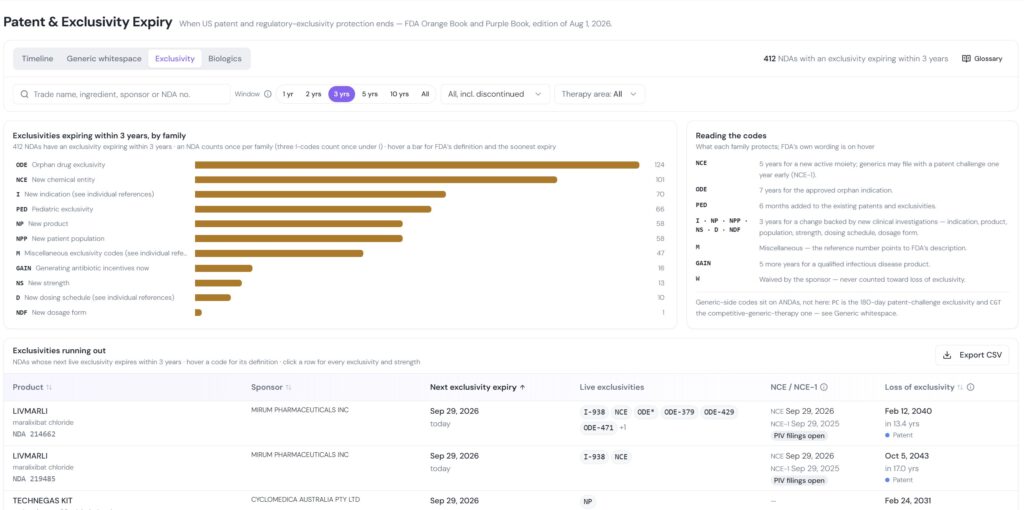
2. Patent Cliff Timeline View
- Visual timeline of the patent and exclusivity expiry dates for each product, per market. Analyze dosage form, strength, route of administration, and indications.
- View all upcoming market entry windows across your pipeline simultaneously with a portfolio-level cliff map.
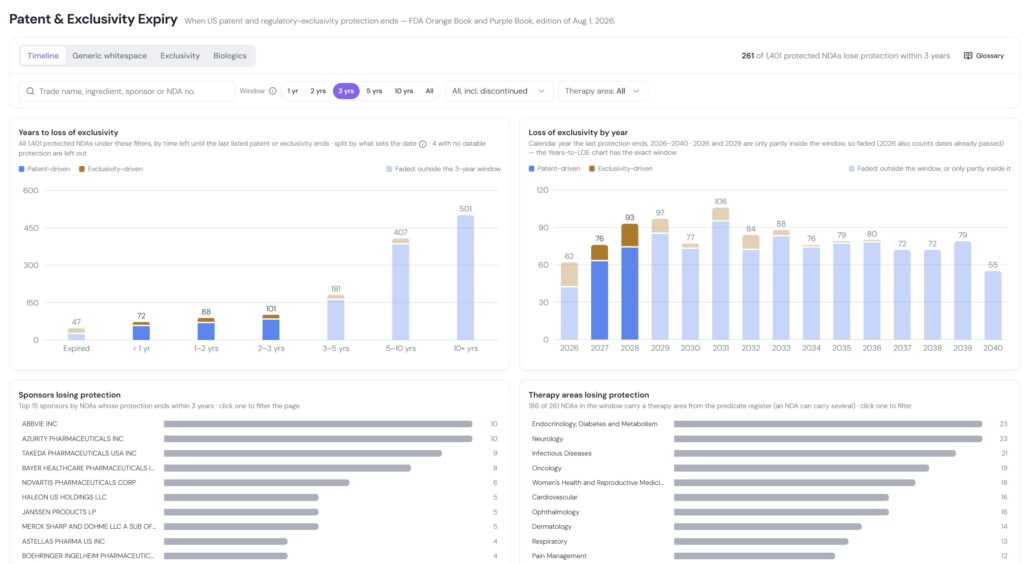
3. SPC & Patent Extension Tracking
- Evaluate SPC grant status and expiry per EU member state and UK along with duration calculation. Pediatric extensions (6-month additions) are flagged wherever applicable.
- Patent term restoration tracking (US) and equivalent mechanisms in other markets.
4. Patent Linkage & Challenge Intelligence
- Includes country-specific patent linkage rules for identifcation of markets with automatic stay provisions vs. those without.
- Tracking Para IV certifications (US) and equivalent challenge mechanisms in other markets.
- Checking active litigation or patent challenges on reference products.
5. Alert & Deadline Engine
- Provides alerts for expiries within timeframes (6, 12, 24 months or custom) along with submission timing guidance (based on expiry date + market-specific regulatory approval timelines).
- Notifications for new patent listings, SPC grants, or challenge outcomes.
6. Competitive Landscape Overlay
- Identifies other generic/biosimilar applicants targeting the same expiry window.
- Tracks originator lifecycle management activity (new formulations, new indications, new patents filed post-expiry of base compound).
- US 180-day first-filer exclusivity status tracking.
Key Benefits of Patent & Exclusivity Tracking
- Precise Market Entry Timing: Assess patent and exclusivity protection lapses per market / per strength.
- Risk Mitigation: Validate patent status before submission/launch to avoid infringement.
- Portfolio-Wide Visibility: View and manage a full pipeline across global markets from one dashboard. Prioritize markets/resources based on the assets that are approaching entry windows simultaneously
- Opportunity Identification: Patent cliff alerts delivered before expiry, giving regulatory and business development teams lead time to act ahead of competitors.
- Optimized Filing Timelines: Combine expiry dates + country-specific approval lead times to calculate the right dossier submission date for each market.
- Audit-Ready Records: All data sourced and cited from primary registers, offers full traceability.
Advantages of QuriousRI Patent & Exclusivity Tracking
- Single Platform for Generic Regulatory Strategy Using Patent Data: Eliminates the need to manually check Orange Book, EP Register, national SPC databases, and IP offices country by country for every product.
- Integrated Patent & Exclusivity Assessment: QuriousRI tracks both in the same view determining actual market entry eligibility.
- Live Process: Real-time updates when patents are listed, SPCs granted, or challenges filed.
- Cross-module integration: Patent decisions feed directly into RLD identification and Gap Assessment (market entry eligibility and dossier readiness are assessed together).
- Cross-Market Nuances: Patent linkage rules, automatic stay provisions, SPC eligibility criteria, and data exclusivity periods differ significantly by country; QuriousRI encodes them per market.
Conclusion
Patent and regulatory exclusivity tracking helps pharmaceutical companies identify potential market-entry opportunities, assess risks and plan regulatory submissions more effectively. QuriousRI brings patent and exclusivity information together to support informed decisions across products and target markets.
Explore Artixio’s QuriousRI platform to learn how its regulatory intelligence capabilities can support pharmaceutical market-entry and portfolio planning.
FAQs
1. What exactly does Patent Expiry Tracking do?
Patent Expiry Tracking helps you check when a patent and regulatory exclusivity protection lapses for a product in each target market (based on evidence). All you need to do is select a molecule and markets, and the platform maps all applicable patents, SPCs, and exclusivity periods to show exactly when the market is open for entry (this data is sourced directly from national patent offices and health agencies).
2. Can I track patent status for my entire product portfolio at once, or only one product at a time?
Both. You can look up a single molecule and market or add your full portfolio to see a consolidated view of upcoming patent cliffs and market entry windows across every product and market simultaneously.
3. Does the tool account for patent challenges or litigation that could change the expiry date?
Yes. If a patent is under active challenge or litigation, the platform flags this status alongside the base expiry date.
4. Is this only useful for generic/biosimilar companies, or does it help originator companies too?
Both. Generic and biosimilar companies can use it to plan market entry timing, while originator companies can use it to track their own patent and exclusivity coverage across markets and monitor competitor filing activity which are approaching the same expiry windows.