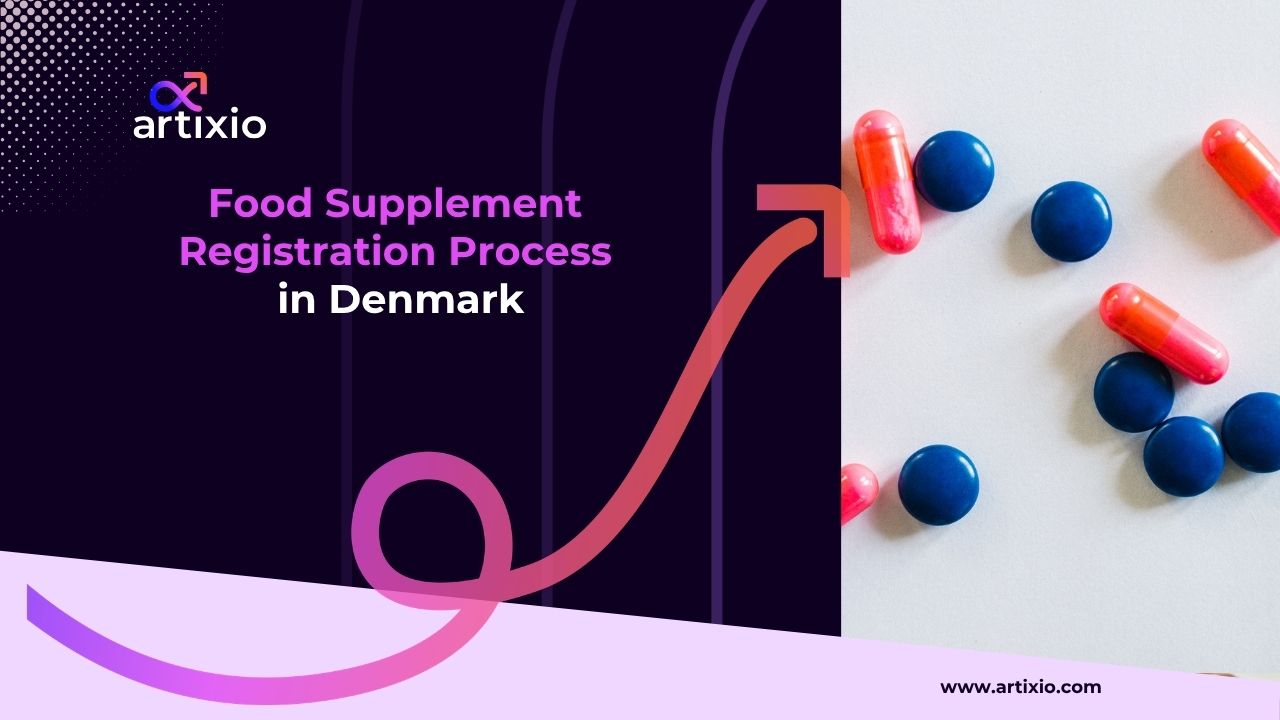
Denmark has its food supplements notified to the Danish Veterinary and Food Administration (DVFA) prior to or at the same time as they are placed on the market. Before commercialisation, companies have to make sure to meet the Danish and EU requirements for composition, labelling, and health claims. This guide provides an overview of the registration procedure and some of the important regulatory aspects for marketing these supplements in Denmark.
Regulatory Authority for Food Supplements in Denmark
In Denmark, food supplements are regulated by the Danish Veterinary and Food Administration (DVFA). They are responsible for food safety across the food chain. They look after the registration of the product, food safety controls, and product-safety inspections. The enforcement of food labelling requirements and overseeing food businesses and relevant food activities are all their responsibilities.
Food supplements are also subject to EU rules, particularly Directive 2002/46/EC and Regulation (EU) No. 1169/2011 on food information to consumers. Nutrition and health claims are governed by Regulation (EC) No. 1924/2006.
What Are Food Supplements Under Danish Regulations?
Called ‘kosttilskud’ in Danish, food supplements are foods intended to supplement the normal diet. They are concentrated sources of nutrients or of other substances. Having nutritional and/or physiological effects, they marketed in a dose form to be consumed in small quantities.
They include vitamins and minerals, plant or animal ingredients, concentrated substances like fish oils, and other materials having a nutritional or physiological effect. They come in measured-dose forms. Capsules, tablets, pills, powders, ampoules, drop-dispensing bottles, pastilles, etc., are a few.
Food Supplements Registration Process in Denmark
All food supplements that want to be marketed in Denmark must register their products. The registration should be made no later than the first day of marketing. This process applies to dietary supplements marketed through conventional retail channels as well as online.
| Who Needs to Register? | When to Register? |
|
|
Important: In case a distributor/ EU-importer is already selling a particular supplement (parallel import), companies need not register it again. Several companies can register the same food supplement in some cases.
If a company doesn’t want to sell/market a particular product, they need to unregister their product. Once this process is done, the unregistered supplement cannot be sold in the country.
Let’s look into the food supplement registration process in detail here:
Step 1: Register your Food Business as a Responsible Entity
The DVFA states that all food-business operators, including importers bringing food into Denmark from other EU Member States or third countries, must be registered or approved by the Danish Veterinary and Food Administration depending on the activity. An automatically generated response is issued after the registration information is submitted, and the business can begin its activity.
Step 2: Confirm the Product Is a Food Supplement
Before product registration, companies need to assess its composition, dosage form, use case, recommended daily dose, nutrients and other substances, claims, and presentations.
Products marketed with disease-prevention or disease-treatment claims may fall under the medicinal-products framework and not ordinary food-supplement rules. The DVFA wants businesses to know that the Danish Medicines Agency clarifies the distinction between food supplements and medicines
Step 3: Make Sure the Formula is Compliant
The product’s formulation should match the EU and Danish requirements. Denmark follows the EU framework for permitted vitamin and mineral sources. The current Danish Food Supplement Order provides that the applicable vitamins, minerals, and forms must comply with the relevant EU rules.
However, Denmark also provides national guidance values for the maximum levels of vitamins and minerals in food supplements. The DVFA states that companies can follow its guidance values, which are based on a scientific safety assessment.
If a company chooses to exceed those values, it is responsible for documenting the safety of the product. The DVFA notes that EFSA tolerable upper intake levels (ULs) and, where relevant, DTU Food temporary guidance levels can be used in the company’s risk assessment.
Important: These levels are not mandatory but a safety benchmark for companies to follow.
Step 4: Check for Other Substances in Food Supplements
EU law does not harmonise all substances other than vitamins and minerals in food supplements. Denmark therefore maintains national rules governing the addition of certain other substances with nutritional or physiological effects. The regulation establishes general permissions for certain substances and circumstances in which an application for approval is required.
If the substance and amount fall within an applicable general permission, a separate approval application may not be necessary. Where the intended addition is outside the general permissions, the company may need to submit an application to the DVFA for approval under the applicable provisions.
Step 5: Review Plant Ingredients, Botanical Substances, & Novel Foods
The DVFA provides guidance concerning the safety assessment of plant ingredients and plant extracts used in food supplements. This means a plant or botanical ingredient should not automatically be described as either “approved” or “prohibited” simply because it does not appear on a fixed list. The business needs to assess its safety and the applicable Danish and EU framework.
The DVFA’s food-supplement marketing guidance specifically tells businesses to check whether a supplement contains ingredients that qualify as novel foods. This assessment may be necessary for new botanical extracts, novel sources of nutrients, new microorganisms, unusual bioactive ingredients, and ingredients without the required history of consumption in the EU.
Novel-food status should be assessed ingredient by ingredient. There shouldn’t be any assumption that every plant extract or innovative ingredient is novel food.
Step 6: Danish Labelling Requirements for Food Supplements
Food supplements must comply with the general EU food-information rules and Danish supplement-specific requirements. These include the following:
- The designation “Kosttilskud” — Food Supplement
- The vitamins, minerals and/or other relevant substances contained in the product
- The amount of those substances
- The Danish and Latin names of plant ingredients where applicable
- Recommended daily dose
- A warning not to exceed the recommended daily dose
- A statement that the supplement should not replace a varied diet
- A warning to keep it out of the reach of young children
- The amount of nutrients/substances with nutritional or physiological effects
- The quantity expressed in relation to the recommended daily dose
- Vitamin and mineral quantities as a percentage of the EU reference values where applicable.
Other general labelling rules involve easy, legible writing in Danish, Swedish, or Norwegian languages. The information should include the company name, product name, a clear list of all food ingredients and additives, etc.
If a product has caffeine, it should explicitly say, “Contains Caffeine. Should not be consumed by children or pregnant women.” It should also have the caffeine percentage in brackets alongside this statement.
Step 7: Prepare the Registration Information
The responsible company has to provide the company name and address, food supplement name, product form, recommended daily dose, ingredient list, and product declaration to authorities.
Step 8: Submit the Food Supplement Notification Form
The Danish Food Authority requires food supplements to be notified through its digital self-service solution, unless the company qualifies for one of the limited exemptions. The official Danish service requires the responsible user to authenticate with MitID.
The digital process provides a specific form for new food supplement registration, changes to the composition of an already registered supplement, and deregistration when marketing permanently ends.
For a new product, the applicant completes the digital registration form with the company and product information described above. Ensure the notification is submitted no later than the first day of marketing.
Step 9: Receive the Notification Confirmation
After the notification is submitted, the DVFA sends a confirmation to the company’s e-Boks. For an applicant without a CVR number, confirmation is sent by email. The confirmation contains the product’s notification number. The notification number is an administrative reference. It is not a product approval.
The Danish authority expressly states that registration is used to facilitate control of food supplements and does not mean that the authority has approved the safety or legality of the product. The responsibility for ensuring that the product is safe and correctly labelled remains with the company.
Step 10: Address any Separate Notification Requirements & Post-Market Compliance
The DVFA can prohibit marketing where its assessment determines that the addition poses a risk to human health. So, a company should complete the ingredient/regulatory assessment before notification, rather than assuming that the product notification itself resolves every ingredient question.
After registration and marketing, consider composition changes, change of responsible company, and permanent discontinuation.
Documents Required for Food Supplements Registration in Denmark
For registration, information such as the responsible company information, product name, ingredient information, product declaration, relevant nutritional/physiological substances, and product labelling is required.
Notification documentation for certain other substances added to foods is a bit different and includes the following:
- Applicant name and address
- Product name
- Product category
- Name of the substance
- Added quantity
- Ingredient list
- Product declaration for food supplements
- Information on total amounts of relevant substances.
Food Supplement Registration Timelines in Denmark
Denmark does not have a statutory approval period – food supplements are notified.
- Send notification prior to or on the first day of marketing.
- After notification, products can be marketed straight away.
- A new notification is required for reformulated products.
Food Supplement Registration Costs in Denmark
Denmark does not charge a fee to notify of a food supplement.
The annual product safety inspection fees are paid by companies with a turnover of above DKK 50,000 per year and one or more registered food supplements:
- DKK 2,736 annual company fee (2026)
- DKK 219 per registered food supplement (2026)
Compliance Checklist for Food Supplements in Denmark
Verify that, prior to notifying a food supplement:
- The product is properly labelled as a food supplement.
- Ingredients are in accordance with the relevant Danish and EU legislation.
- Where required, safety documentation is available.
- The label meets the Danish and EU labelling laws.
- Nutrition and Food claims are in accordance with Regulation (EC) No 1924/2006.
- Technical documentation can be provided to prove compliance.
GMP Requirements & Own Checks for Food Supplements in Denmark
The DVFA requires food businesses to maintain an own-check programme — a documented system showing how the business ensures compliance with food legislation on a continuing basis.
The own-check programme can cover food safety, cleaning, equipment, premises, production controls, and other operational controls.
Food Claims and Advertising Regulations in Denmark
The claims in the range of products should be in line with Regulation (EC) No 1924/2006.
- Authentic nutrition and health claims are only allowed.
- Disease prevention, treatment, or cure claims are not allowed.
- The claims on the label and on marketing materials shall not mislead consumers.
It applies to claims appearing on packaging, websites, e-commerce pages, advertising, social media, and other promotional material.
Dietary Supplement Marketing Process in Denmark
The rules applicable to the labelling and marketing of dietary supplements in Denmark include the following:
1. Review the Product
Notify DVFA about your product at or before the first day of marketing.
2. Assess their Safety
It’s the company’s responsibility to assume safety of their products according to regulations. Safety assessment guidance by the authorities should be checked in advance.
3. Pay Product Inspection Fees
Companies notifying one or more supplements with an annual turnover of over DKK 50,000 must pay an annual amount to finance better control of dietary supplements.
4. Follow the Labelling Rules
Make sure generic and specific labelling rules for food supplements are followed.
5. Follow Special Rules When Marketing on the Internet
Special rules apply for marketing on the internet. They are given in the Danish E-commerce Act.
Import Regulations for Food Supplements in Denmark
Importers are required to make sure that:
- Products meet the food legislation in Denmark and the EU.
- The importer is registered/approved as a food business operator.
- Products from outside the EU meet the EU import requirements.
Conclusion
The companies in Denmark are responsible for making sure the food supplements comply with the Danish and EU legislation before they go to market. To get products onto the market, it is important to classify them appropriately, label them in line with the regulations, and ensure that the product is fully notified.
Artixio provides assistance to manufacturers with product classification, food supplement regulatory strategy, product notification, labelling review, and continued compliance to aid in expediting the launch of Food supplements in Denmark and throughout the EU. Get in touch with us today at info@artixio.com.
FAQs
Do food supplements require approval in Denmark?
No. Food supplements are subject to a notification requirement rather than pre-market approval.
Who may notify a food supplement in Denmark?
Notification can only be made by companies that are established in the EU or EEA.
Can food supplements contain botanical ingredients?
Yes, but the company remains responsible for demonstrating that the product does not pose a health risk. Denmark does not maintain a national legislative list of all forbidden or restricted plant ingredients in food supplements.
How long does the Food Supplement Registration Process in Denmark take?
The statutory review period is not applicable. Products can be sold as soon as they are notified.
Is Danish labelling mandatory for food supplements?
Yes. The mandatory information on the label should be in Danish or another accepted language.