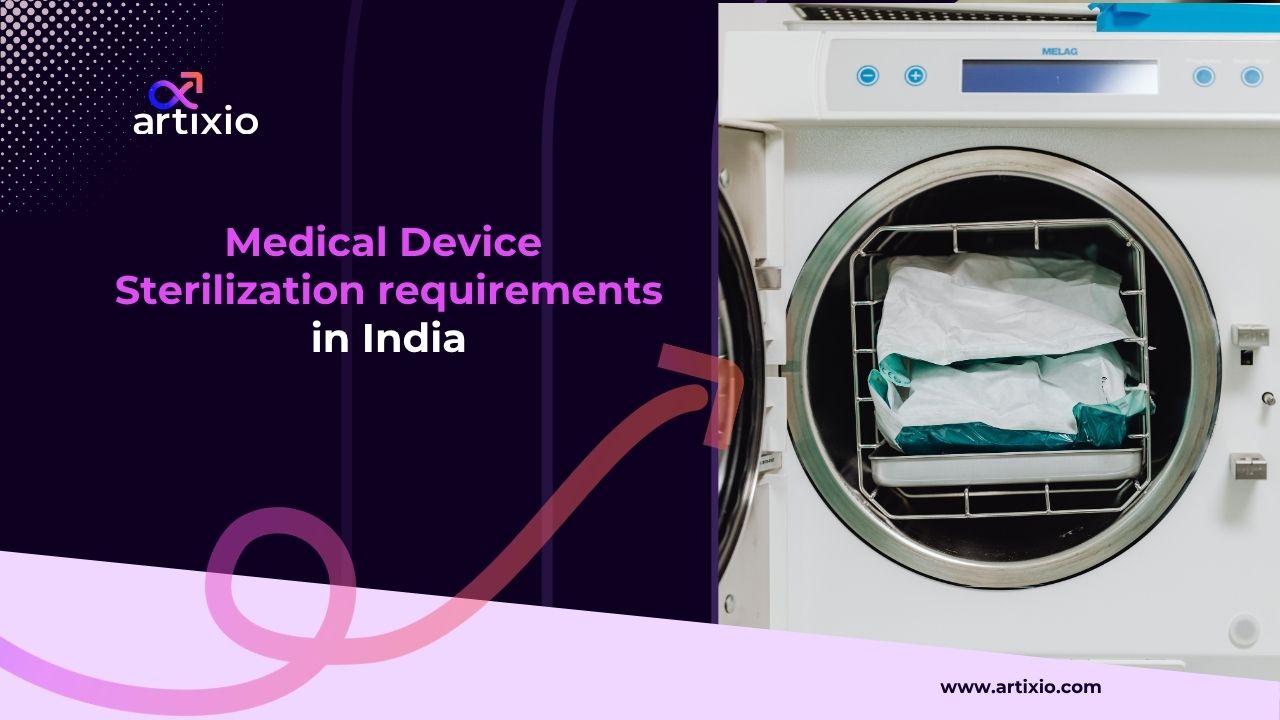
Three obligations are taken on by a manufacturer that supplies a sterile device in India. The process has to be validated. The packaging must hold sterility. And the label states two things, the sterile condition and the sterilization method.
Sterilization is never just a cycle. Validation, sterile barrier packaging, labelling, manufacturing controls and licensing all count. Outsourcing at another facility adds a further layer for many. A gap in any one of them weakens the rest.
The sections below cover sterilization requirements, validation, packaging, labelling, licensing, documentation and standards.
Medical Device Sterilization Requirements in India
A device supplied sterile must be shown to be sterile. The device must have been produced and sterilized by an appropriate validated method, and that must be demonstrated by the manufacturer. Packing matters as well. The device is to be packed so that sterility is maintained until the protective packaging is opened or damaged.
There is no single sterilization method or cycle for every device. Therefore, the applicable requirement should be confirmed based on the device, sterilization method and manufacturing arrangement.
Sterile vs. Non-Sterile Medical Devices
| Aspect | Supplied sterile | Supplied non-sterile, sterilized before use |
| Basis | The manufacturer intends to supply it in a sterile state |
The manufacturer intends it to be sterilized before use
|
| Label | Sterile state and sterilization method | Non-sterile state |
| Pack | Keeps the device sterile until opened or damaged |
Minimizes microbial contamination and suits the indicated method
|
| Instructions for use | Not specified | Must name the sterilization method |
| Expiry or shelf life | As required | May not be necessary on the label |
The distinction changes the label, instructions for use, regulatory documentation, packaging and validation work.
Applicable Regulations and Guidance
Drugs and Cosmetics Act, 1940 and MDR 2017 are the legal basis. Rule 44 covers labelling and the Fifth Schedule covers the quality management system.
CDSCO guidance includes its FAQ addenda and its letter on outsourced sterilization.
Standards follow Rule 7: BIS standards first. Where there is none, ISO, IEC or pharmacopoeial standards apply. Otherwise a validated manufacturer’s standard applies.
Medical Device Sterilization Validation in India
The key requirements for sterilization validation and process control are straightforward. Before initial use, the sterilization process has to be validated. Records of that validation are to be kept. And for each sterilization batch, process records must trace to the production batch.
Sterilization Process Validation
The manufacturer must have documented procedures for validating sterilization processes. Validation must happen before initial use, and records must be kept. Process parameters must be recorded for each sterilization batch and traceable to each production batch.
Each method has its standard. Ethylene oxide is covered by IS/ISO 11135. Gamma is covered by IS/ISO 11137-1. Steam is covered by IS 17812 (Part 1)/ISO 17665. Parametric release is permitted under these standards as part of routine control. But conditions apply. The process must be validated to the standard. Revalidation plans and records have to exist.
Method selection, critical parameters, routine monitoring and revalidation triggers come from the relevant standard and the device. There are no universal parameters or acceptance criteria.
Microbiological and Sterility Controls
The applicable controls depend on the sterilization method and the device. No single microbiological test is prescribed for all sterilized devices. Testing requirements are set by the method in use and by the validated process behind it.
Key controls include:
- Assessing bioburden and establishing sterility assurance.
- Performing sterility testing where applicable.
- Applying appropriate microbiological controls and assessing sterilant residues for relevant sterilization methods.
- Following the requirements of the applicable standard for the selected sterilization method. Sterility testing alone does not validate the sterilization process.
Packaging and Sterile Barrier Integrity
Packaging must keep the device sterile until the protective packaging is opened or damaged. The packaging controls should therefore address the following:
- Maintaining the integrity of the sterile barrier system, package and seals, supported by appropriate packaging validation.
- Specifying any special storage or handling conditions on the label, wherever required.
- Establishing shelf life based on technical parameters, with the shelf life ordinarily not exceeding 60 months from the date of manufacture. A longer period requires satisfactory supporting evidence.
Packaging validation alone doesn’t demonstrate sterility.
Medical Device Labelling Requirements for Sterile Devices
A sterile device label must indicate its sterile state and the sterilization method. Rule 44 particulars are printed in indelible ink on the label, shelf pack or outer cover and on every outer covering. BIS or ISO symbols may replace text if device safety isn’t compromised.
What Must Be Included on the Label?
| Label item | Applicability |
| Name of the device | As required |
| Details to identify the device and its use | As required |
| Manufacturer name and address of manufacturing premises | As required |
| Month and year of manufacture and expiry, or shelf life |
As required. For sterile devices, the date of sterilization may be given as the date of manufacture
|
| Lot or batch number with the prescribed words (“Lot No.”, “Lot”, “Batch No.” or “B. No.”) | As required |
| Special storage or handling conditions | Wherever required |
| Sterile state and sterilization method | If supplied as a sterile product |
| Warnings or precautions | If considered relevant |
| Manufacturing licence number | Except imported devices |
| Sterilization site licence number | If sterilization is outsourced |
Labelling of Non-Sterile Devices Intended for Sterilization
The label must state the device is non-sterile, and the instructions for use must name the sterilization method. The other sterile-label items don’t apply.
2026 Regulatory Update: New Labelling Requirement for Outsourced Sterilization
If a manufacturer outsources sterilization to the site of another facility holding a valid licence to sterilize medical devices, that site’s licence number should be on the device label. This is Rule 44(p), inserted by G.S.R. 743(E).
What Has Changed Under G.S.R. 743(E)?
| Item | Detail |
| Notification |
G.S.R. 743(E), Medical Devices (Second Amendment) Rules, 2026, dated 14 August 2026
|
| Published |
Gazette of India, Extraordinary, Part II, Section 3(i), No. 677, 19 August 2026
|
| Amends | MDR 2017, Rule 44: new clause (p); clause (o) amended |
| Applies to |
A manufacturer that outsourced sterilization to the site of another licensed facility
|
| Label content | The sterilization site’s licence number, with a prescribed prefix |
| Compliance mandatory | Six months from the date of the notification |
The notification also amends clause (o), the clause for small-sized devices. Small devices now carry clause (p) information alongside the other listed clauses.
What Wording Must Appear on the Label Under Rule 44(p)?
The sterilization site licence number is preceded by one of three designations.
- “Sterilization sites Manufacturing License Number”
- “Ster. Mfg. Lic. No.”
- “S.M. L.”
When Does the Requirement Apply?
The notification is dated 14 August 2026, and compliance with clause (p) is mandatory six months from that date. The notification has no other transitional provision. Plan for three things: existing artwork, printed packaging inventory and regulatory documents that reference labels.
Who Needs to Act?
- Manufacturers outsourcing sterilization carry the labelling duty.
- Contract sterilization facilities should confirm their licence details are correct and shareable.
- Regulatory affairs, quality assurance, packaging/artwork and supply-chain teams each own a piece. If production moves between sterilization sites, the label must match the site actually used.
- Importers and foreign manufacturers: clause (p) as printed does not exclude imported devices.
What Manufacturers Should Do Now
These are practical recommendations:
- Identify outsourced sterilization activities.
- Verify each sterilization site’s licence.
- Identify affected products and SKUs.
- Update labelling and packaging artwork.
- Run the change through document and change-control procedures.
Licensing Requirements for Medical Device Sterilization in India
The MDR 2017 manufacturing licence remains applicable. Outsourcing does not replace the manufacturing licence, and a separate loan licence may not be insisted upon where the sterilization facility is licensed, as stated by CDSCO in its letter dated 24 June 2025.
Medical Device Manufacturing Licence
The manufacturing licence continues to cover the device and its manufacture. Rule 44(m) already requires the manufacturing licence number on the label, except for imported devices.
Changing the sterilization method (for example, gamma to ethylene oxide) is treated as a separate device, so the manufacturer needs an endorsement to its licence.
Outsourced Sterilization Facility
Outsourced sterilization has its own rules. They come from CDSCO Letter No. MED/48/2025-eoffice, dated 24 June 2025. The letter is issued by the Drugs Controller General of India to the State and UT Drugs Controllers, and it sets out the following requirements:
- Third-party arrangement: Outsourcing is permitted. A mutual third-party agreement is the route. One condition applies. The sterilization facility must hold a valid licence to carry out sterilization under the Medical Devices Rules, 2017.
- Device-specific licensing: The facility’s licence has to fit the device. It should cover sterilization of the specific medical device for which the manufacturer holds the manufacturing licence.
- Documentation before licensing: Documentary evidence of the outsourced arrangement should be submitted to the Licensing Authority before the manufacturing licence is granted. This may include the agreement between the manufacturer and the sterilization facility and relevant quality management system documents, including the Plant Master File and Device Master File, describing the outsourced activity.
- Labelling requirement: Following the 92nd meeting of the Drugs Technical Advisory Board held on 24 April 2025, the sterilization facility’s licence number is required to be mentioned on the device label. This requirement is reflected in Rule 44(p) of the MDR 2017.
The manufacturer remains responsible for ensuring compliance with the applicable labelling requirements. Outsourcing the sterilization activity does not, by itself, transfer the manufacturer’s regulatory responsibilities to the sterilization facility.
In-House vs. Outsourced Sterilization
In-house: The manufacturer controls the process directly, with internal validation and monitoring. Rule 44(p) doesn’t apply here.
Outsourced: An external licensed facility sterilizes. The manufacturer needs supplier and contract controls and provides documentary evidence to the Licensing Authority at the manufacturing-licence stage. Rule 44(p) adds the site licence-number labelling.
Too often, the sterilizer is seen as just another vendor. In practice, that is where problems begin. The sterilizer is a regulated part of the manufacturing process. The quality agreement, validation records, supplier controls, licence verification and labelling should all stay aligned.
Key Documentation for Sterilization Compliance
For each sterilization batch, process-parameter records are to be maintained by the manufacturer, along with the validation records. That much is constant. Where sterilization is outsourced, CDSCO points to two sources of documentary evidence. One is the manufacturer–site agreement. The other is the relevant QMS documents.
Everything else depends. The device, the sterilization method, the manufacturing arrangement, any outsourcing, each shapes what is needed. Not every item below is universally mandatory.
- Sterilization validation/qualification records
- Sterilization cycle/process records
- Bioburden and sterility-related records
- Packaging validation records
- Sterilization facility licence, where outsourced
- Mutual agreement with the sterilization site and QMS documents describing the outsourced activity
- Label and artwork approval records
- Change-control records
- Revalidation records, where applicable
Standards for Medical Device Sterilization in India
Sterilization validation is tied to standards. CDSCO points to BIS and ISO standards for it. Which ones apply depends on the method and the device. An order of preference is set by Rule 7. Bureau of Indian Standards (BIS) standards come first. Then come ISO, IEC or pharmacopoeial standards. Last, a validated manufacturer standard is accepted.
- IS/ISO 11135: Ethylene oxide sterilization.
- IS/ISO 11137-1: Radiation (gamma) sterilization.
- IS 17812 (Part 1)/ISO 17665: Moist heat/steam sterilization.
Three more ISO standards come up often. ISO 11607 deals with packaging and sterile barrier systems. ISO 11737 covers microbiological methods. ISO 14971 addresses risk management. Whether each applies depends on the device and applicable requirements. Relevance alone doesn’t make a standard mandatory.
Conclusion
Sterilization compliance fails at the weakest point. A validated cycle won’t rescue a pack that doesn’t hold sterility, and a correct label won’t rescue a process that was never validated. That is why medical device sterilization in India has to be managed as one system.
Outsourced sterilization has a new checkpoint. It was added by G.S.R. 743(E). The sterilization site’s licence number must go on the label. Compliance becomes mandatory six months from the 14 August 2026 notification. Before that date, labels, artwork, supplier documentation and quality controls should be reviewed by manufacturers.
For support with medical device sterilization, licensing, labelling and other CDSCO requirements in India, explore Artixio’s medical device regulatory services in India.
FAQs
Q1. Is sterilization mandatory for all medical devices in India?
No. It depends on whether the device is intended to be supplied sterile. A device supplied non-sterile may be meant for sterilization before use, with the method stated in the instructions.
Q2. What must be mentioned on the label of a sterile medical device?
The label must indicate the sterile state and the sterilization method under Rule 44(i). The other Rule 44 particulars apply as listed in the clauses.
Q3. Can medical device sterilization be outsourced in India?
Yes, to a facility holding a valid licence to sterilize medical devices. CDSCO’s 24 June 2025 letter allows it under a mutual agreement, and Rule 44(p) requires the site’s licence number on the label.
Q4. What is the new Rule 44(p) requirement?
Where a manufacturer outsources sterilization to another licensed facility, the sterilization site’s licence number should be on the device label. G.S.R. 743(E), dated 14 August 2026, inserted it.
Q5. What is the sterilization-site licence number requirement?
It applies when sterilization is outsourced. The label carries the site’s licence number after “Sterilization sites Manufacturing License Number”, “Ster. Mfg. Lic. No.” or “S.M. L.”.
Q6. When does the new sterilization labelling requirement become mandatory?
Six months from the date of the notification. The notification is dated 14 August 2026, so the date works out to 14 February 2027. The Gazette states the period, not the date.
Q7. Which standards are commonly used for medical device sterilization?
CDSCO names IS/ISO 11135, IS/ISO 11137-1 and IS 17812 (Part 1)/ISO 17665 for ethylene oxide, gamma and steam. Applicability depends on the method and device.