
Regulations vary from country to country around the world. A failure to receive an update may result in delays in approvals or compliance risks. Regulatory Intelligence Tools can assist teams to keep track of changes and to make quicker and better decisions. This guide outlines what they offer, their characteristics, and what to select.
What Are Regulatory Intelligence Tools?
Regulatory Intelligence Tools enable companies to monitor and interpret changes to regulations in worldwide markets. They receive information from the relevant authorities and other credible sources. They also provide teams with an understanding of the impact those changes will have on products, submissions, and compliance activities.
They are tools to organise regulatory information together, unlike manual monitoring. They save time looking up a lot of authority websites. Many platforms also focus on types of products, markets, or regulatory effects.
AI-powered modern Regulatory Intelligence Software frequently helps categorise updates and highlight the most pertinent info. Regulatory experts, however, continue to be important for regulators. They confirm details and the effect of information prior to business decisions.
Benefits of Regulatory Intelligence for Life Sciences
Regulatory teams deal with evolving requirements in various countries. Manual tracking is time-consuming and hard to scale. Regulatory Intelligence Tools make it easier. They transform new laws and regulations into easy-to-understand, usable information.
1. Track Global Regulatory Changes in One Place
There is no longer a need to keep track of several health authority web pages. Modern Regulatory Monitoring Tools consolidate information from trusted sources in one system. This will save time and minimise the risk of being left out of the changes.
2. Understand the Business Impact Faster
Not all regulatory changes impact all products. Regulatory intelligence assists teams in finding changes that are relevant. This facilitates quicker planning and decision-making.
3. Reduce Manual Work
It will take some time to look at guidance documents. More work is involved in searching different sources. Regulatory Intelligence Software automatically categorises information. Teams have more time to develop strategy and submissions.
4. Support Faster Market Entry
Regulatory requirements may vary from country to country. If the team can visualise it early, they can come up with the best strategy. It also minimises delays in product registration and lifecycle management.
5. Improve Cross-Functional Planning
Regulatory changes impact more than just regulatory affairs. They also impact quality, R&D, labelling, manufacturing, and supply chain teams. Everyone is on the same page with a shared Regulatory Intelligence Platform.
6. Make Better Long-Term Regulatory Decisions
It is helpful to have some background information, regulatory history, and market information. This data can be used by teams in a number of ways for planning submissions, managing product changes, and lessening regulatory risk over time. Regulatory intelligence, in conjunction with Regulatory Compliance Tools, enables organisations to react more effectively to changing requirements.
How Regulatory Intelligence Tools Work
The majority of Regulatory Intelligence Tools have a defined flow. They gather and identify updates and assist teams in taking action.
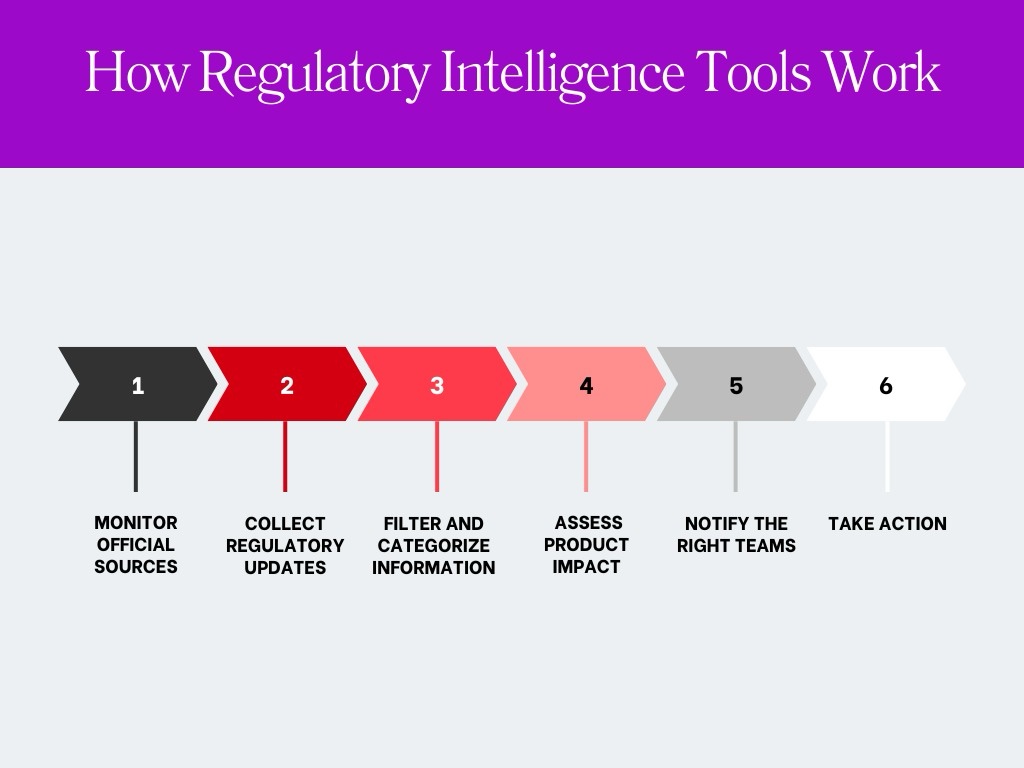
1. Monitor Official Sources
The platform continuously monitors health authorities and other trusted sources. It maintains new legislation, policy changes, and guidance documents.
2. Collect Regulatory Updates
Any new publications are collected together on one platform. This eliminates the manual process of checking a number of sites.
3. Filter and Categorise Information
Updates are sorted by country, product, and regulatory area. Teams don’t view any information that is not relevant to their portfolio.
4. Assess Product Impact
Every update is scrutinised to comprehend its impact on business. Teams can decide which products, submissions, or labels should be addressed.
5. Notify the Right Teams
Regulatory, quality, R&D, and other stakeholders are informed of relevant changes. This ensures everyone is up to speed and on the same page.
6. Take Action
Teams modify documentation, submissions, labelling, or processes. This aids in keeping things compliant and allows for timely regulatory decisions.
Key Features of Regulatory Intelligence Tools
A Regulatory Intelligence Platform should be more than just a repository for updates. It should assist teams in identifying what has changed and what should be done next.
AI-Enabled Global Regulatory Tracking
AI Regulatory Intelligence enables businesses to keep track of regulations in global markets. It gathers information from trusted sources and points out the changes that are pertinent. This helps teams know what is going on without having to manually check.
Expert Review and Risk Assessment
New updates can be detected with technology. Changes still require the expertise of a seasoned regulatory expert. They are able to evaluate the effect on products, submissions, and compliance efforts.
Customised and Actionable Insights
Not all updates are applicable to all organisations. The platform should allow filtering according to countries, products, therapy areas, and regulatory functions. This allows teams to concentrate on updates that are most significant.
Broad Industry Coverage
Multiple organisations have various types of products. A best practice platform will need to be able to accommodate pharmaceuticals, biologics, medical devices, cosmetics, veterinary products, and nutraceuticals. It should also be focused on several therapy areas.
Personalised Dashboards and Alerts
Each team will be prioritising different things. Users should be able to create dashboards based on markets, products, or functions. They also need to decide the frequency of getting regulatory updates.
Impact Analysis
Business Impact should be connected to regulatory changes. The platform should facilitate the identification of impacted products, documents, and regulatory activities. This enables teams to focus on what actions to take and minimise compliance risk.
Cross-Functional Collaboration
It’s not just regulatory affairs that get impacted by regulatory changes. Other teams that require visibility include quality, manufacturing, R&D, labelling, and supply chain. One platform enables all to work on the same information.
Also Read: Regulatory Intelligence In Product Registration
Regulatory Intelligence for Different Life Sciences Sectors
There are different regulatory needs for different product categories and markets. Global Regulatory Intelligence keeps businesses up-to-date and ready to respond. It also facilitates a more effective planning process throughout the product lifecycle.
Pharmaceuticals
Pharma companies have regular updates during the product lifecycle! These include, but are not limited to, clinical development, manufacturing, labelling, and post-market requirements. Regulatory intelligence aids teams in keeping track of changes and making better submissions. It also provides quicker response to new guidance.
Biologics
It is important to be diligent in watching for changing regulatory expectations with biologics. Changes can be in manufacturing, quality, or clinical evidence. Regulatory intelligence is useful to teams for early identification of such updates. This helps ensure compliance and product development on time.
Biosimilars
Appropriate approval of biosimilar drugs is dependent on evolving scientific and regulatory expectations. These requirements may vary from country to country. Regulatory intelligence enables teams to keep pace with market demands and develop more robust regulatory plans.
Medical Devices
There is still continuous evolution in medical device regulations across various markets globally. Up-to-date changes could be to device classification, technical documentation, clinical evidence, or post-market activities. Regulatory intelligence is the aid for keeping manufacturers well-informed and minimising approval time delays.
In Vitro Diagnostics (IVDs)
IVD manufacturers need to keep up with evolving needs for performance, safety, and documentation. Regulatory intelligence allows you to get better visibility into these changes. This enables teams to keep technical files up to date and compliant.
Combination Products
Combination products frequently are subject to more than one regulatory framework. This adds to the complexity of the regulations. Regulatory intelligence enables teams to gain insights into evolving regulatory requirements and select the right solution.
Cosmetics
Cosmetic laws are subject to frequent changes from region to region. Changes can be related to ingredients, claims, labelling or product safety. To help brands keep track of these shifts, regulatory intelligence is used to track them in advance of product introductions.
Veterinary Products
Veterinary products need to meet country-specific requirements throughout their life cycle. Regulatory intelligence assists manufacturers to stay abreast of new guidance and evolving compliance expectations. This helps to facilitate regional markets.
Nutraceuticals
There are different regulations for nutraceuticals in different countries. The ingredients, health claims, and labelling requirements may change over time. Regulatory intelligence helps businesses to keep track of such changes and mitigate compliance risks before entering the market.
How to Choose the Right Regulatory Intelligence Tool
The right platform isn’t only about the budget; it’s about regulatory strategy. These are some points to keep in mind when making a decision.
Global Regulatory Coverage
Select a platform that extends to the markets in which you’re active. It should be alert to information coming from official health sources and trusted information sources. Strong Global Regulatory Intelligence eliminates the need to manually track numerous websites.
AI with Expert Review
AI can extract data from vast amounts of regulatory data in a short time. But manpower is still required. Choose a platform that combines AI Regulatory Intelligence with expert review and risk assessment. This enhances the quality of regulatory decision-making.
Relevant and Actionable Insights
The platform should go beyond just delivering alerts. It should discuss your change and how it impacts your products, markets, or documentation. This enables teams to move quicker and with more information to make decisions.
Customisation and Alerts
Each organisation is unique in its priorities. Seek a platform that will provide customizable dashboards and alerts. This will ensure that teams are updated on what is relevant to their responsibilities.
Scalability
Your regulatory requirements will change throughout the years. Choose a Regulatory Intelligence Platform that can enable new products, markets, and business units. This avoids switching systems as your organisation expands.
Conclusion
The role of regulatory intelligence in today’s day and age in the regulatory world has become a vital factor. It aids in tracking global changes, cutting down on manual labour, and making well-informed decisions. When integrated with AI and expert insight and action, the Benefits of Regulatory Intelligence Tools truly increase.
For Regulatory Intelligence Tools supporting a global compliance perspective, check out QuriousRI by Artixio. It enables regulatory teams to stay informed on the latest international developments, evaluate risks, and act swiftly with assurance. To know more, contact us today at info@aritixio.com.
FAQs
What are Regulatory Intelligence Tools?
Regulatory Intelligence Tools enable companies to track, prioritise, and process regulatory news. They also assist teams in understanding the impact of those updates on products, submissions, and compliance activities.
What are the Benefits of Regulatory Intelligence Tools?
The Benefits of Regulatory Intelligence Tools are rapid regulatory monitoring, improved planning, less manual workload, improved collaboration, and better compliance in worldwide markets.
How does AI Regulatory Intelligence support regulatory teams?
AI Regulatory Intelligence can gather, format, and categorise regulatory data. It will also help find relevant updates. Before any action, critical regulatory decisions must be validated by human experts.
Which industries use Regulatory Intelligence Tools?
Regulatory Intelligence Tools support pharmaceuticals and biotechnology, including biosimilars, medical devices, IVDs, combination products, cosmetics, veterinary products, and nutraceuticals. The more markets that are covered, the more benefit an organisation can derive.
What should you look for in a Regulatory Intelligence Platform?
See worldwide regulatory coverage, AI-powered monitoring, expert review, actionable insight, scalable alerts, and more. The modern Regulatory Intelligence Platform should also provide relevant information and facilitate quick regulatory decisions.