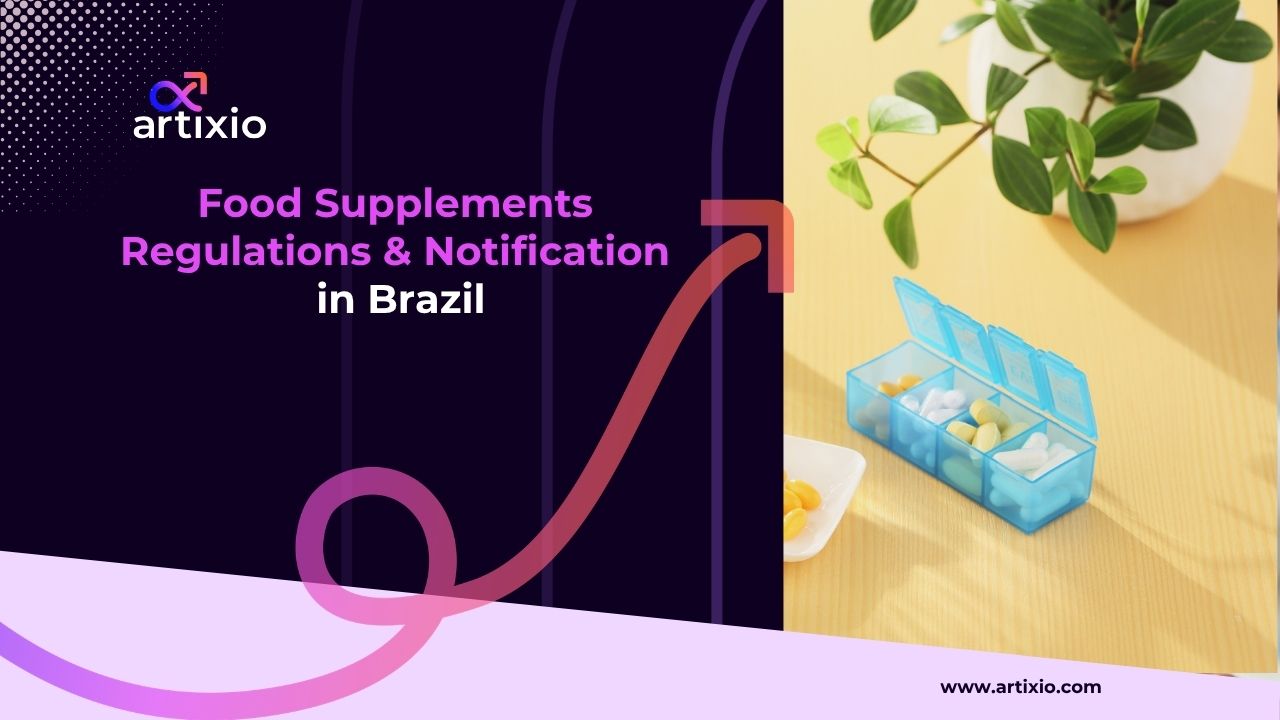
Brazil regulates food supplements under the country’s food regulatory framework. It is administered by the Agência Nacional de Vigilância Sanitária (ANVISA). This framework covers product composition, allowed ingredients, conditions of use, labelling, health claims, and food-safety requirements.
The recent RDC 843/2024 and IN 281/2024 introduced a new framework for the regularisation of foods and food packaging. Under this framework, food supplements are subject to mandatory notification with ANVISA rather than the previous system, under which many supplements were communicated to local sanitary authorities.
This means that companies entering Brazil should focus on food supplement notification and compliance, rather than treating the process as conventional product registration or prior approval. Let’s dive into the details.
Regulatory Authority for Food Supplements in Brazil
The principal federal regulator is ANVISA, short for the Brazilian Health Regulatory Agency (in English). It establishes and enforces sanitary requirements for food supplements. Its supplement framework covers the following:
| Framework | Description |
| RDC 243/2018 | Sanitary requirements for food supplements |
| IN 28/2018 |
|
| RDC 239/2018 |
Authorised food additives and processing aids for supplements
|
| RDC 241/2018 |
Safety and health-benefit requirements for probiotics used in foods
|
| RDC 843/2024 |
Current framework for food and packaging regularisation
|
| IN 281/2024 |
Establishes the regularisation procedure and applicable documentation.
|
Under the post-2024 framework, all supplements must now be notified to ANVISA.
What Are Food Supplements Under Brazilian Regulations?
According to RDC 243/2018, food supplements are products that are meant to be used as dietary supplements by healthy people. It provides a supplemental source of nutrients, enzymes, probiotics, and/or bioactive substances.
It complements an individual’s diet. Healthy individuals can improve their intake of a specific nutrient, or those engaging in intense physical activity can enhance their diet.
Brazil has a constituted list of ingredients to include in supplements and are as follows:
- Vitamins and minerals
- Amino acids and proteins
- Probiotics and enzymes
- Other nutrients
- Carbohydrates
- Dietary fibres
- Lipids
- Bioactive substances
The important point for manufacturers is that an ingredient being permitted in the US, EU or another market does not automatically mean it is authorised for use in a Brazilian food supplement.
Food Supplement Notification Process in Brazil
Earlier, local health surveillance agencies would need to be notified. Now, even ANVISA needs that notification so that the safety and quality of products can be ensured. Also, it will help the agency structure a database on these products and monitor post-market control actions.
Here are the steps to notify the authorities:
Step 1: Verify Ingredient Compliance Under IN 28/2018.
ANVISA states that only authorised constituents can be used in food supplements, with specific conditions applying to their use. These include checking the following:
- Ingredient identity
- Permitted constituents
- Minimum and maximum levels
- Population group
- Dosage
- Applicable warnings
- Approved claims
- Usage of new ingredients
If the applicable positive list doesn’t cover an ingredient, it may require a separate safety assessment/authorisation pathway. It can’t simply be included in the notification.
Step 2: Apply for a Responsible Brazilian Company
ANVISA states that, for products subject to notification, the notification holder must be the matrix of the manufacturer, manufacturer’s representative, or importer. The company responsible for the notification must be registered in ANVISA’s Solicita System (ANVISA’s petitioning system) and maintain its declared information up to date.
Step 3: Prepare Documents for Dietary Supplements Notification in Brazil
Documents are determined by the applicable notification category and Annex X of IN 281/2024. Here is the list:
- Duly completed notification form
- Valid sanitary licence copy for manufacturers in Brazil. Manufacturers outside Brazil: a document proving the manufacturer’s regularity with the sanitary authority in its country of origin.
- Stability study report
- Report/Certificate of Analysis
Companies should also have the product formulation, specifications, label information, ingredient compliance data, and other technical records available to show compliance with the applicable supplement regulations.
Step 4: Register the Company on the Solicita System & Submit the Notification
ANVISA explains that the first step is to obtain access to the system and ensure that the relevant company is properly registered. The company then selects the appropriate petition subject and submits the notification to ANVISA. The specific petition code applicable to the product category is used when submitting.
ANVISA states that the petition must be accompanied by the documents specified for the relevant category under Annex X of IN 281/2024. If a product has multiple presentations, information concerning all presentations must be included as required.
This is a notification procedure, not the same as an application requiring ANVISA’s prior approval before market entry.
Compliance Checklist for Food Supplements in Brazil
Before submitting a food supplement to ANVISA, companies should verify:
- The product meets the Brazilian definition of a food supplement
- All constituents are authorised or have an appropriate regulatory pathway
- Applicable minimum and maximum levels are met
- The intended population is permitted
- Applicable warnings and restrictions are identified
- Claims correspond to those permitted by ANVISA
- The label meets Brazilian requirements
- New-ingredient status has been assessed where relevant
- The company responsible for the notification is appropriately established and registered with ANVISA
- The required notification documentation is available.
ANVISA Labelling Requirements for Food Supplements in Brazil
ANVISA states that supplement labels must include information such as:
- Product name
- Recommended use, including quantity and frequency
- Relevant warnings
- Restrictions on use
- Nutrition information
- Ingredient list
- Allergen information
- Gluten and lactose declarations, where applicable
- Expiry date
- Origin
- Lot/batch information
ANVISA also states that the expression “SUPLEMENTO ALIMENTÍCIO,” i.e., “dietary supplements”, must appear prominently on the packaging, together with the product’s presentation form, such as capsule, powder, or liquid.
Health Claims and Advertising Regulations in Brazil
Nutritional and functional claims are only permitted in Brazil with approval under IN 28/2018.
No supplement can make a claim to prevent diseases, treat diseases, cure medical conditions, or replace medicines.
Where health-benefit claims are permitted, they must follow the wording established by ANVISA. ANVISA specifically notes that these claims should generally be presented without textual variations, helping prevent claims from going beyond the scientific evidence supporting them.
Establishment Licensing Requirements for Food Supplements in Brazil
Companies should ensure that the relevant manufacturing, importing, and food-business establishments hold the sanitary licences and authorisations applicable to their activities, in addition to completing the product notification process.
GMP Requirements for Food Supplements in Brazil
ANVISA requires supplement manufacturers to have GMP controls of product quality and traceability.
Companies should maintain qualification records of raw materials, batch manufacturing records, quality control procedures, stability data, procedures for cleaning and sanitation, and product traceability systems.
In the case of imported supplements, it is necessary that GMP evidence is provided by the foreign manufacturing site at ANVISA review or import inspection.
Import Regulations for Food Supplements in Brazil
Imported supplements must comply with Brazilian food and sanitary requirements before they can be lawfully marketed.
Companies should assess:
- Brazilian notification requirements
- Importer/company requirements
- Applicable sanitary licensing
- Product formulation
- Ingredient compliance
- Brazilian labelling
- Claims
- Import documentation
- Customs requirements
Labelled products that don’t meet the approval standards, don’t include authorised ingredients, or don’t have an approval or permit may be held or refused.
Conclusion
Under the rules of ANVISA, Brazil has extremely demanding requirements for ingredients in supplements, claims, labelling, import, and GMP compliance. Businesses that conduct formulation and labelling assessments at an early stage can minimise the risk of importation delays in approval and reformulation costs for accessing the Brazilian market.
Looking for support with ANVISA food supplements compliance support and market entry in Brazil? Artixio supports global supplement companies with Brazil regulatory affairs services, including product compliance, labelling, and commercialisation requirements. Get in touch with us at info@artixio.com.
FAQs
Are all food supplements registered in Brazil?
No. Food supplements are not subject to product registration with ANVISA under the current framework. Since 1 September 2024, food supplements are subject to mandatory notification with ANVISA under RDC 843/2024 and IN 281/2024. The notification is automatic and is not preceded by ANVISA’s prior assessment, although ANVISA may review the notified product and documentation at any time.
Can foreign companies notify food supplements directly to ANVISA?
No. Foreign companies need to be represented by a Brazilian legal entity or importer for importation.
Do supplements that are approved by the US FDA automatically meet the requirements in Brazil?
Brazil adheres to its own rules regarding ingredients, dosage, labelling, and claims for Brazil, per ANVISA regulations.