
The combinations in Thailand play a major role in marking the pharmaceutical development. Combinational drugs are basically fixed-dose combinations of two or more active ingredients combined into a single dosage form. These combinations target simplified treatment regimens, patient compliance, chronic conditions of treatment, public health, etc.
So, keep reading further for understanding the combinational drug roadmap in Thailand and its compliance essentials by the Thai FDA.
What are Combination Drugs in Thailand?
The combinations are considered as “modern drug” under the Thai FDA. Combinational drugs in Thailand are not a specific, available consolidated list but rather are searchable in the Thai FDA database and commercial drug indexes once the combination is approved.
The novel combinations also in Thailand are classified as “new drugs” under the Ministerial Regulation on Drug Registration B.E. 2555 (2012).
The combinations in Thailand are classified into various sub-categories such as antivirals, antiretrovirals, cardiovascular, anti-malarial, etc.
Some examples of combination in Thailand are sitagliptin and metformin for diabetes, amlodipine and valsartan for blood pressure, etc.
Criteria for Approval of Combinational Drugs by Thai FDA:
The combinations in Thailand are checked for specific compliance requirements before their approval. The following are some of the criteria considered while approving a combinational drug:
- Quality Standards: The quality standards are analyzed through the combinational drug dossiers, CMC data, analytical methods, etc.
- Risk-benefit Analysis: The combination must indicate an equal or greater safety and therapeutic effect than its individual drug components.
- Data Reliability: Data for combination should be detailed and well-researched with proper GMP/GLP compliance and clinical evidence.
- Therapeutic Justification: Therapeutic value of the combination should indicate a synergistic effect, thus adding value to the use of the combinational product.
- Product Quality: The quality, manufacturing details, stability data, etc., of the combination are evaluated from its dossier.
- Safety Assessment: Risk benefit of the combinational drug is compared with the individual effects of its drug components. Various parameters, such as PK/PD compatibility, adverse effects, interactions, etc., are studied.
- Clinical Data: This includes clinical active data for each individual component.
- Combination Rationale: The rationale should prove that the combination adds real value to the therapeutic value of the drug’s individual therapeutic value.
These combinational drugs undergo a new drug review within a time of 180 to 360 days. Once the drug product is approved, it can be found in the Thai FDA searchable database, where all the approved drugs can be searched.
Data Requirements for Combinations Approval in Thailand:
The Thai FDA-approved combination of drugs needs to prove its safety and efficacy. The fixed dose concentration should justify its combination with other drug components and should have a synergistic effect.
The following safety and efficacy data are required by the Thai FDA:
| Data Required | Description |
| PK/PD compatibility data | This indicates that there is no interaction among the drug components, and the combinational drug together brings a synergistic effect. |
| Stability data | The combination should maintain its stability under the Thai climatic conditions and should not undergo degradation or interaction with atmospheric components. |
| Safety profile | The combination should indicate an aggregate risk less than the individual drug risk, with compatibility for long-term use for chronic diseases. |
| Clinical Evidence | This includes clinically active data for each individual component. |
| Combinational Rationale | The rationale should prove that the combination adds real value to the therapeutic value of the drug’s individual therapeutic value. |
Drug Act Regulating Thai Combinational Drugs:
The Regulation Guidance from the Drug Act B.E. 2510 under the Thai FDA regulates the combinational drugs in Thailand. These are regulated as “modern drugs” in the general registration section of the Drug Act.
Following are detailed description of the combinations from the Drug Act:
- Section 4: It defines the combinational drug as a modern drug used for diagnosis, treatment, and prevention affecting human health.
- Section 10: This section recommends drug formula registration, licensing, and import controls.
- Section 12: The minister notifies drug categories, such as dangerous. Controlled, etc. The FDCs are then accordingly classified.
- Section 13: This section mandates the registration of the modern drug before their manufacture, sale, or import.
- Section 18-20: It describes the licensing for production and sale.
- Section 25: It describes all the labelling requirements for the combinational product, such as name, registration code, quantity, active strengths, expiry, and manufacturer.
- Sections 77-79bis: It provides details regarding the clinical research exemptions for unregistered combinations.
- 2001 Amendment: The amendment to the Drug Act in 2001 strengthened the registration of dossiers and notifications for the combinations.
- Drug Act (No. 6) B.E. 2562 (2019): This drug act of 2019 added the patent document requirements for the modern drug registration.
Thai FDA’s Role in Combinational Drugs Approval in Thailand:
The Thai FDA plays a crucial role in combinational drug development, right from the pre-approval to the post-approval.
Below is the role of Thai FDC in the development of Combination drugs:
| Thai FDA’s Responsibilities | Description |
| Pre-Approval Phase | In this phase, the Thai FDA issues facility licenses for the manufacturers and importers before the product registration.
Pre-submission approval is also carried out. |
| Review Phase |
Here, the Thai FDA performs the screening. Scientific evaluation, GMP inspection, and risk-benefit analysis.
|
| Post-Approval Phase |
The marketing approval is granted by the Thai FDA. Once approved, it looks over the various domains such as pharmacovigilance, renewals, variations and changes, adverse effects, etc.
|
How to Find the Thai FDA Approved Combinational List:
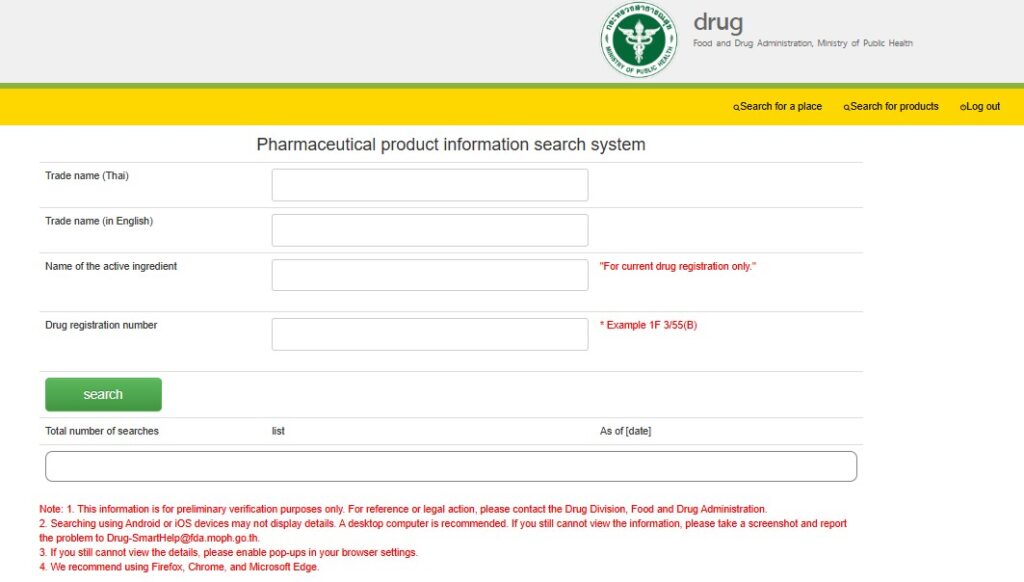
In Thailand, there is no single list or PDF that enlists all the approved combinations, unlike India’s DCGI PDF. Rather, in Thailand, there is a drug database which has all the approved and registered drugs included. The client or user who intends to know the status of a certain Thai FDA-approved combination of drug should enter the name of the drug on the official FDA search tool, and it shall provide them with all the details and regulatory approval status of the drug.
Thailand Official Combination Drugs Search Tool:
The combinational drug register as individual New Combination (NCO) products in the Thai FDA database. From this database, the end user can search and find out the registration status and other details of the drugs.
The database can be accessed through this link. And one such example of amlodipine drug from the Thai FDA database can be accessed here.
Below is the screenshot of the Thai FDA search tool:
Some of the examples of Thai FDA fixed dose combination from the Thai FDA database are as follows:
- Cardiovascular: Amlodipine + Telmisartan, Losartan + HCTZ
- Anti- TB: Rifampicin + Isoniazid + Pyrazinamide + Ethambutol
- Antidiabetic: Metformin + Empagliflozin, Sitagliptin + Metformin
Regulatory Challenges for FDC Approval:
The registration of Thai FDA fixed-dose combination, also known as modern medicine in Thailand, possesses a lot of challenges despite the ASEAN harmonization, such as lengthy timelines, local adaptations, etc.
Some of the major challenges are as follows:
- Long Review Process: The FDA takes a long period for the review process, which is 180-360 days. In addition to this, there are also backlog delays and clinical bridging requirements for complex FDCs.
- Data Gaps: Limited local clinical data, need for foreign studies, etc., possess data gaps in the process of FDC approvals.
- Non-dedicated FDC policy: In Thailand, the FDCs are treated as new drugs and lack guidelines specifically designed for FDCs.
- Resource Constraints: For foreign manufacturers, a local agent is mandatory, which increases the overall cost of FDC approval in Thailand.
- Administrative Hurdles: The Thai language requirement for all the dossiers poses one of the biggest hurdles in the FDC approval. On top of that, GMP inspections for overseas sites increase by 2-3 months in the approval timeline.
Conclusion:
The Combinational drugs are registered through the Thai FDA database under the New Combination (NCO) category. The end users can thus search for the drug name in the database to know the regulatory status and detailed information about the drug.
So, if you are planning to establish your NCO in Thailand, contact info@artixio.com, where our regulatory experts in Thailand will ensure timely compliance and approval of your NCO.
FAQs
How does the Thai FDA initially classify the fixed-dose combination to determine the registration category?
The combinational drugs in Thailand are classified as “modern drugs”; these modern drugs are sub-classified before their dossier submission. During the pre-approval consultation, the preliminary report is submitted. Through these reports, the Thai FDA determines the subcategory of the combinational drug. Novel combinations are considered as new drugs, while bioequivalent combinations are considered generics, and high-scrutiny combinations are categorized as risk-based.
What are some of the essential points that must be discussed with the Thai FDA during the pre-approval meeting to ensure all aspects of compliance?
Some of the essential points that must be discussed during the pre-submission meetings include cover compliance requirements, combination classification category, Good Submission Practice (GSubP), technical evidence requirement, GMP compliance requirements, etc.
Will my FDC approval in other countries, such as the US, EMA, Japan, etc., leverage my fixed-dose combination registration in Thailand?
There is no such abridged route nor explicit pathway for foreign-approved combinations. They need to enroute the full registration pathway.
In which aspects of the dossier for NCO do the sponsors pose the most queries and revert to their approval application?
Most of the regulatory queries and rejections of applications during the combination drug approval deal with stability data gaps, analytical method and manufacturing process validation, inappropriate Thai label translation or format, incomplete Thai bridging studies, non-compliance of foreign site data, etc.
What does the Thai FDA expect during the GMP inspections, and when do the authorities conduct foreign site GMP inspections?
The local manufacturing site requires a manufacturing license, whereas foreign manufacturing sites require Thai FDA GMP clearance. Hence, once the dossier for combinational drug is submitted, the Thai FDA conducts foreign onsite GMP inspection mostly after a period of 3-6 months of dossier submission.
Some of the factors considered while inspecting the site by the Thai FDA are stability production, manufacturing, analytical QC, equipment qualification, etc.