

The world of cosmetics is growing rapidly. While diverse cosmetic products are being released, it is important not to compromise consumer safety. It’s not just an obligation but a regulatory condition for establishments to follow. To achieve this, cosmetic safety assessments are introduced.
These assessments help manufacturers and responsible parties evaluate potential risks associated with ingredients and finished products. They also prove compliance with applicable regulatory requirements.
This article explores cosmetic safety assessment requirements, major regulatory approaches, the components of a Cosmetic Product Safety Report (CPSR), and the role of the cosmetic safety assessor.
Importance of Cosmetic Safety Assessments
Every cosmetic product that enters the market should be completely safe for use under normal and foreseeable conditions. For that, a cosmetic safety evaluation needs to be done. These assessments provide insights into potential hazards associated with ingredients and finished products. Consumer exposure and other potential risks also come to light.
A safety assessment considers the following factors depending on the applicable regulatory framework:
- Toxicological profiles of ingredients
- Product composition
- Physical and chemical characteristics
- Microbiological quality
- Consumer exposure
- Intended and reasonably foreseeable use
- Vulnerable populations
- Undesirable and serious undesirable effects
Regulatory requirements regarding safety are different everywhere. While some prescribe a formal safety assessment and report, others place the responsibility on manufacturers or responsible persons. They need to substantiate the product using scientifically backed information.
Global Regulatory Standards For Cosmetic Product Safety Assessment
Cosmetic safety requirements are not the same across the globe. Every country has a separate structure, like the EU requiring proper assessment and reports, while the US places the safety substantiation responsibility on the responsible person.
European Union
Article 10 of Regulation (EC) No. 1223/2009 speaks about the safety assessment of cosmetic products. It states that the person responsible should make sure that the cosmetic product has undergone a safety assessment before marketing it. There should also be a Cosmetic Product Safety Report (CPSR) in accordance with Annex I, which specifies the minimum information to be included in the CPSR.
Among other factors, the safety assessment must consider the intended use of these products, anticipated systemic exposure to individual ingredients, relevant available data, and a weight-of-evidence approach when reviewing existing information
FDA – USA
Except for color additives, cosmetic products and ingredients do not require approval before they are placed into the market. Instead, other laws and regulations apply, with the main ones being the FD&C Act (Federal Food, Drug, and Cosmetic Act), FPLA (Fair Packaging and Labeling Act), and MoCRA (the Modernization of Cosmetics Regulation Act of 2022).
The FDA or the law does not require specific tests to prove the safety of individual products or ingredients. However, the data used to support safety should be scientifically robust.
Generally, cosmetic products must not be adulterated or misbranded. Manufacturers and marketers remain responsible for ensuring product safety.
Safety Substantiation
MoCRA provides the cosmetic safety substantiation requirements. It states that a responsible person is required to ensure and maintain records supporting adequate safety substantiation for cosmetic products. The FDA defines adequate safety substantiation as tests, studies, research, analyses, or other evidence or information that experts qualified by scientific training and experience would consider sufficient to support a reasonable certainty that a cosmetic product is safe.
The FDA explains that manufacturers may substantiate cosmetic safety by:
- Relying on available toxicological data for individual ingredients
- Reviewing safety information for products with similar formulations
- Using relevant data supplied by cosmetic ingredient manufacturers
- Reviewing relevant scientific literature and research
- Conducting additional toxicological or other testing where existing information is insufficient
Therefore, safety substantiation does not necessarily mean that every finished cosmetic product must undergo the same set of laboratory tests. Manufacturers should evaluate the available information and determine whether additional testing is necessary to address gaps in the safety data. The FDA has consistently advised manufacturers to use whatever testing is appropriate to ensure the safety of their products and ingredients.
Canada
All the cosmetics sold in Canada should comply with the Food and Drugs Act and the Cosmetic Regulation. Other legislative requirements come under the following when applicable:
- Consumer Packaging and Labeling Act
- Canadian Environmental Protection Act, 1999
- Cannabis Act
The manufacturing/preparation, preservation, packaging, and storage of the cosmetics must be under sanitary conditions. Manufacturers and importers are required to notify Health Canada about a cosmetic product within 10 days after it is first sold in Canada. The notification includes information such as the product ingredients.
This is a post-market notification requirement and should not be described as a pre-market product approval process.
Differences in these Global Cosmetic Safety Assessment Approaches
For companies operating internationally, a single global safety file may provide useful scientific information. However, market-specific regulatory documentation and obligations may still need to be addressed separately.
| Countries | Cosmetic Safety Assessment Requirements |
| EU |
A highly structured approach requiring a safety assessment and Cosmetic Product Safety Report before a cosmetic product is placed on the market.
|
| USA |
No pre-market approval requirement for cosmetics, but responsible persons must ensure and maintain records supporting adequate safety substantiation under MoCRA.
|
| Canada |
Manufacturers and importers are responsible for ensuring compliance with applicable cosmetic requirements and must notify Health Canada after the first sale of a cosmetic product within the prescribed timeframe.
|
Components Of A Cosmetic Product Safety Report – EU
The cosmetic product safety report has two parts. Part A covers information, and Part B is assessment.
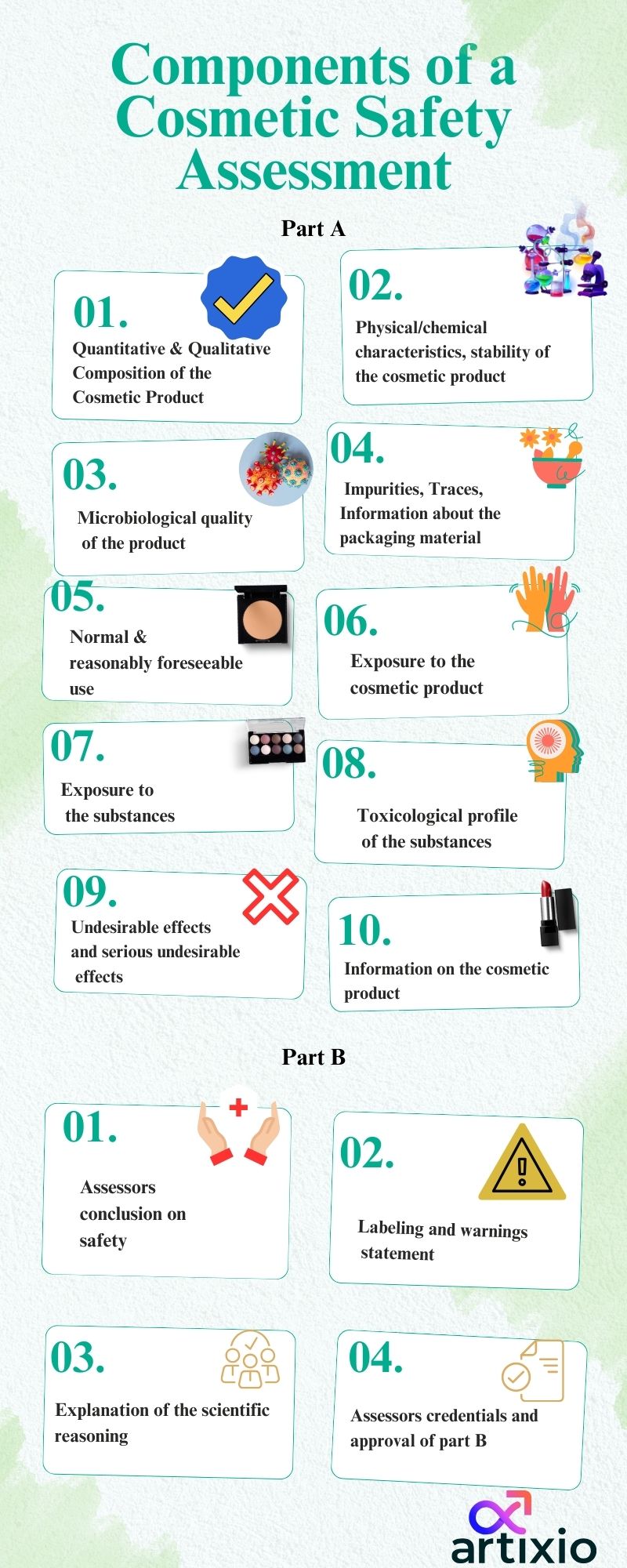
Part A: Cosmetic Safety Information
Part A contains the information necessary to support the safety assessment of the cosmetic product. The Cosmetic Product Safety Report should include the following information.
1. The Quantitative & Qualitative Composition
Document the cosmetic product’s qualitative and quantitative composition, along with the chemical identity of the substances and the function they are intended for. For perfume and aromatic compositions, additional identifying information may be required, including the composition name or code and supplier identity.
2. Physical/Chemical Characteristics & Stability
The physical as well as the chemical characteristics of the substances, mixtures, and the cosmetic product should be considered. The stability of the product under reasonably foreseeable storage conditions should also be evaluated.
3. Microbiological Quality
Microbiological specifications should be considered for the substances, mixtures, and finished cosmetic product. Special attention must be given to cosmetics that are used around the eyes, on mucous membranes, on damaged skin areas, by children younger than 3 years of age, by the elderly, and by people with compromised immune systems. Preservation challenge test results must be provided where relevant.
4. Impurities, Traces, and Information about the Packaging Material
Information should be available regarding the purity of substances and mixtures. Where traces of prohibited substances are technically unavoidable, evidence supporting their technical unavoidability may be required. The characteristics of packaging materials should also be considered where they may affect the stability or purity of the cosmetic product.
5. Normal and Reasonably Foreseeable Use
The safety assessment should take into account both the normal and reasonably foreseeable use of the cosmetic product. This assessment should be consistent with the product’s intended use and relevant warnings or instructions provided to consumers.
6. Exposure to the Cosmetic Product
The data on the cosmetic product exposure in relation to the site and surface area of application, product amount to be applied, duration and frequency, normal or any foreseeable route of exposure, and targeted populations. Potential secondary exposure routes may also need to be considered where relevant.
7. Exposure to the Substances
Exposure to individual substances should be assessed for relevant toxicological endpoints.
8. Toxicological Profile of the Substances
The toxicological profile of relevant substances should be evaluated for applicable toxicological endpoints. Special attention should be paid to the evaluation of local toxicity, skin sensitization, photo-induced toxicity where relevant, systemic toxicity, absorption routes, particle size, including nanomaterials, impurities, and interactions between substances.
The assessment may also involve the calculation of a Margin of Safety (MoS), where appropriate.
10. Undesirable Effects and Serious Undesirable Effects
All data regarding the cosmetic product’s undesirable and serious undesirable effects, including statistical data, should be considered.
11. Information on the cosmetic product
Consider any other information about the cosmetic product that is relevant.
Part B: Cosmetic Safety Assessment
Part B contains the scientific assessment and conclusions regarding the safety of the cosmetic product. It includes:
- Assessment conclusion: A statement regarding the safety of the cosmetic product under the applicable conditions of use.
- Labelled warnings and instructions: A statement regarding any warnings or instructions required for safe use.
- Reasoning: The scientific reasoning supporting the safety conclusion.
- Assessor’s credentials and approval: The name and address of the safety assessor, proof of qualifications, and the date and signature of the assessor.
Among other things, there shall be a specific assessment for the cosmetics that are to be used in children younger than 3 years and for cosmetics considered for their use in external intimate hygiene. Interactions between substances, toxicological information, and the potential impact of product stability on safety should also be considered where relevant.
Steps in Conducting a Cosmetic Risk Assessment
Risk assessment helps identify potential hazards associated with cosmetic ingredients and products and evaluate whether consumer exposure may result in an unacceptable risk. The process generally includes four key steps as follows:
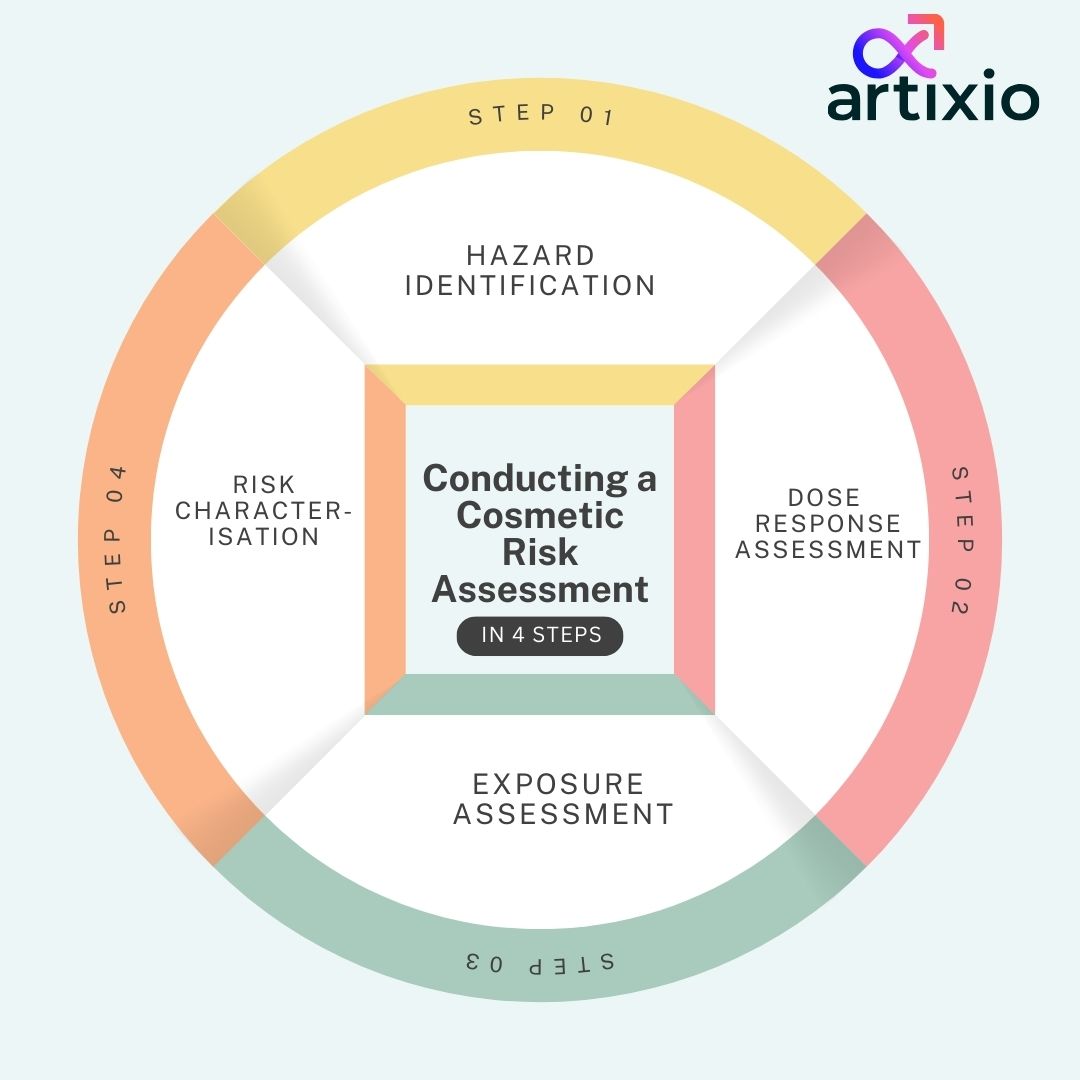
1. Hazard Identification
It involves identifying potential adverse effects of a cosmetic product or its ingredients based on its toxicological profile and scientific information.
2. Dose-Response Assessment
This evaluates the relationship between the level of exposure to a substance and the likelihood or severity of an adverse effect.
3. Exposure Assessment
Evaluates the amount of a substance to which consumers may be exposed under the intended and reasonably foreseeable conditions of use.
4. Risk Characterization
Risk characterization combines hazard and exposure information to evaluate the overall safety of a substance or product.
The Scientific Committee on Consumer Safety (SCCS) uses approaches including the Margin of Safety where relevant. The assessment methodology and available scientific evidence should be appropriate to the ingredient and exposure scenario being evaluated.
The traditional Margin of Safety concept can be represented as MoS = PoDsys / SED. Here, PoDsys refers to a systemic point of departure, which may be based on an appropriate toxicological descriptor. SED refers to the systemic exposure dose.
A Margin of Safety of 100 or greater has traditionally been used as a general benchmark in relevant SCCS safety assessment approaches, although the appropriateness of the methodology depends on the available data and the specific assessment.
Role of a Cosmetic Safety Assessor
The cosmetic safety assessor evaluates the available information to determine whether a cosmetic product can be considered safe under its intended and reasonably foreseeable conditions of use.
The assessment may involve evaluating the following:
- Whether ingredients comply with applicable legal restrictions
- Relevant toxicological endpoints
- The adequacy and relevance of available safety data
- The need for additional information
- Potential changes in toxicological relevance
- Product exposure and potential ingredient penetration
For the EU Cosmetic Product Safety Report, Article 10 requires the safety assessment to be carried out by a person with appropriate qualifications. The Regulation refers to a university degree or equivalent qualification in pharmacy, toxicology, medicine, or a similar discipline recognized as equivalent by a Member State.
How to be in Line with Cosmetic Regulatory Compliance?
Cosmetic regulatory compliance requires companies to understand the requirements applicable to the markets in which their products are placed. Although specific requirements vary between jurisdictions, manufacturers and responsible parties should generally consider:
- Product and ingredient safety
- Applicable ingredient restrictions
- Product quality and manufacturing controls
- Product stability and microbiological quality where relevant
- Safety substantiation
- Appropriate labelling
- Documentation and record maintenance
- Post-market obligations, where applicable
It is important not to state that all cosmetic products universally require proof of “effectiveness” in the same way. Safety is a fundamental regulatory requirement. Substantiation of product performance or efficacy may become relevant depending on the claims made and the applicable jurisdiction.
Conclusion
Companies can remain compliant by following appropriate manufacturing practices, maintaining product safety documentation, and monitoring regulatory changes. As cosmetic regulations continue to evolve, companies should review applicable official guidance and regulatory requirements for each target market.
Artixio Consulting can support companies with cosmetic safety assessment, regulatory compliance, product registration, labeling review, and market-entry strategies across international markets. Reach out to us at info@artixio.com.
FAQs
Q1. What is the purpose of cosmetic risk assessment compliance?
The purpose of cosmetic risk assessment compliance is to demonstrate that the cosmetic product is safe for consumer use. Moreover, it makes sure that the cosmetic product satisfies all the safety and legal requirements. It is also relevant in the detection and prevention of any undesired health effects.
Q2. What does a Cosmetic Product Safety Report (CPSR) include?
Under the EU Cosmetic Products Regulation, the CPSR consists of two parts. Part A contains cosmetic product safety information, including composition, physical and chemical characteristics, stability, microbiological quality, exposure information, toxicological profiles, and undesirable effects. Part B contains the safety assessment conclusion, warnings and instructions, scientific reasoning, and the safety assessor’s credentials and approval.
Q3. Who can perform a cosmetic safety assessment?
Under the EU Cosmetic Products Regulation, the cosmetic safety assessment must be performed by a person with appropriate qualifications. Article 10 refers to a university degree or equivalent qualification in pharmacy, toxicology, medicine or a similar discipline recognized as equivalent.
Q4. What challenges do companies face in cosmetic risk assessment compliance?
Some common challenges include interpreting evolving regulatory requirements, maintaining sufficient safety documentation, evaluating ingredient restrictions across multiple markets, and managing different regional approaches to safety substantiation. Companies marketing products internationally may need to adapt their documentation and compliance strategy to the requirements of each target jurisdiction.
Q5. Do cosmetic products require FDA approval before sale in the United States?
Generally, cosmetic products and ingredients do not require FDA pre-market approval, except for color additives that are subject to applicable approval requirements. However, responsible persons must comply with applicable laws, including the requirement to ensure and maintain records supporting adequate safety substantiation under MoCRA.