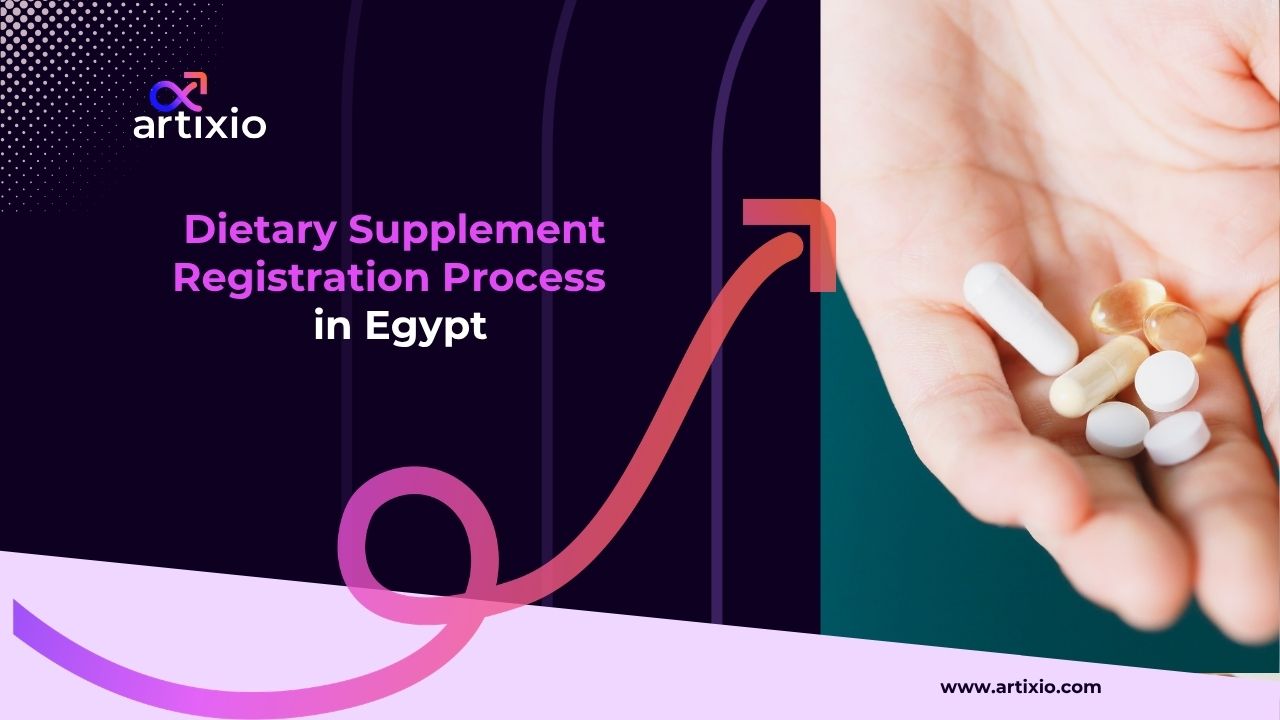
Before importing or marketing dietary supplements in Egypt, companies need to determine the applicable regulatory route based on the product and its ingredients. Egypt’s current official framework involves both the Egyptian Drug Authority (EDA) and the National Food Safety Authority (NFSA). They continue to work through joint mechanisms on dietary supplement regulation.
This guide explains the regulatory authorities, classification considerations, ingredient requirements, registration-related documentation, GMP and stability requirements, advertising, and market-entry considerations for dietary supplements in Egypt.
Regulatory Authority for Dietary Supplements in Egypt
Dietary supplements in Egypt are regulated by the following bodies:
National Food Safety Authority (NFSA)
The NFSA’s Unified Food Safety Registration Portal includes a dedicated category for food supplement factories under Special Foods. The portal provides an establishment-registration workflow covering basic information, responsible-person information, documentary information, establishment information, and file submission.
Egyptian Drug Authority (EDA)
The EDA’s official regulatory reference lists Ministerial Decree No. 76 of 2000 as the regulation governing the registration and advertising of drugs, pharmaceutical products, and dietary supplements. They also maintain registration-related regulatory material for herbal medicines and dietary supplements.
What is a Dietary Supplement According to Egyptian Regulations?
There’s no formal definition of dietary or food supplements according to Egyptian rules. However, there are permitted maximum levels for substances to be registered as food supplements. For that, the 2nd and 3rd White lists are published by the EDA.
This means that the product’s formulation and daily dose must be assessed against the applicable official list, rather than relying only on its commercial description as a “supplement.”
Dietary Supplement Registration Process in Egypt
The registration process should begin with product and ingredient assessment, followed by the applicable establishment and product procedures.
Step 1: Decide the Applicable Regulatory Pathway
Group the products according to ingredients, concentration, dosage form, purpose, regulatory status, and applicable white list entries. The EDA White Lists specifically identify substances and maximum levels for registration as food supplements and also identify certain substances that are registered as medicinal products only.
Step 2: Register the Food Establishment
Be sure to register the responsible food supplement factory in the NFSA Unified Registration Portal under Special Foods. Its registration process includes basic information, responsible-person information, documentary information, establishment details, and file uploads.
Step 3: Prepare the Product Registration Dossier
For locally manufactured herbal medicines and dietary supplements, the EDA’s current stability-file guidance clearly refers to a new registration or re-registration. It requires information including committee approval/composition details, stability documentation, and detailed composition information.
The composition should be in tabular form. It should cover the components of the finished product, their amounts, the function of each component, and the relevant reference/specification.
Step 4: Complete the Applicable Regulatory Review
Dietary supplements are handled within EDA registration-related procedures in relevant circumstances, while NFSA operates the food-establishment registration framework.
Step 5: Approval and Market Entry
The product should only enter the market once the applicable regulatory requirements for the product and establishment have been fulfilled. The current EDA/NFSA framework contains requirements involving product registration/licensing, establishment of registration, analysis, and distribution controls. These depend on the pathway.
Documents Required for Dietary Supplements Registration in Egypt
EDA’s current stability file guidance requires the following documents:
- Herbal Medicine and Dietary Supplements Committee approval and attached composition
- Registration licence for re-registration cases
- Relevant EDA approvals/decisions where applicable
- Stability summary sheet
- Detailed product composition
- Certificate of analysis from the Central Administration of Drug Control, where available.
The NFSA establishment-registration portal separately requires documentary information and uploaded files as part of the establishment registration process.
Dietary Supplement Registration Timelines & Costs in Egypt
There is no single universal registration timeline that can safely be applied to all dietary supplements in Egypt. Processing depends on the applicable NFSA/EDA pathway, product status, documentation, and any required assessment, analysis, or inspection. Similarly, Regulatory fees in Egypt depend on the specific NFSA or EDA service and product pathway. Companies should verify the applicable current government fee for the exact procedure before filing. Additional costs may arise from testing, documentation, translation, legalisation, and regulatory support.
Dietary Supplement Compliance Checklist for Registration in Egypt
Prior to applying for registration, please make sure that:
- Product classification and applicable regulatory authority/pathway.
- Ingredient and concentration compliance against the applicable White List where relevant.
- Food-establishment registration requirements through the NFSA system where applicable.
- Manufacturing and quality documentation required by the relevant regulatory pathway.
- Product composition and stability information required by EDA.
- Advertising requirements where applicable.
- Import and distribution arrangements before market entry.
Ingredients & Concentration Requirements for Dietary Supplements in Egypt
The EDA and NFSA announced the implementation of the first White List for vitamins and minerals. It specifies concentrations permitted for registration as food supplements with the NFSA.
Then, the subsequent EDA White Lists came with maximum levels for additional substances. The 2nd white list covered maximum and minimum levels for other substances, prebiotics, and probiotics. The 3rd white list included maximum levels of additional substances and amino acids. Here are a few examples:
| Substance | Official maximum/condition |
| Coenzyme Q10 | 400 mg/day |
| Creatine |
20 g/day, not exceeding 5 g per single dose
|
| Beta-glucan | 10 g/day |
| Lutein | 20 mg/day; lutein esters 40 mg/day |
| Astaxanthin | 40 mg/day |
| Glutathione | 600 mg/day |
| Melatonin | 2 mg/day |
| Omega-3 |
EPA + DHA 5 g/day; separate EPA, DHA and alpha-linolenic-acid limits also specified
|
| Glucomannan | 13 g/day, with dosage-form conditions |
| Colostrum | 20 g/day |
These lists clarify that not every substance is automatically eligible as a dietary supplement. For example, the third White List states that magaldrate is registered as a medicinal product only.
Egyptian Labelling Requirements for Dietary Supplements
Dietary supplement labelling must comply with the requirements applicable to the product’s regulatory pathway. The final artwork should therefore be reviewed against the current requirements of the competent authority before manufacturing, import, or marketing.
Licensing & Establishment Requirements for Dietary Supplements in Egypt
The NFSA Unified Registration Portal provides registration for food supplement factories and other food establishments, including storage establishments. EDA also provides a guideline under its medical-products-store framework. It states the procedure for storing and circulating dietary supplements that have been registered and licensed by NFSA in medical-product stores licensed by EDA.
Stability Requirements for Dietary Supplements in Egypt
EDA’s guidance expressly covers stability studies submitted for locally manufactured herbal medicines and dietary supplements for new registration or re-registration. The dossier includes a stability summary sheet and detailed product composition.
The composition section must include the components of the finished product and their amounts, the function of each component, and its relevant reference/specification. The guidance also requires inclusion of components used during manufacturing, even where they may be removed during processing.
Health Claims and Advertising for Dietary Supplements in Egypt
Advertising and promotional materials for dietary supplements within the EDA regulatory framework follow EDA’s promotional-control requirements. Its 2026 guidance states that promotional materials for dietary supplements are among the materials submitted through its prior-approval system. There may be specific exemptions as described by the Authority.
Storage & Distribution Requirements for Dietary Supplements in Egypt
A current EDA guideline describes a specific process for storing and circulating dietary supplements registered and licensed by NFSA through medical-product stores licensed by EDA. The product owner must submit a request to NFSA after manufacturing and analysis procedures are completed, and compliant analysis results are received. The request includes the special-food storage request form, product licensing certificate and approved annexes, amendment annexes where applicable, NFSA analysis certificate approving circulation, packaging photographs, and the specified service payment.
The EDA Market Surveillance administration then reviews the submission, with the guideline specifying a response within a maximum of two working days—approval, rejection, or request for completion of documents.
Conclusion
Accurate classification of dietary supplements, preparation of appropriate registration packages, and compliance with relevant NFSA or EDA requirements are essential for successful registration in Egypt.
Artixio assists manufacturers in Egypt with end-to-end regulatory strategy, product classification, dossier preparation, product registration, and market entry. Please contact us at info@artixio.com.
FAQs
Is a GMP certificate universally required for dietary supplements?
The official sources reviewed do not support stating that one GMP certificate is universally required for every dietary supplement. EDA maintains pharmaceutical GMP requirements, while NFSA has its own food-establishment framework. GMP and manufacturing documentation should therefore be assessed according to the applicable product and establishment pathway.
What happens if a product does not comply with Egyptian regulations?
Non-compliant products may be refused registration or denied market access.
Can dietary supplements be stored in medical-product stores?
For NFSA-registered and licensed dietary supplements, EDA’s 2026 guideline provides a specific procedure for storage and circulation through medical-product stores licensed by EDA, subject to NFSA and EDA documentation and approval requirements.