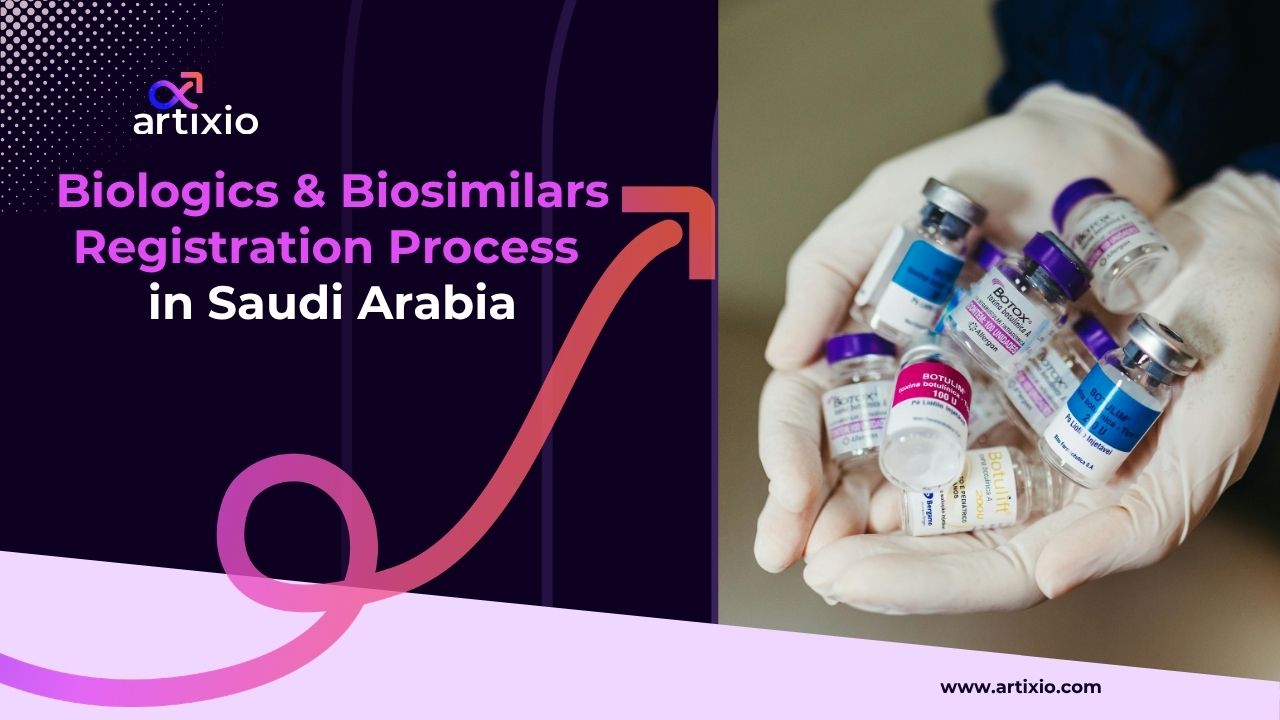
Biologics and Biosimilars Regulation in Saudi Arabia runs through one authority. That authority is the SFDA’s Drug Sector. Biologics and Biosimilars Registration in Saudi Arabia is filed through the eSDR system using a full eCTD dossier. There is no separate biologics office and no shortcut around this process. Biosimilars carry one extra requirement. They need a comparability exercise against a defined reference product, following SFDA’s biosimilar guideline.
This article covers the regulatory authority, the applicable requirements, the registration process, documentation, clinical and labelling rules, timelines, fees, and post-approval obligations.
Regulatory Authority for Biologics and Biosimilars in Saudi Arabia
The Saudi Arabia biologics regulatory authority is the SFDA (Saudi Food and Drug Authority), acting through its Drug Sector. Dossier evaluation, scientific review and the marketing authorization decision all fall under this body. It also continues to monitor the product through inspections and pharmacovigilance oversight for as long as it stays on the market.
The MOH (Ministry of Health) works as a separate function. It runs healthcare delivery and hospital procurement, not dossier assessment. A product only reaches MOH facilities after SFDA has already cleared it.
Nothing about this changes once the process looks regional. Where the Gulf Health Council’s (GHC) centralized route is used, it facilitates registration across member states, but SFDA still remains the authority granting marketing authorization inside Saudi Arabia.
Clinical development adds one more layer to this structure. For trials run inside the Kingdom, an IRB (Institutional Review Board) or equivalent ethics committee at the trial site must sign off before enrollment starts. That approval runs alongside SFDA’s own clinical trial authorization, not instead of it.
Taken together, SFDA’s Drug Sector covers biologics, biosimilars, vaccines, blood products, plasma-derived medicinal products and, where applicable, ATMPs (Advanced Therapy Medicinal Products). Some of these classes carry their own technical guidance sitting alongside the general biologics framework. But whichever product class is involved, the marketing authorization decision always sits with SFDA.
SFDA Biologics and Biosimilars Regulatory Requirements in Saudi Arabia
Biologics Regulatory Requirements Saudi Arabia is based on a small, defined set of documents. Getting the right version of each one matters as much as reading it in the first place.
On the biosimilar side, Biosimilars Regulatory Requirements Saudi Arabia starts with the Regulatory Framework for Drugs Approval. It governs how any drug moves through SFDA review whether biological or not. The registration dossier also includes the following product-specific documents:
- General Guideline on Regulatory and Scientific Requirements for Development and Approval of Biosimilars: It is issued on 10 June 2026 and effective from 10 July 2026, covering the biosimilarity principle, reference product selection, and the conditions under which clinical data can be waived
- Guidelines on Quality Considerations for Development and Comparability Assessment of Biosimilars (Version 2.0): the analytical and CMC comparability rulebook
- Data Requirements for Human Drugs Submission: governs module content generally
- Guideline on Good Pharmacovigilance Practices (GVP)
- Regulations and Requirements for Conducting Clinical Trials on Drugs
- Guidance for Priority Review of Product Registration
SFDA has built core International Council for Harmonisation (ICH) guidelines directly into its expectations. Q5E covers comparability after manufacturing changes. Q9(R1) covers quality risk management. Q10 covers the pharmaceutical quality system. Where SFDA’s own guidance is silent on a biosimilar development question, manufacturers are pointed to WHO’s Annex 3 guidelines on evaluation of biosimilars.
Good Manufacturing Practice (GMP) applies to every site named in the dossier. SFDA doesn’t take a foreign GMP certificate at face value and reserves the right to inspect directly. Good Distribution Practice (GDP) covers the local supply chain once the product reaches the Saudi market. Anything moving through the Saudi Drug Track & Trace System needs unit-level serialization data attached.
Data integrity isn’t a separate checklist item. It’s a standing expectation across every module. Raw data, audit trails and method validation records all need to be on point if SFDA looks closely, at any point in the process.
Biologics and Biosimilars Registration Process in Saudi Arabia
The biologics approval process and the biosimilars approval process in Saudi Arabia run through the same core stages. Biosimilars just carry an extra comparability review layered on top.
Step 1: Pre-submission engagement.
For biosimilars specifically, SFDA recommends submitting an outline of the biosimilarity protocol at least six months ahead of filing, through its formal meeting mechanism with the Drug Sector. This isn’t a pre-assessment of data. It exists purely to stop immature dossiers from entering the review queue.
Step 2: Marketing Authorization Application (MAA) submission.
Filed through electronic Saudi Drug Registration (eSDR), in electronic Common Technical Document (eCTD) format.
Step 3: Validation.
SFDA checks that the full submission is administratively complete before any technical reviewer looks at it. This is also the stage where the dossier’s modular structure, covered in more detail below, first comes under scrutiny. An incomplete administrative module gets sent back here, before scientific review even starts.
Step 4: Scientific assessment, running across three parallel tracks:
- Quality review (Module 3, including the comparative quality exercise for biosimilars)
- Non-clinical review (Module 4)
- Clinical review (Module 5, including PK/PD, immunogenicity, and comparative efficacy data where required)
Step 5: Benefit-risk evaluation
SFDA, weighing the full quality, non-clinical and clinical picture together, reaches a benefit-risk conclusion.
Step 6: Expert committee review
SFDA brings in an expert committee where the product class or its novelty calls for specialist input beyond the standard assessment team.
Step 7: SFDA decision
SFDA issues its decision on the application. If the decision is positive, the sponsor is granted Marketing Authorization.
Step 8: National implementation
Once Marketing Authorization is granted, the manufacturer still has to complete pricing registration and listing. Where relevant, GCC-wide recognition steps follow as well.
Only after these steps are done can the product actually be marketed and sold in Saudi Arabia.
Documents Required for Biologics and Biosimilars Registration
Biological Medicinal Products Registration Saudi Arabia runs through the standard eCTD structure, Modules 1 to 5:
Module 1: administrative information, application forms, product information (SmPC, PIL, labelling), Certificate of Pharmaceutical Product (CPP) where applicable, manufacturing site licenses
Module 2: quality overall summary, non-clinical and clinical overviews
Module 3: full quality/CMC data for drug substance and drug product, plus the comparative quality exercise for biosimilars
Module 4: non-clinical study reports. For biosimilars, in vivo comparative studies are only expected in defined exceptional cases, including new cell lines, novel excipients, new impurities, or new critical quality attributes.
Module 5: clinical study reports, including comparative PK/PD data and, where not waived, comparative efficacy studies
Every biological products marketing authorization application also needs a few standing items. These include a Risk Management Plan (RMP), pharmacovigilance system documentation and GMP certificates for every manufacturing site. Biosimilar Registration Requirements Saudi Arabia also include a justification letter is required for any comparability data the sponsor proposes to waive.
Clinical Trial Requirements for Biologics and Biosimilars
The Regulations and Requirements for Conducting Clinical Trials on Drugs govern every clinical trial conducted in Saudi Arabia. No trial can begin without both SFDA Clinical Trial Authorization and approval from a local IRB. Good Clinical Practice (GCP) requirements apply throughout the clinical trial process.
For biologics generally, the clinical requirements follow the standard efficacy and safety pathway set out in SFDA’s Clinical Considerations for Efficacy and Safety Assessment guidance.
Biosimilars work differently, and this is where Saudi Arabia’s biosimilar clinical trial requirements really diverge from a standard biologic filing:
- Comparative PK/PD studies are usually conducted in healthy volunteers. This population is the most sensitive for detecting differences. An exception is made when safety concerns make healthy volunteers unsuitable.
- Immunogenicity assessment is required whenever a comparative efficacy study is waived. Testing is expanded to multiple-dose studies if anti-drug antibodies are known to affect the product’s efficacy or safety.
- Comparative efficacy studies (CES), which are no longer a default requirement. SFDA’s current position, based on its own internal review of approved and rejected applications, is that these are assessed case by case rather than mandated across the board
Labelling Requirements for Biologics and Biosimilars
Biologics labelling requirements in Saudi Arabia mean every product needs an SFDA-compliant Summary of Product Characteristics (SmPC) and Patient Information Leaflet (PIL), submitted in both Arabic and English within Module 1.3.
Outer packaging has to carry the required product identifiers and batch information. For products moving through the Saudi Drug Track & Trace System, it must also include the applicable serialization barcode. Biosimilars are expected to clearly flag their relationship to the reference product wherever SFDA’s product information guidance calls for it, so there’s no ambiguity for the prescriber or the pharmacist at the point of dispensing.
Timeline for Biologics and Biosimilars Approval
SFDA’s published position is straightforward. Once a marketing authorization application is validated and every requirement is fulfilled, the decision follows within 35 business days maximum. SFDA also maintains a Guidance for Priority Review of Product Registration, offering an accelerated route for products that meet its defined priority criteria. Check that guidance directly rather than assuming a product qualifies.
Total time to market depends heavily on how many review cycles and requests for information the dossier goes through before it is validated.
Fees for Biologics and Biosimilars Registration
The applicable fee depends on the application type. A new biological entity, a biosimilar and a post-approval variation are each charged differently, so there is no single fixed number that applies across the board.
SFDA publishes its marketing authorization fee schedule directly through its official website, and it’s revised periodically.
Post-Marketing Surveillance Requirements for Biologics and Biosimilars
Pharmacovigilance requirements for biologics in Saudi Arabia apply the same way to biosimilars. This holds true even though a biosimilar relied on the reference product’s efficacy and safety data at approval.
Once the marketing authorization is granted, the same obligations apply under the Guideline on Good Pharmacovigilance Practices (GVP):
- Periodic Safety Update Reports (PSURs), submitted on the required schedule
- Risk Management Plan (RMP) implementation and updates
- Ongoing signal detection and adverse event evaluation
- Adverse event reporting to SFDA within defined timeframes
- Notification and evaluation of manufacturing variations
- SFDA inspections of manufacturing and distribution sites
- Batch traceability through the full distribution chain
- Handling of product quality complaints and defect reports
- Product recalls, where a safety or quality issue makes one necessary
Conclusion
Biologics and biosimilars registration services for Saudi Arabia require careful planning, a complete eCTD dossier. Biosimilars carry the added task of building a defensible biosimilarity protocol around the right reference product from the start. Manufacturers who treat pre-submission engagement and post-marketing pharmacovigilance as part of the plan, not an afterthought, tend to move through the process with far fewer delays.
For manufacturers navigating SFDA registration, having the right regulatory partner on the ground makes the difference. Artixio’s team handles dossier preparation, documentation and market entry strategy for the Saudi Arabia markets. Reach us at info@artixio.com
FAQs
Q1. What is the SFDA biologics approval process in Saudi Arabia?
It runs through MAA submission, validation, parallel quality, non-clinical and clinical review, benefit-risk evaluation and a final SFDA decision. Once the dossier is validated and complete, SFDA’s own published position is that the authorization decision follows within 35 business days maximum.
Q2. How is a biosimilar different from a generic drug in Saudi Arabia?
A generic is chemically identical to its reference product. A biosimilar isn’t, because biological manufacturing using living systems can’t produce an exact copy. That’s why SFDA asks for a comparability exercise, covering quality data and in some cases non-clinical and clinical data, instead of a simple bioequivalence study.
Q3. Does SFDA require a comparative efficacy study for every biosimilar?
No. Under the current guideline, comparative efficacy studies are assessed case by case, based on how strong the comparative quality exercise and PK/PD data already are. Certain conditions still trigger a requirement for clinical data, such as an unclear mechanism of action for the reference product or unresolved differences in critical quality attributes.
Q4. Which authority regulates vaccines and blood products in Saudi Arabia?
The same one. SFDA’s Drug Sector oversees vaccines, blood products and plasma-derived medicinal products alongside biologics and biosimilars, though each product class has its own specific technical guidance sitting on top of the general framework.
Q5. Can a biosimilar be substituted for its reference product in Saudi Arabia?
SFDA’s position is that a biosimilar approved to its standard is considered interchangeable with its reference product, without needing dedicated switching studies after approval. That said, substitution should still account for differences like excipients that might carry their own precautions for use.
Q6. Where can I find the official SFDA biosimilar guideline?
The current General Guideline on Regulatory and Scientific Requirements for Development and Approval of Biosimilars, and the related Guidelines on Quality Considerations for Development and Comparability Assessment of Biosimilars, are both published on SFDA’s official website and its regulatory consultation platform.