
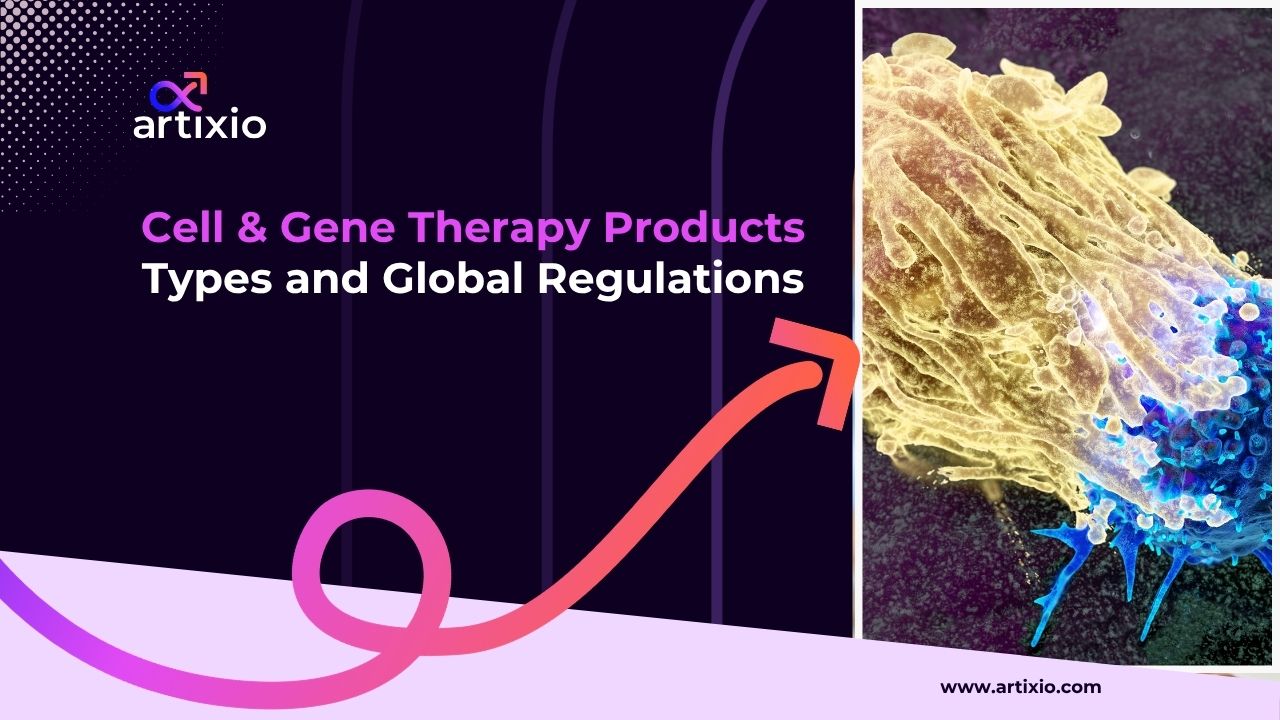
Cell and gene therapy (CGT) products are advanced biological treatments. They can change cellular functions or genetic materials to potentially resolve the root causes of cancers, rare genetic diseases, and inherited disorders. There are strict worldwide regulations around them.
CGT developers need to undergo product classification, clinical evidence, manufacturing controls, long-term safety monitoring, and market-specific approval requirements. They also need to look out for the evolving regulatory landscape around the globe.
This guide covers the major types of cell and gene therapy products. Learn how they are classified in crucial markets, which authorities regulate them, and other relevant information.
What are Cell and Gene Therapy Products?
Cell and gene therapy products use human cells or genetic material for the treatment, prevention, and potential cure of diseases.
- Cell therapy uses living cells to repair or replace damaged cells.
- Gene therapy includes adding, changing, or replacing genes for better functioning of the body.
CGT products include CAR-T cell therapy, stem cells, in vivo viral vectors, gene editing treatments, and therapies for inherited genetic disorders.
Types of CGT Products
The categories below broadly reflect major types of advanced therapies, with the EU ATMP framework providing one of the clearest formal classifications:
Cell Therapy Products
They use living cells to repair or replace damaged cells or tissues. Some of these are stem cell therapies or CAR-T therapies. Depending on the product, cells may be derived from the patient (autologous) or another donor (allogeneic) and may be expanded, selected, differentiated, or genetically modified before administration.
Gene Therapy Products
These products alter or fix genes to cure disease, particularly inherited diseases and some cancers. They modify genetic material to achieve a therapeutic effect. The regulatory assessment can therefore involve considerations around the vector, genetic modification, delivery method, off-target effects, and the durability of the intended effect.
Tissue-Engineered Products
They help restore, repair, or regenerate skin, cartilage, or bone.
Combined Products
Such products mix cells or tissues with medical devices or biomaterials to use for treatment. More than one regulatory domain may impact their existence.
Cell & Gene Therapies Classification & Regulatory Authorities around the Globe
CGT products are subject to different special categories of regulation in various countries. The regulatory category and main authority vary in every market. Here’s an overview table of the same:
| Market | Regulatory Terms Used | Main authority |
| USA | Biologics/cell & gene therapy products | FDA / CBER / OTP |
| EU | Advanced Therapy Medicinal Products (ATMPs) | EMA |
| UK | ATMPs | MHRA |
| Japan | Regenerative Medical Products | PMDA / MHLW |
| India | Cell & Gene Therapy Products | CDSCO / ICMR |
| Singapore | Cell, Tissue, and Gene Therapy Products (CTGTs) | HSA |
| China | CGT Products | NMPA |
| Thailand | ATMPs | Thai FDA |
| Brazil | Advanced Therapy Products | ANVISA |
| Mexico | Advanced Therapies/ Biologics | COFEPRIS |
| South Korea | Advanced Biopharmaceuticals | MFDS |
| Australia | Biologics & Gene Therapies | TGA |
| Canada | Cell & Gene Therapies | Health Canada |
| Saudi Arabia | ATMPs | SFDA |
| United Arab Emirates | CGTs |
Emirates Drug Establishment/ MOHAP
|
| Malaysia | CGT Products | NPRA |
| Indonesia | Advanced Therapy Products | BPOM |
| Argentina | Pharmaceutical products for Advanced Therapy | ANMAT |
| Switzerland | ATMPs | Swissmedic |
Why Do CGT Products Require Specialized Regulations?
CGT products are more complicated than conventional medicines. They need special regulations since they are based on living cells or modified genes. They also need to have tighter regulations for their production, holding, and long-term safety monitoring procedures.
Major Global Regulatory Pathways for CGTs and Relevant Updates 2026
Various countries have specific health regulatory bodies and regulations for CGT products in their jurisdiction. Let’s look into their regulatory status and understand the details and dynamics:
1. United States: FDA, CBER, and the Office of Therapeutic Products
Cellular and gene therapies are regulated by the FDA’s Center for Biologics Evaluation and Research (CBER) in the US. After reorganizing the former Office of Tissues and Advanced Therapies, it established the Office of Therapeutic Products (OTP). OTP oversees a broad range of products, including gene therapies, cell therapies, and therapeutic tissue-engineered products.
Development generally involves an Investigational New Drug (IND) framework for products requiring an investigational pathway. It’s followed by a biologics marketing application where applicable. The regulatory focus spans the following:
- Product design
- CMC and manufacturing
- Preclinical safety
- Clinical development
- Product characterisation
- Manufacturing facilities
- Benefit-risk assessment
- Post-approval safety monitoring
FDA’s current CGT activity also illustrates how quickly the field is evolving. In May 2026, FDA issued final guidance addressing CMC flexibilities for human cellular and gene therapy products being developed for BLAs. FDA also continues to develop product-specific guidance. In June 2026, it issued draft guidance on leveraging prior knowledge in developing human gene therapy products that have genome editing.
2. European Union: ATMPs and Centralised Authorization
The EU regulates advanced therapies. They do so through the Advanced Therapy Medicinal Products (ATMP) framework. It includes the following:
- Gene therapy medicinal products
- Somatic cell therapy medicinal products
- Tissue-engineered products
- Certain combined ATMPs
The European Medicines Agency (EMA) is central to development and assessment. It includes scientific and regulatory support through its advanced-therapy framework.
ATMPs are subject to the EU’s centralized marketing authorization process. It’s different from a system in which individual EU countries independently authorize these medicines. EMA states that advanced therapy medicines are authorized centrally through the Agency and benefit from a single evaluation and authorization procedure.
The Committee for Advanced Therapies (CAT) plays a specialist role in the assessment of ATMPs. EMA’s PRIME scheme can provide earlier and enhanced scientific and regulatory support for developers handling unmet medical needs. PRIME provides enhanced scientific and regulatory support to developers of medicines that may offer a major therapeutic advantage or address unmet medical needs.
3. United Kingdom: MHRA and ATMPs
The Medicines and Healthcare products Regulatory Agency (MHRA) is the competent authority for medicinal products, including ATMPs, in the UK.
UK ATMPs include the following:
- Gene therapy medicinal products
- Somatic cell therapy medicinal products
- Tissue-engineered products
- Combination ATMPs
The MHRA regulates the licensing and manufacturing/importation aspects of ATMPs in the UK. The country has also developed specialist scientific and technical resources for ATMP developers. For example, the British Pharmacopoeia, as part of the MHRA, provides ATMP phase-appropriate best-practice guidance covering areas such as flow cytometry, vector characterization, and replication-competent virus testing.
4. Japan: Regenerative Medical Products
Japan takes a distinct approach by regulating relevant cell and gene therapies as Regenerative Medical Products under its framework. PMDA identifies regenerative medical products as including certain processed human or animal cells intended for reconstruction, repair, formation, treatment, or prevention of disease, as well as products involving gene therapy, subject to the applicable legal definitions.
Japan’s framework includes a conditional and time-limited approval pathway for applicable regenerative medical products, allowing certain products to reach patients based on the regulatory conditions and evidence applicable to that pathway.
The framework continues to evolve. PMDA’s current materials show updates to regenerative medical product marketing approval requirements in 2026, illustrating the importance of ongoing regulatory monitoring for developers targeting Japan.
5. India and Other Emerging Markets
India has developed a dedicated framework and guidance around cell and gene therapy products, with CDSCO and ICMR playing important roles in the regulatory and scientific framework.
For companies pursuing global development, India should not simply be treated as an extension of the US or EU pathway. Separate assessment is required for local regulatory requirements, clinical development expectations, manufacturing controls, and submission needs.
The same principle applies to other markets. That covers China, Singapore, South Korea, Australia, Canada, Brazil, and countries across the Middle East and Southeast Asia.
What Clinical & Trial Requirements Apply to CGT Products?
Clinical development for CGTs needs to account for both conventional clinical considerations and product-specific risks. For genome-editing products, for example, regulators may expect specific consideration of intended and unintended editing effects. The key point is that clinical strategy and regulatory strategy should not operate independently.
Depending on the product and market, developers may need to address the following:
- Preclinical safety
- Biodistribution, where applicable
- Product identity
- Purity and potency
- Manufacturing controls
- Dose and administration
- Immunogenicity
- Off-target or unintended effects (where relevant)
- Ethical and regulatory approvals
- Patient eligibility and monitoring
- Long-term follow-up
- Traceability of donor or patient-derived material
Manufacturing and GMP Requirements for CGT Products
CGT manufacturing is subject to product-specific quality and manufacturing requirements due to the presence of living cells, tissues, or genetic material. Also, manufacturing is one of the most challenging parts of CGT development because the process and product can be closely interconnected.
So, the key consideration points are as follows:
- GMP-certified manufacturing facilities
- Sterile processing and contamination control.
- The screening of donors and raw materials is carried out.
- Identity, purity, and potency testing
- Chain of identity/custody tracking
- The control of cold-chain storage and transport
- Batch traceability and quality documentation, tracking of work batches, and the record of work quality.
There are also CGT-specific GMP guidelines in other countries, including the US, EU, Japan, and South Korea.
Regulatory Checklist for CGT Products
Typical regulatory specifications for CGT products may involve the following:
- Determine the classification of the product and the evaluation of the pathway through which it will access the market.
- Preclinical safety studies
- Donor screening and Raw material controls
- Ethical and clinical trial approvals.
- Compliance with GMP requirements
- The identification of products, their purity, and potency.
- Specific testing of virus safety and sterility.
- They are subjected to a process of validation of stability and storage.
- Long-term safety monitoring
- Pharmacovigilance and Adverse Event Reporting System.
- Submissions for marketing authorization or product approval.
Expedited Approval Programs for CGT Products
Countries have alternative processes to approve CGT products to treat rare, severe, or life-threatening conditions.
| Region | Expedited Program |
| United States |
|
| European Union | PRIME |
| Japan | Conditional and Time-Limited Approval |
| United Kingdom | ILAP – Innovative Licensing and Access Pathway |
| South Korea |
Expedited review mechanisms for qualifying advanced biopharmaceuticals
|
There are still studies to be confirmed, and pathways to undergo monitoring following their approval.
Conclusion
General regulatory frameworks for clinical trials, manufacturing, GMP compliance, and long-term safety monitoring apply to cell and gene therapy (CGT) products. While global regulatory systems are converging, there is still some regional variation in product classification, how products are approved, and post-market requirements.
Artixio provides regulatory strategy, clinical trial support, GMP compliance, pharmacovigilance, and market access support to biotech and life sciences companies developing CGT products across global markets.
Want to make your cross-border CGT regulatory strategy and approval easier? Connect with us at info@artixio.com.
FAQs
What are ATMPs?
A category of EU regulations, Advanced Therapy Medicinal Products (ATMPs), refers to the terms used for advanced therapies comprising gene or cell therapies, tissue-engineered products, and combined products.
Who regulates the products of CGT?
It can be different based on the country. Examples include FDA (US), EMA (EU), PMDA (Japan), MHRA (UK), CDSCO (India), and NMPA (China).
Why do we need long-term follow-up of the patients in the CGT?
The delayed effects or long-term risks of some CGT products may necessitate the need for patient monitoring for several years after administration by the regulators.