Introducing a new medical device to the international market requires that you not only develop a new product, but manufacturers must also consider changing global standards for regulation.
As regulations become more restrictive, the medical device industry is faced with more common delays in submissions, questions on deficiencies in submissions, and setbacks in the approval process. These issues are not only more costly to the industry, but they also lengthen the approval time it takes to make new medical advancements available to patients. Submission issues are typically not caused by the product being submitted but are caused by the lack of planning and documentation required by the regulations.
Want to know the reasons for medical device submission rejections? Check it out below.
What is a Medical Device Submission?
A medical device submission is a set of documents submitted to regulatory authorities to comply with country-specific regulatory requirements and demonstrate that the medical device intended for market launch is safe, effective, and compliant.
Top Reasons Why Medical Device Submissions Get Rejected
Companies seeking to gain approval in the global market must include evidence of safety and performance, and many other evolving requirements of compliance. Let’s see the most common reasons for submission failures.
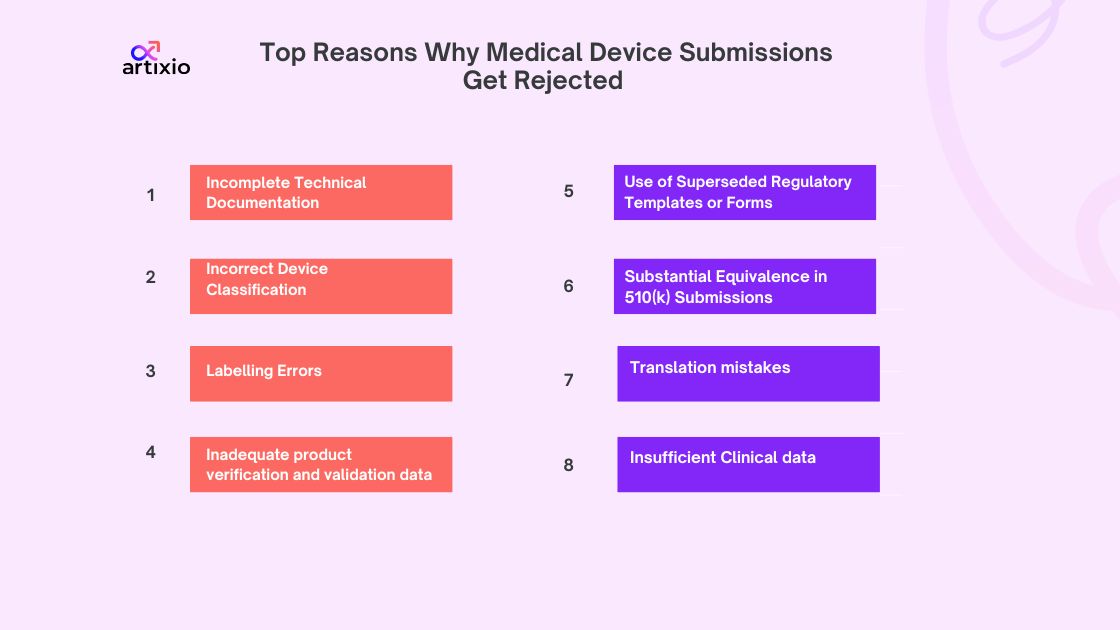
Incomplete Technical Documentation
Manufacturers are expected to provide complete technical documentation as required by the regulations or Notified Body guidance. Whether it is the Common ASEAN dossier template or summary technical documentation, it shall include all the relevant sections, for example: device description, information supplied by the manufacturer, design and manufacturing, risk management, and product verification and validation.
Incorrect Device Classification
Classification of the device plays an important role as it helps in choosing the appropriate regulatory pathway. Based on the classification, the regulatory requirements apply, which in turn helps in understanding the timelines and fees associated with bringing the device into the market.
Labelling Errors
Device labels must fulfill all the applicable country’s labeling requirements. The label shall include at a minimum, the following:
- Trade name
- Device details (short description of the device, pack size, device dimensions)
- Manufacturer address
- Authorized Representative address
- Batch/Lot number
- UDI barcode
- Manufacture date/Expiry date
- Indication of sterile status and sterilization method, if supplied in a sterile state
- Storage/handling conditions
- Warnings or precautions
Inadequate product verification and validation data
Manufacturers need to perform all the applicable verification and validation tests, such as biocompatibility, stability, electrical safety and electromagnetic compatibility, software verification and validation data, transport validation, packaging validation, and sterilization tests, to demonstrate conformity of the device with the requirements of the regulation. Where no testing is performed, proper justification should be provided.
Use of Superseded Regulatory Templates or Forms
Medical device forms and templates are revised regularly. For example, it is necessary to use the current version of the eSTAR template when submitting to the US FDA. Use the current versions of templates and forms that comply with the recent regulatory requirements to avoid delays in submissions.
Substantial Equivalence in 510(k) Submissions
The appropriate predicate device selection from the FDA database and proving substantial equivalence to a legally marketed device is critical for 510(k) submissions. It is equally essential to demonstrate that the new device is as safe and effective as the predicate device regarding its intended use and technological features. Even if there are differences in technological characteristics, they should not cast doubt on safety or performance.
Translation mistakes
Each country requires IFU and safety information to be available in the local language where the device is sold. Some common mistakes include using normal translators instead of regulatory experts, wrong medical translations, missing review of translated content, and delaying translation work until the end of the project.
Insufficient Clinical Data
Clinical data must be strong with proper sample size, literature reviews, and show compliance with the essential requirement or general safety and performance requirement checklist, for instance, in EU Notified Bodies expect manufacturers to monitor device performance after CE marking and conduct post market clinical follow up.
Impact of Submission Rejections
Additional Information Requests
For example, the submission of 510(k) using an outdated version of eSTAR may lead the FDA to request more information, which will result in delaying the approval and pushing out the entire timeline.
Delay in the Approval process
Compliance failure with the applicable regulation can delay the approval process timeline. It can greatly impact the schedule for launching the product. Manufacturers might require extra time to complete remediation, document fixes, and regulatory follow-ups before receiving approval. These delays may diminish market opportunities.
Rework and Re-Submission Activities
Submission deficiencies may compel manufacturers to revise the sections of their documentation. This could involve updating technical files, revising risk management documents, bolstering clinical evidence, or reperforming specific validation activities. Comprehensive remediation efforts frequently result in extended review periods and multiple resubmissions.
Increased Costs
Increased compliance, operational costs, and regulatory shortcomings lead to more financial expenses. Lab testing, clinical data collection, quality system upgrades, consultant assistance, and multiple regulatory reviews can significantly raise total project expenses.
Commercial and Business Impact
Regulatory delays may produce results that go far beyond the anticipated mere approvals. For instance, delays in getting clearance can not only affect the company’s revenue but also its relationships with distributors, strategies for expanding into markets, and overall business growth.
How Regulatory Consultants Help Avoid Rejection
1. Regulatory consultants serve an important purpose in improving the quality of submissions and minimizing compliance risks during the entire lifecycle of a product.
2. They assist in strategic planning on the regulatory side by selecting the right classification of devices, determining the right submission pathway, understanding standards, clinical evidence needs, and regional regulatory requirements.
3. In addition, regulatory consultants can assist in developing technical documentation through technical file improvement, gap analysis, labeling, and IFU assessment, clinical evaluation assistance, and risk management alignment. Pre-submission readiness reviews inconsistencies, lack of evidence, and regulatory concerns before submission.
4. Finally, regulatory consultants stay up to date on changes in global regulations, guidelines, cybersecurity aspects, artificial intelligence-related requirements, and post-market surveillance requirements. This helps manufacturers keep up with changing regulatory requirements and greatly lowers the chances of regulatory issues and submission rejections.
Tips to Avoid Medical Device Submission Rejection
- Planning a regulatory strategy at the early phase of the medical device lifecycle rather than later-stage activity.
- Maintain consistency in the intended use and indications for use throughout the technical documentation, risk files, and clinical documents.
- Adopting harmonised standards is often considered complying with the legal requirements.
- While transitioning from MDD to MDR, it is better to perform the gap assessment and generate a gap analysis report, which in turn helps identify compliance gaps.
- Electronic submission requirements must be followed when submitting the documents through an electronic portal for correct folder structure, file naming, bookmarks, hyperlinks, and maximum file size.
- Regulatory queries to be responded immediately and accurately so that you are not held up unnecessarily in the review process.
Conclusion
Work with the regulatory experts in the medical device field. This will help you not only enhance the quality of your documentation but also to get approvals at a faster pace.
In practice, reasons for the rejection of submissions of a medical device to regulatory authorities are unrelated to the safety and performance of the device. It is due to the lack of a proper regulatory strategy, weak documentation, insufficient testing, and inconsistency in technical documents, and delayed response to regulatory requests that result in rejection.